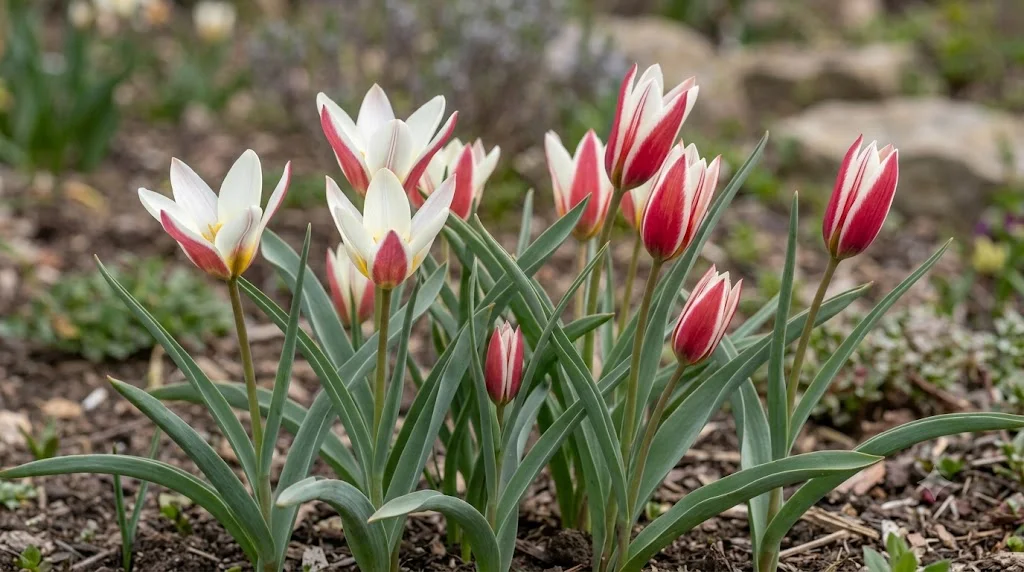

Lady tulips flower most successfully in bright, open positions where their leaves receive several hours of direct sunlight each day. Adequate light supports compact growth, strong flower colour, and the production of energy reserves for the following season. The flowers themselves respond visibly to sunshine by opening wide and revealing their contrasting inner colours. Poor light may not kill the bulbs immediately, but it gradually weakens flowering and naturalisation.
Selecting the right level of sunlight
Full sun is generally the best choice for lady tulips. A position receiving at least six hours of direct light during active growth usually supports reliable flowering. Morning and midday sun are particularly valuable because they warm the soil and dry moisture from the foliage. Open exposure also reduces the humid conditions associated with fungal disease.
Light shade can be acceptable in warm climates or beneath deciduous trees. The trees are often still bare while the tulips grow and flower, allowing sunlight to reach the ground. Shade that develops only after the tulip foliage begins to fade is rarely problematic. Dense evergreen shade, by contrast, limits light throughout the entire growth cycle.
South-facing and west-facing beds often provide strong light, although they may become hot and dry quickly. East-facing positions receive gentler morning sun and may preserve flowers for slightly longer. North-facing sites are usually less suitable unless they remain open and bright. Local buildings, fences, and shrubs should be considered because they can create seasonal shadows.
The best site should be evaluated in early spring rather than during summer. A bed that appears sunny in July may be shaded by low sun angles in March and April. Observing the area at several times of day gives a more accurate picture. Light conditions also change as trees mature and nearby structures are added.
More articles on this topic
Recognising insufficient or excessive exposure
Lady tulips grown in insufficient light may develop long, weak stems that lean toward the brightest direction. Their leaves can appear pale, thin, or unusually soft. Flower buds may remain small or fail to develop. Repeated seasons in shade can eventually reduce the bulb population.
Sparse flowering is often blamed on poor feeding when inadequate light is the real cause. Adding fertiliser does not compensate for limited photosynthesis. The plants must receive enough sunlight while their leaves remain green. Moving the bulbs during dormancy is usually more effective than increasing nutrients.
Excessive sunlight is rarely a problem in temperate spring conditions. However, containers beside reflective walls can heat rapidly and dry out faster than expected. Sudden high temperatures may shorten the flowering period. Regular moisture checks help protect actively growing plants without keeping the compost wet.
Flowers may close during cloudy weather and reopen when direct sun returns. This behaviour is natural and does not indicate stress. The opening response protects pollen and reproductive tissues from cold or wet conditions. On bright days, the fully expanded flowers display their characteristic star-like form.
More articles on this topic
Managing light in mixed borders and containers
Companion plants should be selected so they do not shade the tulip foliage prematurely. Low-growing alpines, small ornamental grasses, and drought-tolerant ground covers often work well. Tall perennials may be suitable if their dense growth begins after the tulips have nearly completed their cycle. Aggressive evergreen ground covers are more likely to create persistent shade.
Containers can be moved to optimise exposure during the active season. A pot kept in a dark corner during winter should be placed in bright light as shoots emerge. Rotating the container periodically promotes even growth when light comes primarily from one direction. Once flowering begins, a slightly cooler bright position may help the blooms last longer.
Indoor cultivation is difficult without strong natural light and a proper cold period. A warm windowsill often produces stretched leaves and short-lived flowers. Forced bulbs can be displayed indoors briefly after buds form, but they should not remain in heat for long. Their best long-term performance comes from outdoor cultivation.
After flowering, light remains just as important as it was before bloom. The leaves must continue receiving sun while they rebuild the bulb. Moving pots into a dark storage area too early prevents this essential recovery. Containers should only be placed in dormant storage after the foliage has yellowed naturally.