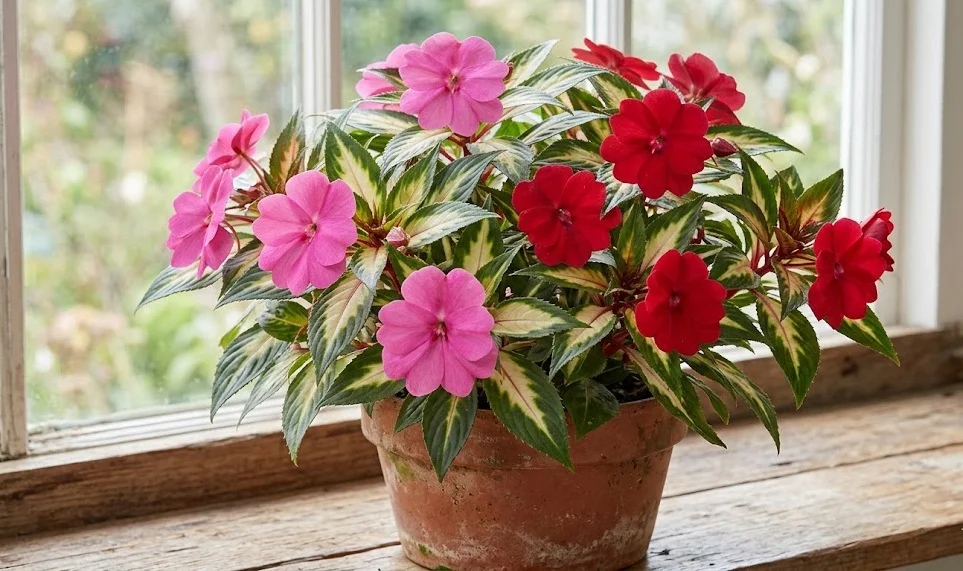

Watering and fertilizing New Guinea impatiens requires consistency rather than intensity. The plant grows quickly, flowers continuously, and has a shallow root system that reacts fast to both shortage and excess. It needs evenly moist soil, but it also needs oxygen around its roots. A balanced feeding program supports flowering without pushing the plant into weak, watery growth.
Moisture needs through the growing season
New Guinea impatiens prefers soil that stays lightly and evenly moist. It should not sit in saturated conditions, but it should also not dry out completely. Repeated wilting reduces flower production and can make the plant more vulnerable to pests. Moisture stability is one of the most important factors in maintaining a polished appearance.
Spring watering is usually moderate because temperatures are cooler and plants are still small. As growth increases, the root system expands and the leaf surface becomes larger. This means water demand rises steadily toward summer. A plant that needed water every few days in spring may need daily attention in hot weather.
Container plants dry out faster than plants in beds. Small pots, hanging baskets, and balcony boxes are especially vulnerable because their soil volume is limited. Windy locations can remove moisture from leaves and potting media very quickly. Larger containers provide a more buffered environment and reduce stress.
Garden-grown plants still need irrigation during dry periods. Even though soil beds hold more moisture than pots, shallow roots can suffer if the upper soil layer dries deeply. Mulch helps protect this root zone from heat and evaporation. A steady soil environment keeps flowering continuous and foliage fresh.
More articles on this topic
Practical watering techniques
Water deeply enough to moisten the whole root ball. Light surface sprinkling may leave the lower roots dry, especially in containers. A thorough watering should allow excess water to drain from the bottom of the pot. This confirms that the entire medium has been rehydrated.
Morning is the best time to water in most situations. Plants enter the warmest part of the day fully hydrated, and wet leaves have time to dry. Evening watering can be acceptable in hot periods, but constantly wet foliage overnight may raise disease risk. Watering at the soil surface is usually better than soaking the entire canopy.
Check moisture with your finger rather than relying only on a schedule. The top layer may dry while the lower root zone remains moist, or it may look damp while the center is dry. Lifting a container also helps judge water content by weight. With practice, this becomes a reliable way to avoid both drought and overwatering.
Avoid leaving pots standing in water for long periods. A saucer can be useful indoors or on terraces, but it should be emptied after the plant has drained. Waterlogged roots cannot breathe properly and may begin to decay. Drainage is not optional for healthy New Guinea impatiens.
More articles on this topic
Recognizing watering problems
Drought stress usually appears as limp leaves and drooping stems. If caught early, the plant often recovers quickly after watering. Severe or repeated wilting can cause leaf drop, bud loss, and brown leaf edges. A plant that wilts every afternoon may need a larger pot, more shade, or more consistent watering.
Overwatering often looks different but can also cause wilting. Leaves may turn yellow, stems may soften, and the soil may remain wet for too long. Roots damaged by lack of oxygen cannot absorb water properly, so the top growth may droop even in wet soil. This is why checking the root-zone condition is more reliable than judging by leaves alone.
Uneven watering can lead to cycles of stress. A dry root ball can become difficult to rewet because some potting mixes shrink away from the container wall. Water may then run down the sides without soaking the center. Slow watering or temporary bottom soaking can help rehydrate a severely dry pot.
Water quality can also affect performance. Very hard water or water high in dissolved salts may contribute to mineral buildup in containers. This can appear as white crust on the soil surface or leaf edge burn. Occasional flushing with clean water helps remove accumulated salts.
Fertilizer types and timing
New Guinea impatiens benefits from a controlled and balanced feeding plan. A slow-release fertilizer at planting provides a steady background supply of nutrients. Liquid fertilizer can then be used during active growth, especially in containers that are watered frequently. Frequent watering leaches nutrients, so container plants usually need more regular feeding than bed-grown plants.
A balanced fertilizer for flowering annuals is usually suitable. The formula should not be excessively high in nitrogen because lush leaves can come at the expense of flowers. Potassium is important for flower production, stem strength, and stress tolerance. Micronutrients help maintain rich leaf color and healthy new growth.
Begin regular feeding after the plant has settled and started active growth. Feeding too heavily immediately after transplanting can stress roots. A diluted liquid fertilizer every one to two weeks is often enough for vigorous container plants. In fertile garden soil, less frequent feeding may be sufficient.
Reduce feeding during periods of extreme heat or cold. Plants under stress do not use nutrients efficiently, and salts may accumulate in the growing medium. Resume normal feeding when growth becomes active again. Good fertilization follows the plant’s rhythm rather than a rigid calendar.
Fine-tuning nutrition for flowering
If the plant has lush foliage but few flowers, the problem may be low light, excess nitrogen, or both. Moving the plant to brighter filtered light often improves bud production. Switching to a fertilizer with a stronger flowering balance can also help. However, no fertilizer can compensate for inadequate light.
Pale leaves may indicate nutrient deficiency, root stress, or unsuitable soil reaction. Young leaves that turn yellow while veins remain greener may suggest limited micronutrient availability. In containers, using a complete fertilizer with trace elements usually solves this. In garden soil, improving organic matter and drainage may be necessary.
Flowering plants in small pots often run out of nutrients by midsummer. Even if slow-release fertilizer was added at planting, high temperatures and frequent watering can shorten its effective period. A supplemental liquid feed can restore vigor. Always apply it to moist soil to reduce root stress.
The best plants are not forced aggressively. They are supplied steadily, watered evenly, and given the right light. This produces compact growth, strong color, and reliable blooming. Balanced care is more effective than trying to correct problems with large fertilizer doses.