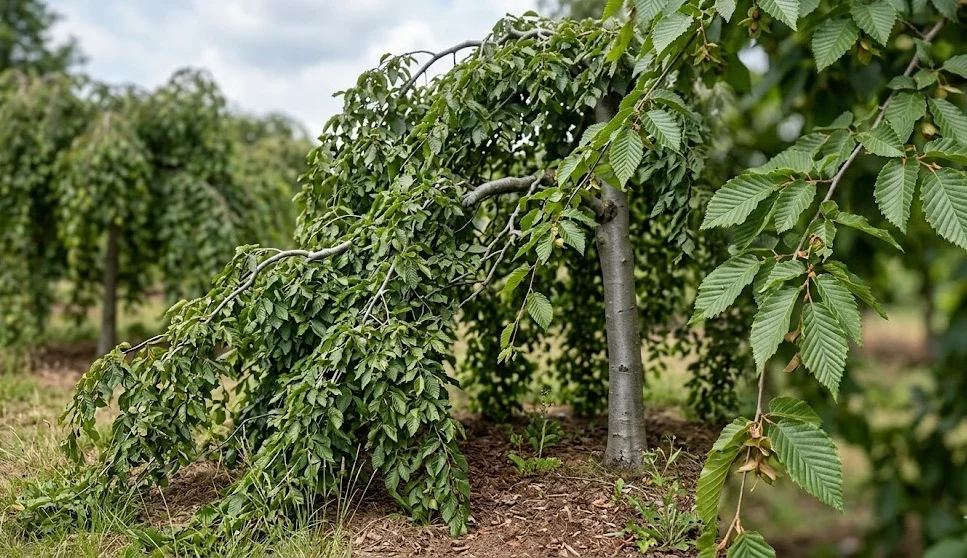

Weeping hornbeam should be pruned with restraint, because its beauty lies in the natural fall of its branches and the gradual layering of its crown. The aim is not to force a rigid shape but to guide the tree toward a clean, healthy, and balanced silhouette. Incorrect heavy cutting can leave awkward stubs, weak regrowth, and a permanently damaged outline. Skillful pruning removes only what is necessary while preserving the character of the tree.
Timing and pruning goals
Late winter is a useful time for structural pruning. The tree is dormant, and the branch framework is easy to see. Dead, damaged, crossing, or badly placed branches can be identified clearly. Cuts made before spring growth often heal efficiently.
Light summer pruning can refine the shape after the main flush of growth. This is helpful when branches reach paths, lawns, or neighboring plants. Summer cuts should be modest. Removing too much foliage reduces the tree’s ability to feed itself.
Avoid heavy pruning in late autumn. Fresh wounds have little time to begin closing before cold weather. Late pruning may also expose inner branches to winter stress. If a branch is dangerous or broken, remove it, but save cosmetic work for a better season.
Every cut should have a purpose. Good reasons include improving airflow, removing weak growth, correcting rubbing branches, and maintaining access around the tree. Random shortening often creates a stiff, unnatural outline. The weeping habit should remain soft and continuous.
More articles on this topic
Techniques for shaping the crown
Start by studying the tree from several angles. Weeping hornbeam often looks different depending on viewpoint. A branch that appears awkward from one side may complete the outline from another. Careful observation prevents unnecessary removal.
Cut back to a side branch or natural junction rather than leaving stubs. Stubs die back and can invite decay. Clean cuts support natural wound closure. Sharp, clean tools are essential.
Branches that drag heavily on the ground may be shortened. This improves air movement and makes maintenance easier. However, some ground-reaching branches can be part of the desired design. Decide whether the tree should have a lifted skirt or a full cascading curtain.
Thin crowded areas selectively. Remove one branch entirely rather than clipping many branch tips. This keeps the crown natural and reduces dense regrowth. Tip-shearing usually produces a blunt, artificial surface.
More articles on this topic
Managing graft shoots and rejuvenation
Shoots from below the graft union must be removed promptly. They belong to the rootstock and do not share the desired weeping form. If ignored, they may grow strongly and compete with the ornamental crown. Cut them cleanly at their base.
Weak, dead, or shaded-out inner shoots can be removed during regular inspection. This improves the appearance of the winter framework. It also reduces sites where pests and disease can persist. Light annual attention is better than occasional severe correction.
Old neglected trees may need gradual renovation. Do not remove too much in one year. Spread corrective pruning over several seasons to avoid shock and awkward regrowth. The tree should retain enough leaf area to recover strongly.
Large cuts should be avoided whenever possible. If a major branch must be removed, use proper technique to prevent bark tearing. Do not apply thick wound paints as a routine practice. Healthy trees close pruning wounds best when cuts are clean and correctly placed.