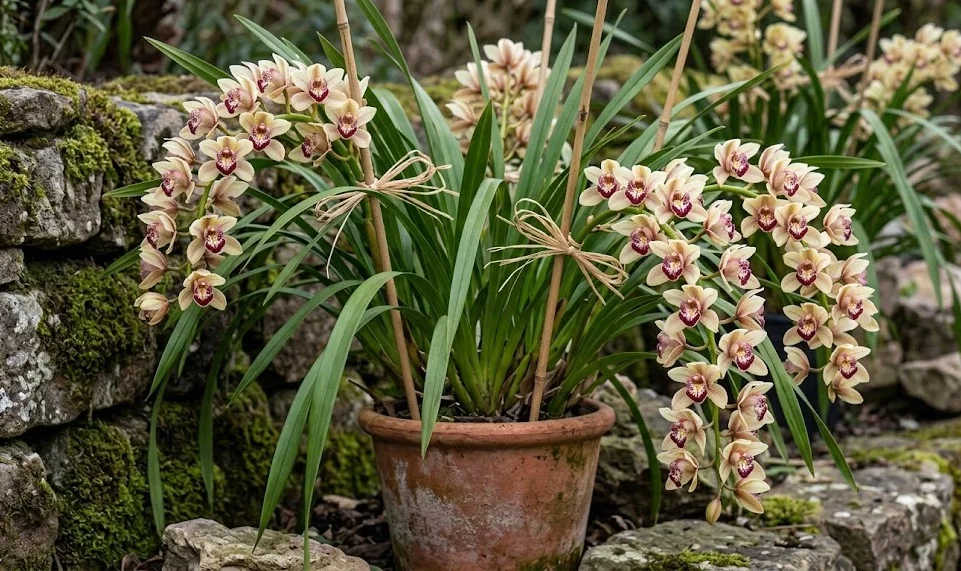

Planting a boat orchid correctly is the foundation of every later success, because the root system determines how well the plant can absorb water, use nutrients, and support flowering. These orchids dislike stale, collapsed potting medium and respond best when roots have both moisture and air. Propagation is usually done by division rather than seed, because seed raising requires specialized sterile conditions. A careful division can produce strong new plants, but rushed work can weaken both the parent and the divisions.
Selecting the right time and plant material
The best time to repot or divide a boat orchid is when new growth is starting and fresh roots are ready to develop. This timing allows the plant to recover quickly after disturbance. Repotting during deep rest or full bloom can cause unnecessary stress. The plant should have enough energy to rebuild its root system.
A suitable plant for division should be mature and vigorous. It should contain several healthy pseudobulbs, firm leaves, and at least some active roots. Weak, dehydrated, or diseased plants should be stabilized before division. Dividing a struggling plant often makes recovery harder.
Each division should contain multiple pseudobulbs rather than a single small piece. A group of three or more healthy bulbs usually has better reserves. Older back bulbs can support growth, but they are slower to restart when separated alone. Strong divisions flower sooner and establish more reliably.
Tools should be clean and sharp before the work begins. Dirty blades can introduce pathogens into fresh cuts. Pots, labels, and potting mix should be prepared in advance. This prevents roots from drying while the grower searches for materials.
More articles on this topic
Preparing the pot and growing medium
A good pot for boat orchids should provide stability and drainage. These plants can become top-heavy when leaves and flower spikes develop. Clay pots offer weight and breathability, while plastic pots retain moisture longer. The best choice depends on the growing environment.
The potting mix should be coarse enough to allow air movement. Medium-grade bark is commonly used as a foundation. Added materials can improve drainage, moisture retention, or structure. The mix should never become dense like ordinary garden soil.
Before planting, old medium should be removed carefully from the root ball. Dead roots can be trimmed away with sterilized tools. Healthy roots should be disturbed as little as possible. Some broken roots are unavoidable, but rough handling should be minimized.
The plant should sit at a depth that keeps the pseudobulbs above the surface of the mix. Burying bulbs invites rot and weakens the base of new growth. The newest growth should usually have space to expand toward the center of the pot or across the surface. Correct positioning prevents the plant from immediately crowding the container.
More articles on this topic
Dividing the plant without weakening it
Division begins by gently loosening the root mass and identifying natural separation points. Many mature boat orchids form clusters that can be separated with moderate effort. If the rhizome is very tough, a clean cutting tool may be needed. The goal is to separate sections while preserving as many roots as possible.
Each division should be inspected before potting. Soft bulbs, blackened tissue, and rotted roots should be removed. Cuts can be allowed to dry briefly before planting. In humid conditions, extra care is needed to prevent infection.
Fresh divisions should be placed firmly in the potting mix but not buried deeply. The plant should not wobble, because unstable roots struggle to establish. Stakes or clips can help secure heavy divisions. Stability encourages new roots to enter the medium quickly.
Newly divided plants should be watered with care. The medium can be lightly moistened after potting, but constant wetness before new roots form is risky. Bright shade and moderate humidity help reduce stress. Strong sun and heavy feeding should be avoided until growth resumes.
Aftercare for successful establishment
During the first weeks after planting, the plant should be observed closely. Slight leaf softness may occur if roots were reduced during division. Severe shriveling of pseudobulbs indicates that water uptake is poor. Adjusting humidity and reducing heat can help the plant recover.
New root tips are the clearest sign that establishment is progressing. Once roots begin to grow into the fresh medium, watering can gradually become more normal. Fertilizer should remain weak until the plant is clearly active. Overfeeding a recently divided orchid does not speed recovery.
Divisions may take a season or more to regain full strength. Even healthy sections can delay flowering while they rebuild root mass and storage tissue. Patience is important because the plant is investing in structure first. Strong vegetative growth today often means better flowering later.
Labels are useful when several divisions or cultivars are grown together. They help track flowering color, performance, and care responses. Notes on repotting date and division size can guide future decisions. Professional growers rely on these records because memory alone is rarely precise.