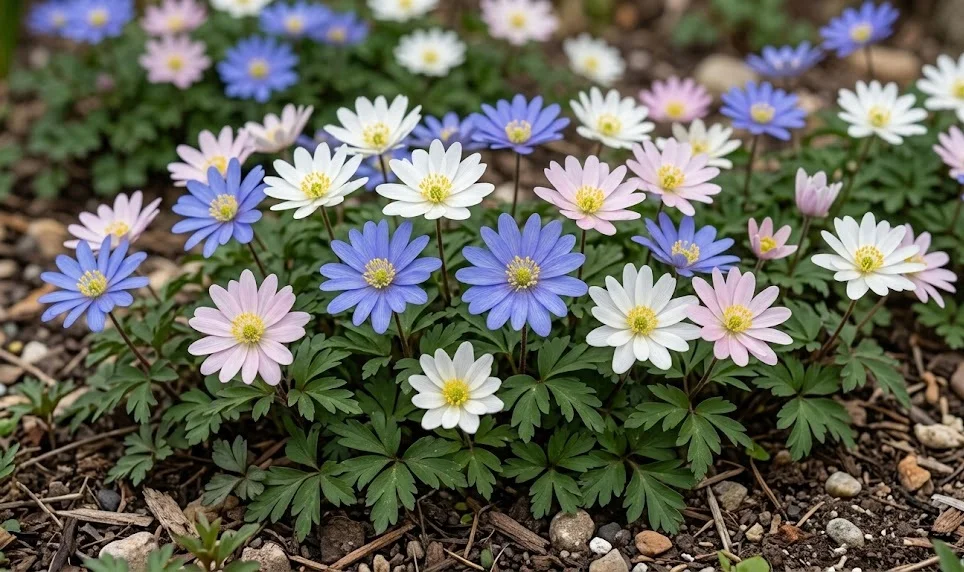

Grecian windflower is a small plant, but planting it well has a large effect on its future performance. The tubers are dry, dark, and irregularly shaped when bought, which can make them look lifeless to inexperienced gardeners. Once settled in suitable soil, however, they root strongly and produce a bright spring display for many years. Careful timing, correct depth, and gentle propagation are the foundations of a lasting colony.
When and where to plant
Autumn is the best planting season in most climates. Planting at this time allows the tubers to absorb moisture, initiate roots, and prepare for early spring growth. The soil is usually still workable, but temperatures are cool enough to reduce stress. Spring planting is possible with potted plants, but dry tubers usually establish better when planted in autumn.
Choose a position with good drainage and seasonal light. Under deciduous trees or shrubs is often ideal, because the plants receive light before the canopy develops. A border with light shade and loose soil also works well. Avoid dense evergreen shade, where the soil may be dry and flowering is reduced.
The planting area should be cleared of perennial weeds before the tubers are set. Couch grass, bindweed, and deep-rooted weeds are difficult to remove once windflowers have naturalized. Because the tubers are small, later digging can easily disturb them. Preparation before planting saves a great deal of future work.
For a natural effect, plant in groups rather than straight lines. Scattering the tubers gently across the prepared area can create a more relaxed pattern. Groups of at least fifteen to twenty tubers usually look better than isolated plants. Larger drifts are especially effective beneath trees or along informal paths.
More articles on this topic
Preparing and planting the tubers
Dry tubers benefit from soaking before planting. A few hours in lukewarm water helps them rehydrate and begin the transition from storage to growth. They may swell slightly, although they will still look irregular. Soaking is not essential in very moist autumn soil, but it improves establishment in many gardens.
Planting depth should be moderate. As a general guide, the tubers are placed about five to eight centimetres deep, depending on soil texture and climate. In lighter soil, they can be planted slightly deeper to protect them from drying. In heavier soil, shallower planting with improved drainage is safer.
Spacing should allow room for gradual spread. A distance of seven to ten centimetres between tubers is usually practical for a full but not overcrowded display. For a meadow-like effect, slight irregularity looks more natural than exact spacing. Press the soil gently after planting, but do not compact it heavily.
It can be difficult to identify the top and bottom of each tuber. Fortunately, Grecian windflower is forgiving if the tuber is placed sideways or at a slight angle. The shoots will usually find their way upward. Planting in well-prepared soil matters more than perfect orientation.
More articles on this topic
Establishing plants after planting
After planting, water the area lightly if the soil is dry. The goal is to settle soil around the tubers, not to saturate the bed. In autumn, rainfall often provides enough moisture after this first watering. If the season is unusually dry, occasional watering can help root development.
A thin mulch of leaf mould is useful after planting. It moderates soil temperature, reduces surface crusting, and imitates the woodland conditions the plant prefers. The layer should be light enough for spring shoots to pass through easily. Thick bark mulch or heavy compost should not be piled over the planting area.
Do not expect much visible activity in the first months. Rooting happens below ground while the garden appears quiet. Shoots usually appear in late winter or early spring, depending on climate. Patience is important, because newly planted tubers may flower lightly in their first year and improve later.
Protecting the area from disturbance is essential. Since the tubers are small, they can be accidentally lifted during other planting work. Marking the bed helps prevent damage while the plants are dormant. In mixed borders, companion plants should be chosen so they do not require frequent digging nearby.
Propagation by division and natural spread
The easiest propagation method is to allow the plant to spread naturally. In suitable conditions, the tubers multiply gradually and form wider clumps. This process is slower than with some vigorous bulbs, but it produces a stable and natural-looking colony. Good drainage and undisturbed soil encourage this expansion.
Division can be done when clumps become dense or when plants need to be moved. The best time is during dormancy, after the foliage has fully died back. Lifting should be done carefully with a fork, starting well outside the visible clump. Small tubers are easy to overlook, so the soil should be handled gently.
Replant divisions as soon as possible. Tubers can dry out quickly if left exposed in warm air. Any healthy firm pieces can be replanted at the correct depth in prepared soil. Damaged or soft pieces should be discarded to reduce the risk of rot.
Seed propagation is possible but less predictable. Seedlings may take several years to flower and may vary in colour. For gardeners who enjoy naturalistic planting, allowing some seed to mature can add diversity. For quick and reliable results, division and tuber planting remain the most practical methods.