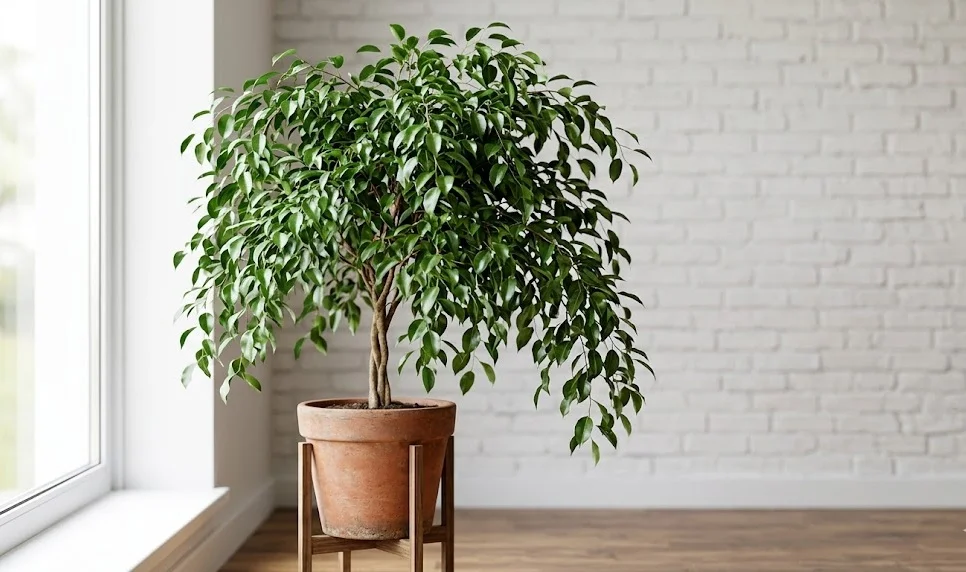

Light is one of the defining factors in weeping fig care, because it controls leaf density, branch strength, water use, and overall resilience. The plant can tolerate moderate indoor light, but it develops its best form in bright, filtered conditions. Poor light often leads to thinning, weak shoots, and increased sensitivity to watering mistakes. Understanding light quality is therefore essential for professional indoor cultivation.
Ideal light conditions
Bright indirect light is the safest and most productive condition for weeping fig. This means the room is clearly bright during the day, but the leaves are protected from harsh direct sun. Near an east-facing window, the plant often receives enough gentle light without overheating. A sheer curtain can make stronger exposures suitable.
Variegated forms usually need brighter conditions than green-leaved forms. Their lighter leaf areas contain less chlorophyll, so they have less capacity to produce energy. In too little light, variegated plants may grow slowly or lose color quality. They should be placed where brightness is high but leaf scorch is avoided.
A plant that receives suitable light will usually maintain a denser canopy. New leaves will emerge at normal size, and stems will not stretch excessively. The overall outline remains balanced and full. Such a plant also tolerates routine care more easily because its root and shoot activity are better synchronized.
Low light does not always kill the plant quickly, but it weakens it gradually. Leaves may drop from the interior, branches may become bare, and watering becomes harder to manage. Soil stays wet longer because growth slows. This creates a chain of problems that often begins with insufficient light.
More articles on this topic
Recognizing too much or too little light
Too little light often produces long spaces between leaves. Shoots may lean strongly toward the window, and the crown may become one-sided. Leaf drop may increase, especially from older inner branches. The plant may appear alive but slowly lose its ornamental quality.
Too much direct sun can scorch leaves, especially when sunlight is intensified through glass. Scorched areas may appear pale, brown, dry, or irregularly burned. Leaves closest to the window are usually affected first. Moving the plant slightly back or filtering the light often solves the problem.
Seasonal changes can alter the same location dramatically. A position that is perfect in winter may become too hot in summer. Likewise, a summer position set back from the window may become too dim in winter. Light should be reassessed at least a few times each year.
The plant should be adjusted gradually when light conditions change. A sudden move from dim shade to strong sun can cause shock and leaf burn. A sudden move from bright light to shade can trigger leaf drop. Slow adaptation gives the foliage time to adjust.
More articles on this topic
Artificial light and indoor design
Artificial grow lights can help where natural light is limited. They are especially useful in offices, interior rooms, or winter conditions. The light should be strong enough to support foliage growth and positioned to cover the canopy evenly. Weak decorative lighting is usually not enough.
The distance between the light source and the foliage matters. Too far away, the light becomes ineffective; too close, it may heat or stress leaves. The plant should receive a consistent daily duration that mimics a reasonable growing day. A timer helps keep the rhythm stable.
Interior design choices should not compromise the plant’s basic needs. A weeping fig may look beautiful in a dark corner, but it will not remain full there for long. Placing it where both aesthetics and light requirements are satisfied produces the best long-term result. The plant should be treated as a living design element, not a static object.
Reflective surfaces, pale walls, and open space around the plant can improve available light. Crowded corners absorb light and shade parts of the canopy. Regular gentle rotation may help maintain an even shape. With good light management, the weeping fig becomes far easier to maintain and far more attractive.