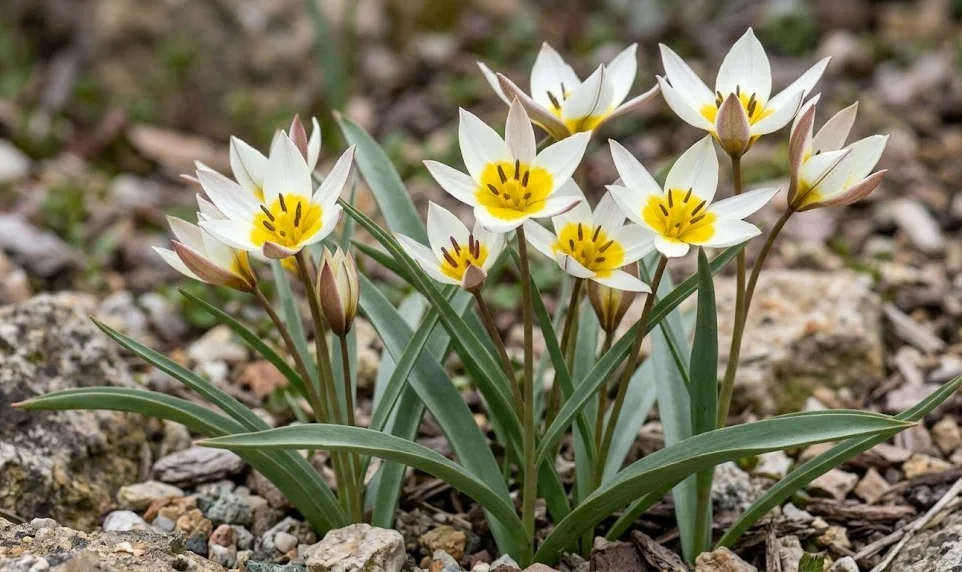

The Turkestan tulip grows best when water and nutrients are supplied in a restrained, seasonal way. It is not a plant for constantly moist beds or rich feeding regimes, even though it needs sufficient moisture during active growth. The main principle is simple: support the bulb while it is rooting, shooting, flowering, and rebuilding, then allow it to rest dry. This balance is what keeps the bulb healthy and capable of returning year after year.
Seasonal water needs
The bulb begins its active life underground in autumn. Once planted, it forms roots in cool soil and prepares for spring growth. If autumn rainfall is normal, extra watering is often unnecessary. In a dry autumn, one thorough watering after planting can help root establishment.
During winter, the bulb usually receives enough moisture from natural conditions. It does not need artificial watering unless grown under cover or in containers protected from rain. Cold wet soil is more dangerous than cold dry soil. Good drainage remains the most important safeguard.
In early spring, the plant’s water demand increases. Shoots elongate, flower buds expand, and leaves begin photosynthesis. At this stage, soil should be lightly moist but never saturated. A dry spell during bud development can reduce flower size and shorten the display.
After flowering, water remains important for a limited time. The leaves continue feeding the bulb until they turn yellow. If spring is very dry, occasional deep watering can help the plant store energy. Once the foliage begins to fade, watering should be reduced and then stopped.
More articles on this topic
Avoiding overwatering and bulb rot
Overwatering is one of the most common causes of failure. Tulip bulbs are storage organs, and they can decay if surrounded by wet, airless soil. The Turkestan tulip is especially sensitive during dormancy. Wet summer conditions are far more dangerous than brief spring dryness.
Signs of overwatering may appear as weak shoots, yellowing foliage before the normal ripening period, or bulbs that fail to emerge. In severe cases, bulbs become soft and brown below ground. Because symptoms often appear late, prevention is better than rescue. A well-drained planting site is more reliable than frequent corrective action.
Mulches should be used carefully around this tulip. A thin mineral mulch such as gravel can help keep the surface open and reduce splashing. Thick organic mulch may hold too much moisture around small bulbs. If organic mulch is used nearby, keep it light and away from the crown area.
In irrigated borders, place the Turkestan tulip away from plants that need constant summer watering. It pairs better with drought-tolerant perennials and alpine plants. Drip irrigation should not soak the bulb area during dormancy. The planting design should protect the tulip’s dry rest period.
More articles on this topic
Feeding without forcing weak growth
The Turkestan tulip is adapted to relatively lean conditions. It does not require heavy feeding to flower well. In fact, too much fertilizer can encourage soft foliage at the expense of durable bulb growth. A moderate approach produces stronger, more natural plants.
A low-nitrogen bulb fertilizer can be applied as shoots appear in spring. This supports root activity, leaf function, and future flower formation. Phosphorus and potassium are often more useful than high nitrogen for bulbs. Always follow moderate rates rather than assuming more fertilizer gives better results.
Compost can improve soil structure, but it should be used sparingly. Well-rotted compost is preferable to fresh organic matter. Fresh manure is unsuitable because it can burn roots, introduce disease, and create overly rich conditions. In heavy soils, mineral drainage amendments are more important than extra fertility.
Container-grown bulbs may need slightly more attentive feeding. Nutrients leach from pots more quickly than from garden soil. A diluted liquid feed after flowering can help rebuild bulbs if foliage is still green. Feeding should stop as the leaves begin to yellow.
Supporting the bulb after flowering
The period after flowering is critical. Although the flowers are finished, the bulb is still working intensely. Leaves capture light and convert it into stored energy. This energy determines the strength of next year’s growth.
Do not tie, braid, or cut the leaves while they are still green. These old practices reduce the leaf surface exposed to light. The plant may survive, but flowering can decline over time. Let the foliage collapse naturally, even if it looks less tidy for a few weeks.
Deadheading can be useful when seed is not wanted. Removing the spent flower heads prevents energy from going into seed formation. The stem and leaves should remain intact. This simple step helps direct resources back into the bulb.
A light feed after flowering may be beneficial in poor soil. It should be applied while leaves are still green and active. Feeding after the foliage has yellowed is ineffective because the plant is no longer taking up nutrients strongly. Timing is therefore more important than quantity.
Watering and feeding in containers
Containers dry faster than open ground during active growth. Check the compost regularly when shoots appear and during flowering. Water thoroughly when the upper layer begins to dry, then allow excess water to drain away. Never leave pots standing in saucers of water.
The compost should be gritty and free draining. A standard potting mix can be improved with horticultural grit or coarse sand. The pot must have drainage holes, and raising it slightly on feet can help water escape. Good drainage is especially important during cold wet weather.
Feeding in pots should be light but consistent. A balanced liquid fertilizer at low strength can be applied after flowering while leaves remain green. This helps compensate for the limited nutrient reserve in container compost. Strong feeding before flowering is not usually necessary if the bulbs were planted in fresh compost.
After the foliage dies back, container bulbs should be kept relatively dry. The pot can be moved to a sheltered, airy location. Complete baking heat should be avoided, but constant summer wetness is worse. In autumn, the bulbs can be refreshed, replanted, or left in place if the compost remains open and healthy.