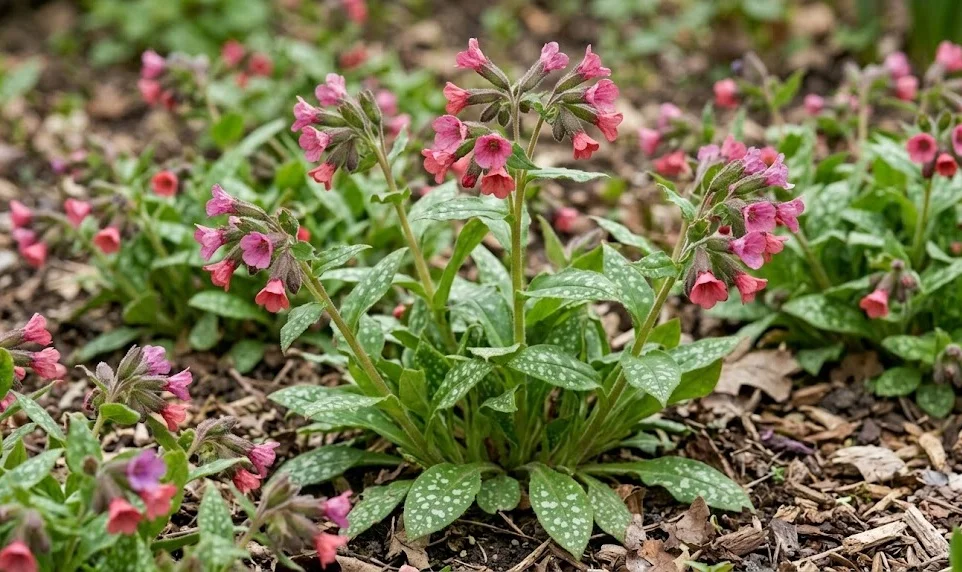

Red lungwort is a dependable woodland perennial that brings vivid coral-red flowers to the garden at a time when many other plants are only beginning to wake from winter. It performs especially well beneath deciduous trees, beside shrubs and along cool, partially shaded borders. Although it is generally easy to maintain, the plant looks its best when its soil, moisture and light conditions remain reasonably stable. A thoughtful growing position and a few timely care measures can keep an established clump attractive for many years.
Red lungwort forms low, spreading clumps of softly hairy leaves and produces arching flower stems during early spring. Its flowers are valuable to early pollinating insects because they appear when alternative nectar sources may still be limited. The foliage usually remains decorative after flowering, although heat, drought or fungal problems can reduce its quality later in the season. Understanding this natural growth cycle makes routine maintenance far easier.
The plant originates from cool woodland environments where the soil contains plenty of decomposed organic matter. In the garden, it appreciates similar conditions, including moderate shade, regular moisture and a root zone protected from extreme temperature changes. It is not a plant that enjoys baking in dry, exposed ground. Once established in a suitable site, however, it can tolerate short periods of less-than-perfect weather without serious damage.
Successful care does not depend on constant intervention. In fact, excessive watering, overfeeding and repeated disturbance can cause more problems than a slightly relaxed approach. The main goal is to preserve an evenly moist but well-aerated soil while allowing the plant to follow its seasonal rhythm. Observation is often more useful than a rigid maintenance calendar.
Understanding the seasonal growth cycle
New shoots usually emerge from the crown while the weather is still cool. Flower stems develop quickly and may rise above the young foliage before the leaf clump has reached its full size. This early growth relies partly on energy stored in the roots and crown during the previous season. Protecting the foliage after flowering therefore contributes directly to the following year’s performance.
More articles on this topic
Flowering normally continues for several weeks, depending on temperature, soil moisture and the amount of shelter around the planting site. Cool conditions often extend the display, while sudden warmth can shorten it considerably. Individual flowers may age rapidly, but new buds keep opening along the stems. A healthy plant can create a surprisingly intense patch of color despite its modest height.
After flowering, the plant redirects its resources toward foliage and root development. Fresh basal leaves often expand as the old flowering stems begin to decline. During this stage, adequate moisture supports photosynthesis and helps the plant rebuild energy reserves. Severe drought immediately after flowering can weaken the clump and reduce the number of buds formed for the next spring.
Growth slows during hot summer weather, especially in regions with dry summers. Leaves may become tired, spotted or partially dormant if conditions are unfavorable. Cooler autumn temperatures sometimes encourage a flush of cleaner foliage before winter arrives. The plant then rests close to ground level, with its crown protected beneath leaf litter or mulch.
Choosing the best soil conditions
Red lungwort prefers humus-rich soil with a loose, crumbly structure. A soil containing decomposed leaf mould or mature compost holds useful moisture without becoming dense and airless. This balance is important because the plant dislikes both prolonged drought and stagnant water around its roots. Soil improvement before planting is usually more effective than trying to correct poor conditions later.
More articles on this topic
A slightly acidic to neutral soil reaction suits the plant particularly well, although it can grow in mildly alkaline ground if the structure and moisture level are appropriate. Extreme pH conditions may interfere with nutrient availability and reduce vigor. Gardeners working with very chalky soil should incorporate generous organic matter and monitor the foliage for signs of stress. Container culture may be a practical alternative where the native soil is severely unsuitable.
Heavy clay can support good growth when it is improved rather than merely loosened at the surface. Adding well-rotted organic matter through a broad planting area creates channels for air and water movement. Coarse mineral materials may help in extremely compacted soil, but organic amendments should remain the foundation of improvement. Planting into a small pocket of compost surrounded by solid clay should be avoided because water can collect around the roots.
Very sandy soil presents the opposite challenge because it loses water and nutrients rapidly. Compost, leaf mould and other stable organic materials increase its moisture-holding capacity. A surface mulch further reduces evaporation and protects shallow roots from sudden heat. Regular observation is still necessary because sandy ground can become dry several centimeters below the surface even when it looks cool above.
Maintaining suitable moisture
Consistent soil moisture is one of the most important elements of red lungwort care. The root zone should feel fresh and slightly damp but never saturated for long periods. Newly planted specimens need particular attention because their roots have not yet spread into the surrounding soil. Once established, the plant becomes more resilient, although it still suffers during prolonged drought.
Watering should be thorough enough to moisten the entire active root zone. Frequent light sprinkling encourages shallow rooting and may leave deeper soil dry. Applying water slowly allows it to penetrate instead of running away across the surface. In compacted areas, watering in two shorter stages can improve absorption.
The best time to water is generally early in the morning. Leaves that become wet can then dry during the day, reducing the conditions that favor fungal disease. Water directed at the soil is preferable to repeated overhead irrigation. A watering can with a narrow spout or a low-pressure drip system works particularly well around dense clumps.
Mulch helps maintain a more stable moisture level between waterings. A layer of leaf mould, composted bark or well-rotted garden compost imitates the natural woodland floor. The material should be spread around the plant without burying the crown. Mulch pressed tightly against the center can retain excessive moisture and encourage decay.
Feeding without encouraging weak growth
Red lungwort is not a heavy-feeding perennial. In reasonably fertile garden soil, an annual application of compost is often sufficient. Organic matter releases nutrients gradually while also improving soil structure and biological activity. This gentle approach supports balanced growth rather than producing oversized, vulnerable leaves.
A modest amount of slow-release fertilizer may be useful in poor soil. The product should contain a balanced nutrient profile and should be applied at the lower end of the recommended rate. Excess nitrogen encourages lush foliage that can be more susceptible to mildew, slug damage and collapse. Heavy feeding may also reduce the compact character that makes the plant attractive.
Spring is the most useful time for supplementary feeding. Nutrients become available as the plant enters active growth and begins forming flowers and leaves. Feeding during dry soil conditions should be avoided unless the ground is watered first. Concentrated fertilizer in a dry root zone can damage fine roots.
Container-grown plants require more regular feeding because nutrients are gradually washed from the potting mixture. A dilute balanced liquid feed can be applied during active growth, usually at wider intervals than for vigorous bedding plants. Feeding should be reduced after midsummer so that growth can mature naturally. The potting medium should always be moist before liquid fertilizer is used.
Supporting flowering and attractive foliage
The quality of flowering depends heavily on conditions during the previous growing season. Plants that retain healthy foliage after flowering can store more energy for spring. This is why summer moisture and disease control matter even when the flowers are no longer visible. A stressed clump may survive but produce a thinner display the following year.
Spent flower stems can be removed once flowering has clearly finished. This improves appearance and may reduce unwanted self-seeding around named cultivars or carefully arranged borders. Cutting should be performed close to the base without damaging newly developing leaves. Clean, sharp secateurs reduce tearing and bruising.
Older leaves often become marked or untidy during late spring and summer. Individual damaged leaves can be removed whenever necessary. If most of the foliage has deteriorated, the whole clump may be cut back to encourage fresh basal growth. This stronger treatment is most successful when the soil remains moist and the plant is not suffering from extreme heat.
Good spacing contributes to cleaner foliage. Air movement around the leaves allows surface moisture to evaporate and limits fungal development. Crowded clumps should be divided, while aggressive neighboring plants should be kept from covering them. The goal is not an exposed site but a sheltered planting with enough room for leaves to dry naturally.
Dividing and rejuvenating mature clumps
Red lungwort slowly expands through short underground growth and may form a broad colony over time. Mature clumps can become congested, with reduced flowering in the center and vigorous growth around the edges. Division restores space around individual crowns and renews the planting. It also provides new plants that retain the characteristics of the parent.
Early autumn is often an excellent time for division because the soil remains warm while evaporation is lower than in summer. Spring division is also possible when handled before active growth becomes too advanced. The plant should be lifted with a generous root ball to minimize damage. Dry, hot weather should be avoided whenever possible.
The lifted clump can be separated by hand or divided with a clean knife or spade. Each section should contain healthy roots, a firm crown and at least one strong growing point. Old, woody or decayed central material should be discarded. Divisions should be replanted promptly so that their roots do not dry out.
After replanting, the soil must be settled gently around the roots and watered thoroughly. The new divisions may look temporarily wilted, but they should recover as root contact improves. A light organic mulch helps maintain moisture during establishment. Heavy fertilizer is unnecessary and can place additional stress on damaged roots.
Long-term care in borders and woodland gardens
In a mixed border, red lungwort works best when paired with plants that appreciate similar conditions. Ferns, hellebores, hardy geraniums and shade-tolerant spring bulbs can provide a long sequence of interest. Companion plants should not be so vigorous that they smother the lungwort during summer. Some seasonal overlap is useful because neighboring foliage can conceal tired leaves later in the year.
Beneath deciduous trees, the plant benefits from spring light before the canopy becomes dense. Fallen leaves provide natural insulation and gradually enrich the soil. Very thick mats of wet leaves should still be loosened or reduced because they can suffocate the crown. Shredded leaves decompose more evenly than whole, compacted layers.
Routine inspection allows problems to be addressed before they become serious. Look beneath the leaves for slugs, check crowded growth for mildew and feel the soil during dry periods. Small adjustments made early are usually enough to restore balance. Red lungwort rarely needs intensive treatment when its basic environmental needs are met.
A well-positioned clump becomes more impressive as it matures. Its early flowers connect the winter garden with the first strong wave of spring growth. By combining moisture-retentive soil, partial shade and restrained maintenance, you can preserve both flowering and foliage quality. The result is a durable woodland perennial that looks natural while still responding well to professional care.