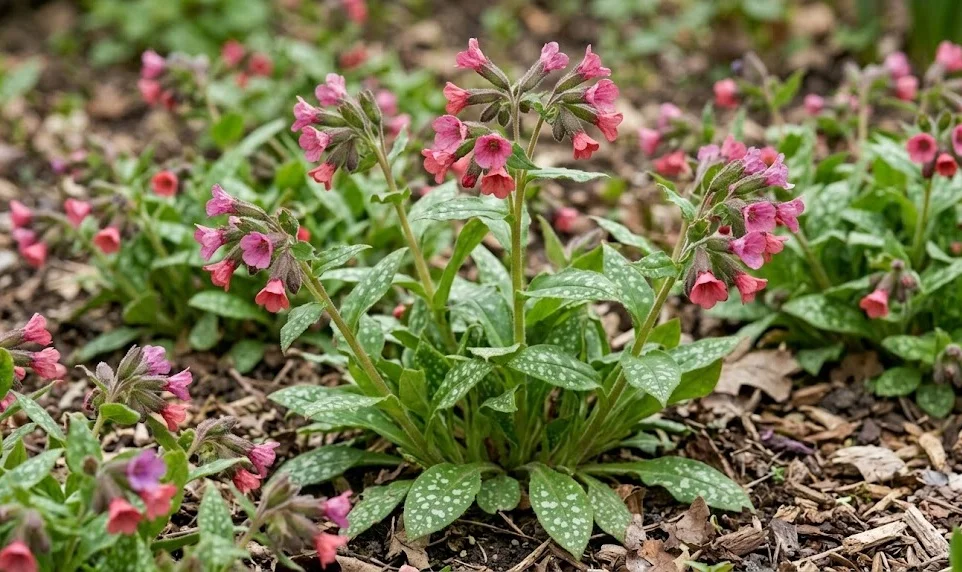

Red lungwort thrives when its root zone remains evenly moist without becoming saturated or airless. Its broad, softly hairy leaves lose moisture steadily during active growth, particularly when spring weather turns warm. At the same time, the plant is vulnerable to root damage in poorly drained soil. Successful watering therefore depends on depth, timing and soil structure rather than on applying water as often as possible.
Nutrition should be managed with similar restraint. Red lungwort grows naturally in soils enriched by gradually decomposing woodland litter rather than by concentrated fertilizer. It responds well to compost, leaf mould and mild balanced feeds. Excessive nutrient levels can produce soft leaves, weak stems and increased susceptibility to disease.
Water and fertilizer cannot be considered separately. Nutrients move through the soil in water, while root activity declines when the ground is either too dry or too wet. A fertilized plant in dry soil may suffer root scorch, and a heavily watered plant may lose nutrients through leaching. Balanced care maintains both moisture and nutrient availability within a moderate range.
The plant’s needs also change through the season. Emerging spring growth requires reliable moisture, summer demand depends heavily on shade and temperature, and autumn care supports root recovery. Winter irrigation is rarely needed in open ground unless conditions remain unusually dry. Adapting to these changes prevents both neglect and overmanagement.
Assessing moisture in the root zone
The appearance of the soil surface is not always a reliable guide. Mulch may look dry while the soil beneath remains adequately moist, or the reverse may occur in crusted ground. A finger, narrow trowel or soil probe should be used to examine conditions several centimeters deep. Watering decisions are more accurate when based on the active root zone.
More articles on this topic
Leaves that wilt during the hottest part of the day do not always indicate severe drought. Temporary midday drooping can occur even in moist soil because water loss briefly exceeds root uptake. If the foliage recovers by evening, immediate irrigation may not be necessary. Persistent morning wilt is a more serious warning.
Dry soil usually feels light, loose and warm around the roots. Moist soil feels cooler and holds together gently without releasing water when squeezed. Saturated soil appears glossy, sticky or water-filled and may have a sour smell. These physical signs help distinguish drought stress from poor drainage.
Container-grown plants require closer monitoring because their limited soil volume changes quickly. A pot may dry within a day during warm weather, especially beneath tree canopies that intercept rainfall. Lifting the container provides a useful indication of moisture because dry pots feel noticeably lighter. Drainage holes should remain open so that excess water can escape freely.
Watering through the growing season
Early spring watering may be necessary when flowering coincides with a dry period. The plant is actively producing stems, flowers and leaves, so an abrupt moisture shortage can shorten flowering and weaken growth. Water should be applied slowly at the base of the plant. Wetting the flowers and foliage repeatedly is unnecessary.
More articles on this topic
After flowering, moisture remains important because fresh basal leaves and new roots are developing. This period is sometimes overlooked once the main display has ended. A deep watering during dry weather supports energy storage and helps the clump recover from flowering. Mulch can then reduce the frequency of later irrigation.
Summer watering depends on shade, rainfall and soil type. Plants in cool woodland soil may need little additional water, while those near walls or beneath mature trees can dry rapidly. Tree roots compete strongly for moisture even when the ground surface looks shaded and comfortable. Checking the soil is therefore essential in apparently protected positions.
Autumn watering should continue during prolonged dry spells until temperatures fall and growth slows. Recently divided or planted specimens are especially dependent on moisture because their roots are still limited. Watering can be reduced once rainfall becomes regular and evaporation decreases. Standing water around the crown must never be allowed to persist.
Applying water efficiently
Deep, infrequent irrigation is generally more useful than daily surface sprinkling. Water that penetrates the soil encourages roots to explore a larger volume of ground. Shallow applications keep roots near the surface, where they are more vulnerable to heat and drought. The quantity must still be adjusted to the soil’s drainage capacity.
A slow flow from a watering can, hose or drip line allows water to soak in with minimal runoff. On sloping ground, a shallow basin can be formed around the planting area to hold water temporarily. The basin should not cover the crown or become permanently waterlogged. Several short applications may be more effective than one rapid flood.
Morning irrigation gives foliage time to dry if accidental splashing occurs. Evening watering is acceptable when water is directed only to the soil and nights are not persistently cool and humid. Repeated wet foliage during the night encourages mildew and leaf spotting. Water pressure should remain low enough to avoid compacting soil or exposing roots.
Rainwater is excellent for red lungwort, especially in areas with very hard tap water. Stored rainwater is usually close to ambient temperature and contains little dissolved mineral residue. Containers should be covered or managed to prevent contamination and insect breeding. Cold water applied directly to warm roots is rarely disastrous, but moderate-temperature water is gentler.
Building fertility with organic matter
A yearly surface application of mature compost provides slow, balanced nutrition. It also feeds soil organisms that release nutrients gradually and improve aggregation. The compost should be spread in a thin, even layer around the clump. Burying the crown beneath rich material can encourage rot.
Leaf mould is particularly suitable because it reflects the plant’s natural habitat. Although it contains fewer nutrients than compost, it has excellent moisture-retaining and soil-conditioning properties. Leaf mould can be combined with a small amount of compost where fertility is low. This mixture creates a stable woodland-style root environment.
Composted bark can also be used as mulch, but it should be sufficiently mature. Fresh woody material may temporarily immobilize nitrogen where it mixes into the upper soil. This effect is limited when bark remains on the surface, yet signs of pale growth should still be observed. A small compost application beneath the bark usually prevents deficiency.
Animal manure must be thoroughly rotted before use. Even then, it should be applied sparingly because red lungwort does not need intense fertility. Strong manure can produce coarse foliage and may raise salt levels near the roots. A mild, humus-rich amendment is more suitable than a heavy feeding layer.
Using fertilizers safely
A balanced granular fertilizer can be applied in early spring when soil fertility is clearly inadequate. The product should be distributed around the plant rather than placed against the crown. It should then be watered in unless rain is expected soon. Using half strength is often sufficient for an established clump.
Nitrogen-rich lawn fertilizers are unsuitable because they stimulate excessive leaf growth. Such growth is softer, more prone to collapse and more attractive to slugs. It may also reduce the plant’s ability to maintain a compact habit. A balanced or slightly potassium-supportive formula is more appropriate.
Liquid fertilizer is mainly useful for plants grown in containers. A dilute feed every few weeks during spring and early summer replaces nutrients lost through drainage. The concentration should remain lower than that used for vigorous annual flowers. Feeding should be suspended when the plant is heat-stressed, diseased or recently divided.
Symptoms must be interpreted carefully before fertilizer is added. Yellow leaves can result from waterlogging, root damage, excessive sun or natural aging rather than from nutrient deficiency. Feeding a plant with damaged roots may worsen the problem. Soil moisture, drainage and seasonal growth patterns should be checked first.