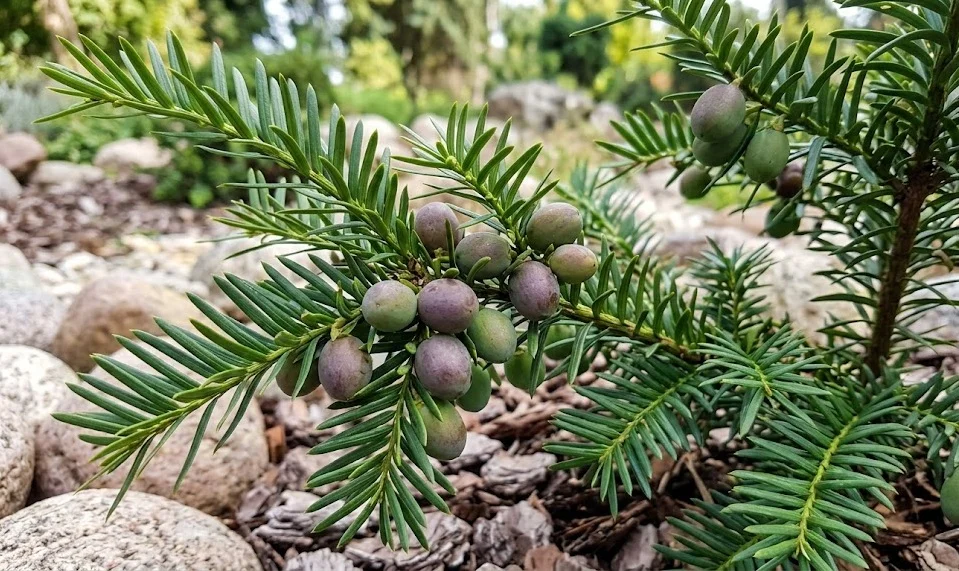

Japanese plum yew is valued because it can provide evergreen structure where many other needled plants struggle with shade. Its best growth usually occurs in partial shade, filtered woodland light, or morning sun with afternoon protection. It can tolerate deeper shade, although growth may become slower and less dense. Full sun is safest only in cooler, moist climates where heat and drought do not combine. Missouri Botanikus Kert+2Négyévszakos Növénysegéd+2
Ideal light conditions
Partial shade is the most reliable exposure for Japanese plum yew. This usually means several hours of gentle light or bright shade throughout the day. Morning sun is generally safer than afternoon sun because it is cooler and less drying. In this position, the foliage usually remains deep green and firm.
Filtered light under high deciduous trees can also be excellent. The plant receives enough brightness for steady growth without harsh direct exposure. Seasonal leaf drop allows more winter light, which is usually acceptable when wind protection is present. This woodland edge environment closely matches the plant’s natural strengths.
Deep shade is tolerated, but expectations should be realistic. Growth may slow further, and the plant may become more open. Foliage density often depends on how much reflected and indirect light reaches the shrub. A plant in total darkness under dense evergreen canopies will not perform as well as one in bright shade.
Light quality changes during the year. A site that seems shaded in spring may become hot and exposed in summer. Conversely, a summer-shaded site may receive strong winter sun after deciduous leaves fall. Observing the site across seasons helps prevent placement errors.
More articles on this topic
Problems caused by too much sun
Excessive sun can cause needle scorch, especially in hot climates. The first symptoms may appear as pale tips, bronzing, or browning on the sun-facing side. Reflected heat from walls, paving, gravel, or glass can intensify the damage. Even a plant labeled sun-tolerant may suffer in these microclimates.
Full sun also increases water demand. If roots cannot supply enough moisture, foliage quality declines. This is most likely in sandy soil, containers, raised beds, or windy sites. Mulch and deep watering help, but they may not fully compensate for poor exposure.
Young plants are more sensitive to sun stress than established shrubs. Nursery-grown specimens may have been raised under shade cloth or protected conditions. Sudden placement in strong sun can shock the foliage. Gradual acclimation is safer when more light is required.
If sun scorch occurs, do not immediately prune the plant hard. Improve moisture, add temporary shade, and wait to see which shoots remain alive. Damaged foliage may persist for some time because evergreen needles are not replaced instantly. Preventing repeat stress is more important than cosmetic correction.
More articles on this topic
Using shade creatively in design
Japanese plum yew can make shaded spaces look intentional rather than difficult. Its dark foliage creates depth behind lighter plants. It pairs beautifully with variegated hostas, silver ferns, pale hellebores, and bright woodland bulbs. The contrast is strongest where filtered light catches the needle surface.
In formal gardens, it can be used as a quiet evergreen mass. It provides structure without the stiffness of some clipped conifers. Because it tolerates shade, it can be placed near entrances, north-facing walls, or under open-canopied trees. The result is a composed green framework throughout the year.
In containers, light management is even more important. Pots heat and dry faster than garden soil, so harsh sun can stress roots and foliage at the same time. A bright courtyard with morning sun is often better than a hot terrace with afternoon exposure. Container plants should be turned occasionally if one side receives much more light.
A balanced light environment also reduces maintenance. Plants in suitable shade need less emergency watering, less corrective pruning, and fewer interventions. Their foliage remains more even, and their form develops naturally. For this shrub, the right light is one of the most powerful care practices.