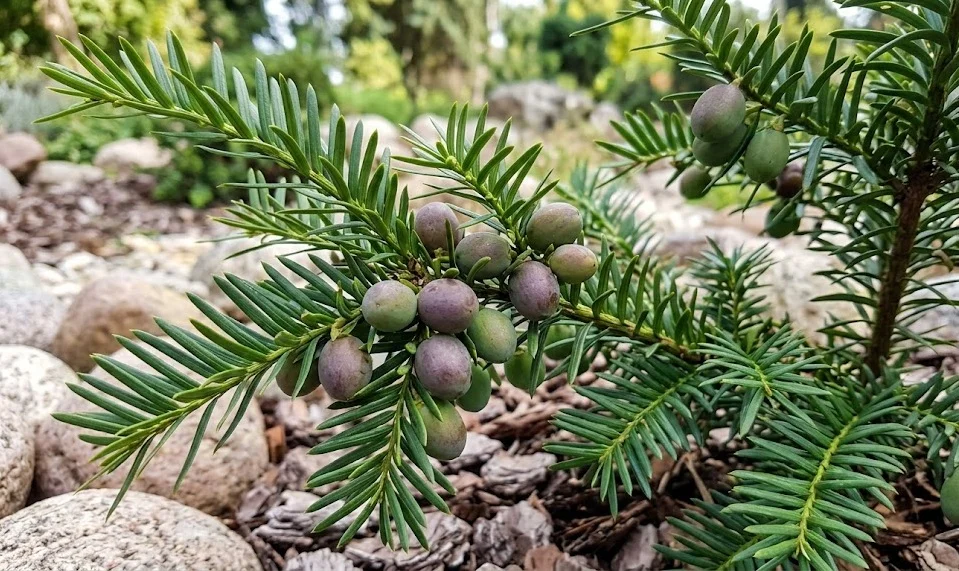

Japanese plum yew usually needs little pruning, and that is one of its strengths in professional landscape design. Its slow growth allows it to hold a refined shape for years with only selective correction. Heavy cutting is rarely necessary and can reduce the layered texture that makes the plant attractive. The best pruning approach is restrained, observant, and timed to support long-term structure. RHS+1
When and why to prune
The best time for structural pruning is late winter or early spring before active growth begins. At this stage, the plant’s framework is easier to see. Winter damage can also be assessed as spring approaches. Pruning at this time gives the shrub a full season to recover.
Light corrective pruning may also be done after spring growth hardens. This can tidy an uneven shoot or remove a branch that disrupts the outline. Avoid repeated trimming during hot, dry weather. Cutting during stress can increase browning and slow recovery.
The main reasons to prune are damage, crowding, shape correction, and clearance. Remove broken, dead, crossing, or inward-growing stems first. This improves air movement and reduces clutter inside the plant. Cosmetic pruning should come after health-related pruning.
Pruning should respect the plant’s natural habit. Japanese plum yew is often most attractive when its branch layers remain visible. Over-shearing can turn it into a flat, unnatural mass. Selective cuts preserve depth and elegance.
More articles on this topic
Techniques for clean shaping
Use sharp, clean pruning tools. Hand pruners are better than hedge shears for most maintenance cuts. They allow individual shoots to be shortened back to a side branch. This produces a softer, more natural finish.
Step back frequently while pruning. The plant’s slow growth means mistakes remain visible for a long time. Removing a small amount from several areas is safer than cutting one side heavily. A measured approach maintains balance.
When reducing height or width, cut to existing laterals rather than leaving blunt stubs. Stubs can brown and interrupt the plant’s texture. Cutting back to a natural branch junction helps new growth blend into the shrub. This technique is especially important on visible specimens.
Avoid cutting into old, bare interior wood unless renewal is clearly needed and some green growth remains nearby. Many conifers respond poorly to severe cuts into leafless wood. Japanese plum yew can be more forgiving than some evergreens, but recovery is still slow. Conservative pruning is the professional choice.
More articles on this topic
Rejuvenation, hedging, and long-term control
If an older plant has become too large, reduce it gradually over several seasons. Sudden hard cutting can leave gaps and expose shaded inner branches to sun scorch. A staged approach allows the canopy to adjust. It also keeps the plant useful in the design while renovation continues.
For informal hedging, prune lightly and regularly rather than waiting for major size problems. The goal is to guide growth while keeping the surface textured. Slight tapering, with the base wider than the top, helps light reach lower branches. This prevents thinning at the bottom.
Formal shearing is possible but should be used carefully. Repeated shearing creates dense outer growth that can shade the interior. It may also hide pests or dead needles inside the canopy. Where a formal outline is needed, combine light shearing with occasional thinning cuts.
After pruning, support recovery with good watering and mulch. Fertilizer is not always necessary, especially after light pruning. The plant should be encouraged to make steady, firm growth rather than soft flushes. With patience and restraint, Japanese plum yew can be shaped for many years without losing its quiet evergreen character.