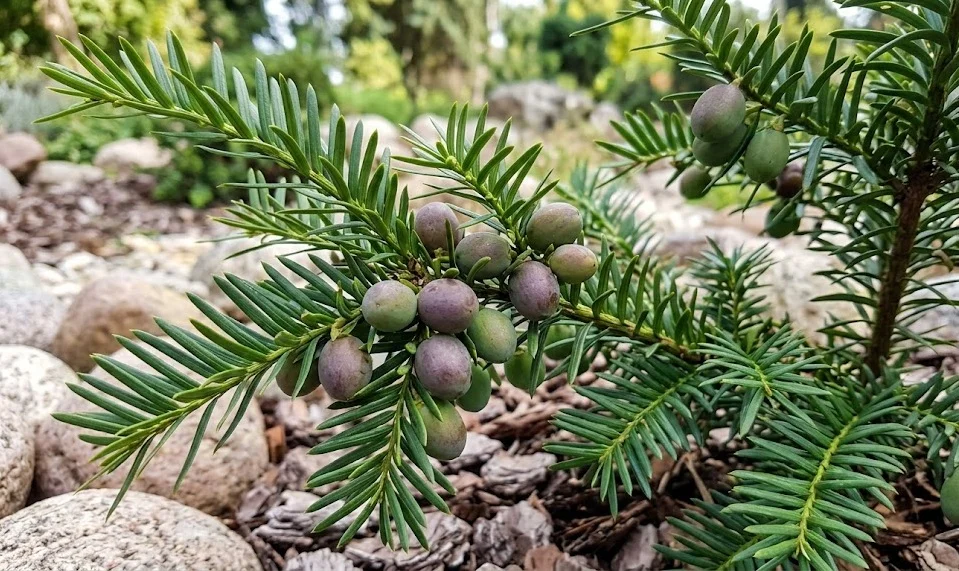

Japanese plum yew is generally considered a low-problem evergreen, and well-sited plants often remain healthy for many years. Its resistance to heat, shade, and browsing makes it valuable in difficult gardens, but it is not immune to stress. Most serious problems begin with poor drainage, drought, wind exposure, or planting mistakes rather than aggressive pests. A prevention-based approach is the most reliable way to keep the plant dense, green, and long-lived. Négyévszakos Növénysegéd+2RHS+2
Recognizing healthy and stressed foliage
Healthy Japanese plum yew carries firm, deep green needles with a slight gloss. The foliage should feel leathery but not brittle. Growth is naturally slow, so modest annual extension is not a problem. A stable, compact appearance often indicates good health.
Stress often appears first as dull foliage. Needles may lose their shine before they turn brown. Shoot tips can become pale, dry, or uneven. These early symptoms should prompt a review of water, drainage, light, and wind exposure.
Browning on the outer side of the shrub often points to sun scorch or winter burn. Browning low inside the plant may result from shade, age, or poor air movement. Sudden collapse of shoots can suggest root trouble. Patterns matter because they help separate environmental stress from pest activity.
Do not remove every browned shoot immediately unless it is clearly dead. Some damage becomes easier to evaluate after new growth begins. Premature pruning can make the plant look worse and remove tissue that might still recover. Careful observation is often the first step in diagnosis.
More articles on this topic
Root and crown problems
Poor drainage is the most important disease-related risk for Japanese plum yew. Roots that remain saturated are vulnerable to rot and oxygen deprivation. Above ground, this may look like drought because damaged roots cannot move water properly. The plant may wilt, dull, yellow, or die back even when soil feels wet.
Planting too deeply can create similar problems. Soil or mulch against the crown holds moisture where the stems need air. Over time, this can weaken the base of the plant. Correct planting depth is one of the simplest forms of disease prevention.
If root problems are suspected, examine the site before applying treatments. Check whether water collects after rain, whether irrigation is excessive, and whether mulch is piled against the stems. Correcting those conditions is essential. Fungicides rarely solve root decline when the physical environment remains wrong.
For valuable plants in wet soil, improving drainage may be necessary. This can include redirecting runoff, thinning surrounding vegetation, or creating a raised bed edge. In severe cases, replacement in a better location is more practical. Japanese plum yew is adaptable, but it cannot thrive indefinitely in stagnant soil.
More articles on this topic
Insect pests and monitoring
Serious insect problems are uncommon on well-grown Japanese plum yew. However, stressed evergreens can attract opportunistic pests. Scale insects, mites, or other small sap-feeding pests may appear under dry or crowded conditions. Regular inspection helps detect issues before they spread.
Look closely at the undersides of needles and along young stems. Scale may appear as small bumps rather than active moving insects. Mite damage may show as stippling, bronzing, or dusty foliage. A hand lens can make diagnosis more accurate.
Cultural correction is the first step in pest management. Improve watering, reduce dust, remove severely infested shoots, and increase air movement where possible. Many minor infestations decline when plant vigor improves. Broad-spectrum insecticides should be avoided unless a pest is accurately identified.
If treatment is needed, choose targeted methods appropriate to the pest and season. Horticultural oils can be useful for some scale problems when applied correctly. Always avoid spraying during extreme heat or drought stress. The plant should be watered and stable before any treatment is applied.
Environmental disorders
Winter burn is one of the most common non-pest problems. It develops when evergreen foliage loses moisture during cold, windy, or sunny weather while roots cannot replace it quickly. Damage often appears on exposed sides of the plant. Shelter and autumn watering are the best prevention.
Summer scorch can occur in hot climates where plants receive too much direct afternoon sun. Needles may brown at the tips or on the sun-facing side. Reflected heat from walls, paving, or gravel can make the problem worse. Partial shade and mulch reduce the risk substantially.
Drought stress can be subtle because the plant is slow to show symptoms. By the time browning appears, root-zone dryness may have persisted for weeks. Deep watering during extended dry periods prevents cumulative damage. A consistent mulch layer makes drought stress less severe.
Nutrient disorders are less common than moisture problems. Pale foliage should not automatically be treated with fertilizer. Compacted soil, poor drainage, or root damage can prevent nutrient uptake even when nutrients are present. Soil improvement and root health should come first.
Integrated prevention in professional care
Professional care begins with placing the plant correctly. A sheltered, partially shaded site with moist, well-drained soil prevents most problems. Good spacing reduces humidity trapped inside the canopy. A plant that is not crowded is easier to inspect and maintain.
Water management should be deliberate. Deep watering during establishment, occasional drought support after maturity, and autumn hydration all strengthen resistance. Overwatering should be avoided as carefully as underwatering. Roots need both moisture and oxygen.
Sanitation also matters in dense plantings. Remove fallen leaves that collect inside the shrub and stay wet. Prune out dead or damaged twigs with clean tools. Avoid leaving diseased material in contact with the crown.
Finally, avoid excessive intervention. Japanese plum yew often remains healthiest when care is steady and restrained. Too much fertilizer, too much pruning, or too much water can create more problems than neglect. The best maintenance program supports the plant’s natural resilience.