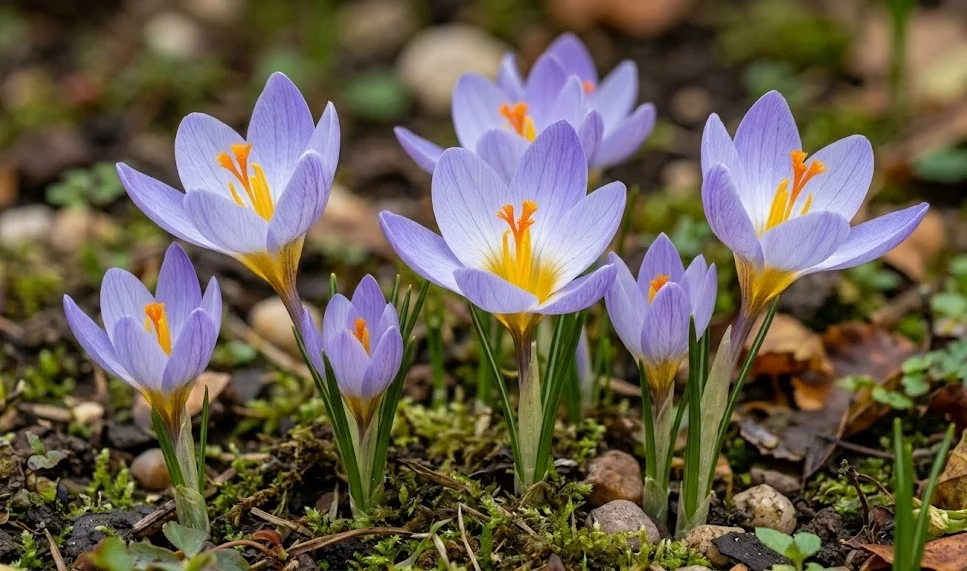

Beautiful crocus needs bright seasonal light to flower well and rebuild strong corms. Because it grows mainly in the cooler part of the year, its light needs must be judged differently from summer perennials. A place that is shaded in summer may still be bright enough in autumn and winter if overhead trees lose their leaves. The best results come from matching light exposure with soil drainage and seasonal growth.
Full sun and open positions
Full sun is often the best position for beautiful crocus. It encourages compact growth, strong flowering, and healthy leaves. Open light also helps the soil surface dry after rain. This reduces the risk of fungal disease and corm rot.
In cooler climates, full sun rarely causes stress during the plant’s active season. Autumn and winter sunlight is softer than midsummer light. The corms are often dormant during the hottest part of the year. This makes sunny gravel beds and rock gardens very suitable.
A south-facing or west-facing exposure can work well if drainage is excellent. The soil may warm slightly faster, encouraging active growth. However, the site should not become irrigated heavily in summer. Sun and dryness during dormancy are usually beneficial.
Open positions also make the flowers easier to see. Beautiful crocus blooms close to the ground, so it can disappear among taller plants. Planting it at the front of a sunny border gives the flowers visual importance. Small drifts create a stronger effect than scattered single corms.
More articles on this topic
Light shade beneath deciduous plants
Light shade can be suitable when it comes from deciduous shrubs or small trees. During autumn and winter, falling leaves allow more light to reach the ground. This seasonal opening fits the growth rhythm of beautiful crocus. It can flower well under airy canopies.
The key is avoiding dense shade during the leaf stage. The leaves must photosynthesise after flowering to recharge the corms. If they grow in gloom for months, future flowering weakens. Bright shade is acceptable, but deep shade is not.
Leaf litter should not be allowed to smother emerging flowers. A thin natural layer is usually harmless, but heavy wet leaves can block light and trap moisture. Clear the planting area gently by hand if needed. Avoid raking aggressively over shallow corms.
Companion roots are another factor beneath trees and shrubs. Very thirsty woody plants may compete strongly for moisture during active growth. Beautiful crocus can tolerate some competition, but not severe dryness at the wrong time. The best overhead companions are open, not dense and greedy.
More articles on this topic
Recognising poor light conditions
Poor light often shows up as weak flowering rather than immediate plant death. The leaves may appear thin, long, or pale. Flowers may become fewer each year. The clump may survive but lose its ornamental value.
If plants flower well in the first year and then decline, light should be considered along with feeding and foliage management. Stored energy from the purchased corm may support the first bloom. Later performance depends on the leaves receiving enough light. A shaded leaf stage leads to shrinking corms.
Dense evergreen shrubs are usually unsuitable neighbours. They block light precisely when beautiful crocus needs it most. They also keep soil cooler, damper, and more crowded. Moving the corms to a brighter site is often the simplest solution.
In mixed borders, summer growth can hide the planting area by autumn. Tall perennials may collapse over the crocus just as it starts to flower. Cutting back neighbouring plants carefully can improve light and visibility. The crocus itself should not be cut while green.