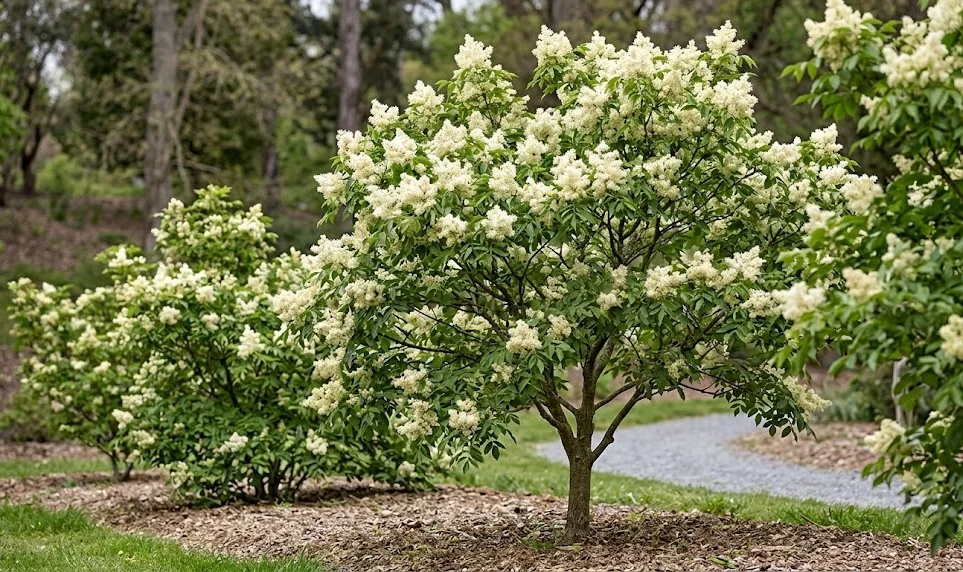

Flowering ash is a light-loving tree that develops its best crown shape and floral display in bright, open conditions. While it can tolerate some partial shade, flowering is usually stronger and growth more balanced when the tree receives generous direct sunlight. Light affects not only the number of blossoms, but also shoot strength, leaf density, and overall tree vitality. For this reason, understanding exposure is essential when choosing a planting position or evaluating an underperforming specimen.
Full sun and flowering quality
Full sun is the preferred exposure for flowering ash in most gardens. A sunny position encourages abundant flower clusters and a well-formed crown. The tree’s ornamental value is closely linked to this seasonal bloom, so light should be treated as a priority. A shaded tree may remain alive, but it often loses much of its character.
Direct sunlight also helps produce stronger, shorter, better-ripened shoots. This matters because well-matured growth is more resilient during winter and less prone to weak branching. In too much shade, shoots may stretch toward the light and create an uneven structure. Over time, this can make the crown look thin or one-sided.
Flowering ash is especially well suited to open lawns, sunny borders, Mediterranean-style gardens, and warm courtyards with enough root space. It can handle heat better than many moisture-loving ornamentals once established. However, hot exposure should still be balanced with proper watering during establishment. Sun tolerance does not remove the need for early care.
If the tree is being planted primarily for flowers, avoid placing it beneath taller trees or close to buildings that cast long shadows. Morning and midday sun are particularly valuable for strong growth. Afternoon shade may be acceptable in very hot climates, but deep shade is not ideal. The more ornamental performance matters, the more important full sun becomes.
More articles on this topic
Partial shade and limitations
Flowering ash can adapt to partial shade, especially if the shade is light and not constant throughout the day. It may grow reasonably well where it receives several hours of direct sun and bright indirect light for the rest of the day. This can be suitable in mixed gardens where full exposure is limited. The tree will usually perform better in bright partial shade than in dense shade.
The main limitation of partial shade is reduced flowering. Fewer flower clusters may develop, and the spring display can be less impressive. Growth may also become more open, with longer spaces between shoots. These changes are not always signs of disease; they may simply reflect lower light.
Partial shade can be helpful in very hot, dry locations if soil moisture is difficult to maintain. Some protection from the strongest afternoon sun can reduce leaf scorch on young trees. Even so, too much shade will compromise the tree’s natural habit. The best compromise is bright light with enough sun to support flowering.
When assessing a shaded site, observe the light through the whole growing season. A place that looks sunny in early spring may become shaded once nearby trees leaf out. Buildings, fences, and evergreens can also create persistent shade patterns. Successful planting depends on real seasonal light, not a single moment of observation.
More articles on this topic
Managing light in the garden
If a flowering ash is already planted in a shaded position, surrounding vegetation may be adjusted to improve light. Selective thinning of nearby shrubs or branches can increase exposure and air movement. This should be done carefully so the garden remains balanced. Sudden severe exposure after years of shade can also stress some plants.
Pruning the flowering ash itself will not solve a lack of light. Removing branches may make the crown smaller, but it cannot create the sunlight needed for abundant flowering. In fact, heavy pruning can reduce bloom further. The source of the shade should be considered before cutting the tree.
Young trees should be trained so their crowns develop evenly toward available light. If growth becomes one-sided, light competition is often part of the reason. Early structural pruning can help, but it should be gentle. Correct site conditions remain more important than corrective cutting.
In small gardens, careful placement is the best solution. Plant flowering ash where it can receive light without overwhelming nearby plants. Its moderate size makes it easier to position than many larger trees. With good exposure, it can become a refined focal point rather than a struggling background plant.