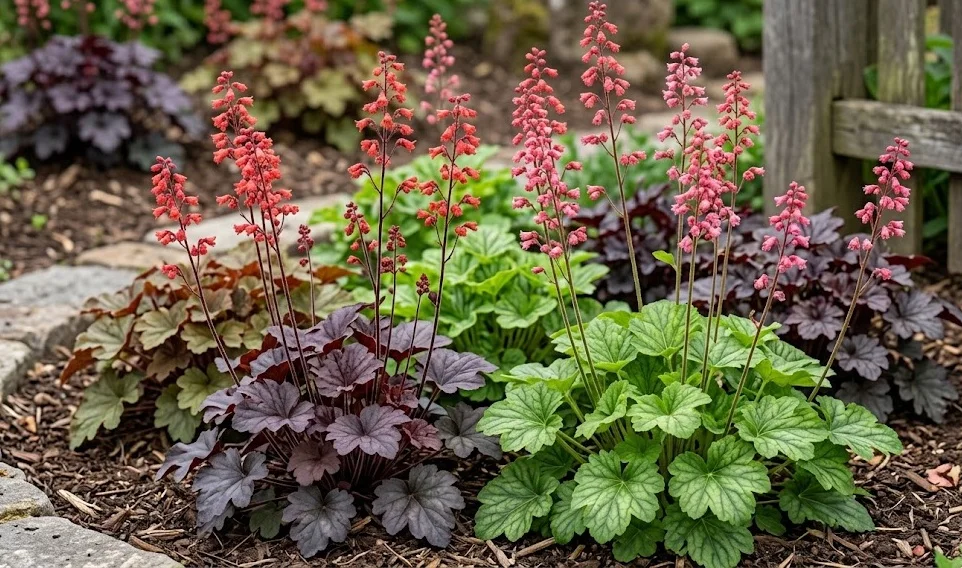

Light has a major influence on the color, vigor, and durability of coral bells. These perennials are often described as shade plants, but their needs are more nuanced than that simple label suggests. Many varieties perform best in bright shade or morning sun, while others can tolerate more direct light in cooler conditions. Understanding the relationship between foliage color and exposure helps gardeners place each plant where it will look its best.
Matching light to foliage color
Coral bells with dark purple, bronze, or deep red foliage often tolerate more sunlight than pale-leaved types. Their pigments can help protect the leaves from stronger light. In cool climates, these varieties may develop richer color with several hours of sun. In hot regions, even dark varieties usually benefit from afternoon shade.
Lime, yellow, caramel, and silver varieties often prefer softer light. Their leaves can scorch when exposed to intense midday sun, especially during summer heat. Bright shade allows these colors to glow without burning. This is why pale coral bells are especially valuable in shaded borders and woodland edges.
Green-leaved varieties are often flexible and natural-looking in mixed plantings. They usually cope well with partial shade and can blend easily with ferns, hostas, and spring bulbs. Their flower stems may be more noticeable when the foliage is not intensely colored. These varieties are useful where subtle texture is more important than strong contrast.
Varietal differences are significant, so observation remains essential. A plant that thrives in one garden may struggle in another because of temperature, soil, and reflected heat. Leaf scorch, fading, or weak growth are practical signals. Moving a plant slightly can often solve the problem without changing the entire design.
More articles on this topic
Recognizing too much or too little light
Too much sun often appears as browned leaf edges, faded color, or dry patches on the foliage. The damage is usually worse on the side facing the strongest afternoon light. Hot walls, pale paving, and gravel can intensify the effect by reflecting heat. Even a sun-tolerant variety may suffer in these conditions.
Plants receiving too little light may become loose, stretched, and less colorful. Flowering can also decline when shade is too dense. The leaves may remain healthy but lack the compact, full shape expected from a strong plant. In deep shade, coral bells can survive but may not show their best ornamental qualities.
Morning sun is often the best compromise. It provides useful light while temperatures are still moderate. Afternoon shade protects the plant during the most stressful part of the day. This pattern suits many gardens and many varieties.
Seasonal changes should also be considered. A site that is sunny in spring may become shaded once trees leaf out. Conversely, low winter sun may reach areas that are shaded in summer. Coral bells can adapt to these changes if extremes are not severe.
More articles on this topic
Using light creatively in garden design
Coral bells can brighten shade more effectively than many flowering plants. Pale, amber, or silver foliage catches limited light and makes dark corners feel more alive. Placing these varieties near paths or seating areas increases their impact. Their leaves provide interest even when flowers are absent.
Dark-leaved coral bells create depth and contrast. They look especially effective beside chartreuse foliage, silver grasses, or pale stone. In too much shade, however, very dark leaves may visually disappear. A background with lighter texture helps them stand out.
In container design, light can be managed more flexibly. Pots can be placed where foliage color looks strongest and moved if summer heat becomes excessive. This is useful for balconies, terraces, and small courtyards. Container-grown coral bells also allow experimentation with combinations before committing plants to the border.
Professional planting schemes often use coral bells as light-responsive accents. A repeated variety can guide the eye through a shaded bed. Contrasting foliage can mark entrances, steps, or transitions between garden areas. When light is understood as part of the design, coral bells become far more than simple shade fillers.