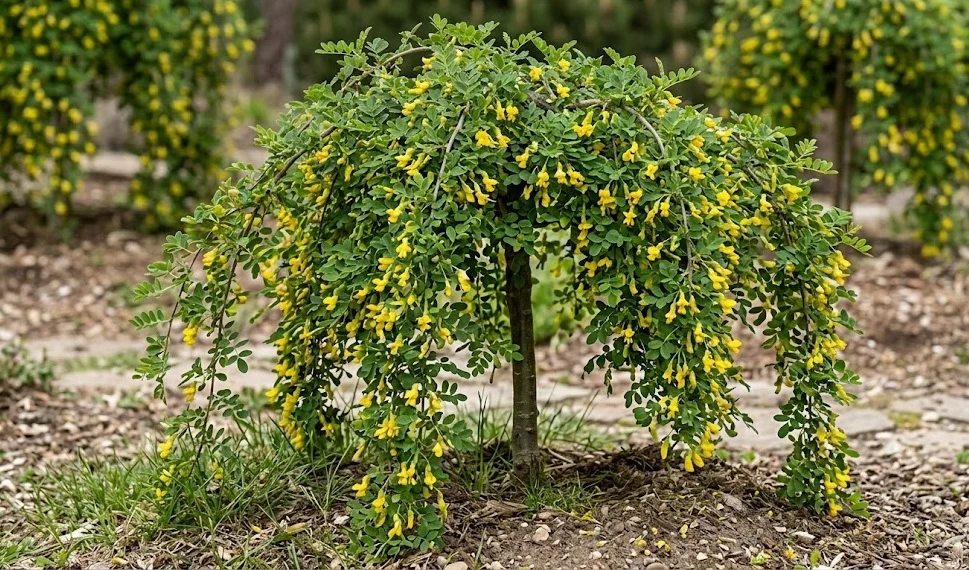

The weeping pea tree develops its best shape, flowering, and foliage density in bright, sunny conditions. Although it can tolerate some light shade, it should not be treated as a shade tree. Sun exposure influences not only the number of flowers but also the strength of shoots and the fullness of the cascading crown. Choosing the right light conditions from the beginning is one of the simplest ways to keep the plant attractive and healthy.
Full sun and ornamental performance
Full sun is the ideal position for the weeping pea tree. A site receiving at least six hours of direct sunlight supports strong flowering and compact shoot growth. The yellow spring flowers are usually most abundant when the tree grows in open light. Dense shade reduces both bloom quality and crown density.
Sunlight also helps the branches ripen properly before winter. Firm, well-matured shoots are more resistant to cold and less likely to suffer damage. In shaded conditions, shoots may become softer, longer, and less structured. This can weaken the clean umbrella-like form of the tree.
The weeping crown looks most refined when light reaches it evenly. Uneven exposure may cause growth to develop more strongly on one side. This is not always a problem, but it can make the crown appear unbalanced. Open placement allows the plant to maintain a more harmonious shape.
In hot regions, full sun is still acceptable if the soil is well managed. Mulching and occasional deep watering during establishment help prevent stress. Once mature, the plant is well suited to sunny and dry garden conditions. Its natural toughness makes it useful where many more delicate ornamentals struggle.
More articles on this topic
Tolerance of partial shade
The weeping pea tree can grow in partial shade, especially if the shade is light and occurs only part of the day. Morning sun with afternoon shade is usually better than deep shade throughout the day. Bright, filtered light may be tolerated if the site remains airy. However, flowering may be reduced compared with full sun.
Partial shade can be useful in very hot or reflective urban environments. Near paving, stone walls, or south-facing facades, some afternoon shade may reduce heat stress. The key is to maintain enough brightness for healthy growth. A dull, enclosed position should be avoided.
In partial shade, pruning may become more important. Branches can elongate as they reach toward light, and the crown may lose density. Selective trimming and thinning can help preserve form, but pruning cannot fully replace sunlight. If the site is too dark, the plant will always perform below its potential.
Companion planting should not increase shade over time. Small perennials and low groundcovers are suitable, but vigorous shrubs or fast-growing trees may eventually crowd the weeping pea tree. What begins as a bright position can become shaded after several seasons. Long-term light conditions should be considered when designing the planting area.
More articles on this topic
Problems caused by insufficient light
Insufficient light often leads to sparse foliage and weak flowering. The tree may remain alive but lose much of its ornamental value. The weeping crown can become thin, uneven, and less graceful. This is particularly noticeable in small gardens where the plant is expected to serve as a focal point.
Low light can also increase disease pressure. Leaves dry more slowly after rain in shaded and sheltered positions. Persistent humidity around the crown may encourage fungal leaf spots. Better light and airflow usually reduce these problems naturally.
A shaded tree may produce longer, weaker shoots that disrupt the crown outline. These shoots can make the plant look untidy and may require more frequent corrective pruning. However, repeated cutting can further reduce energy reserves if light remains limited. The more sustainable solution is improving exposure where possible.
If a planted tree is clearly struggling from shade, nearby vegetation should be thinned before considering relocation. Removing competing branches or reducing neighboring shrubs may restore enough light. Young trees can sometimes be moved during dormancy, but established specimens are more difficult to transplant. Proper site choice at planting remains the best strategy.