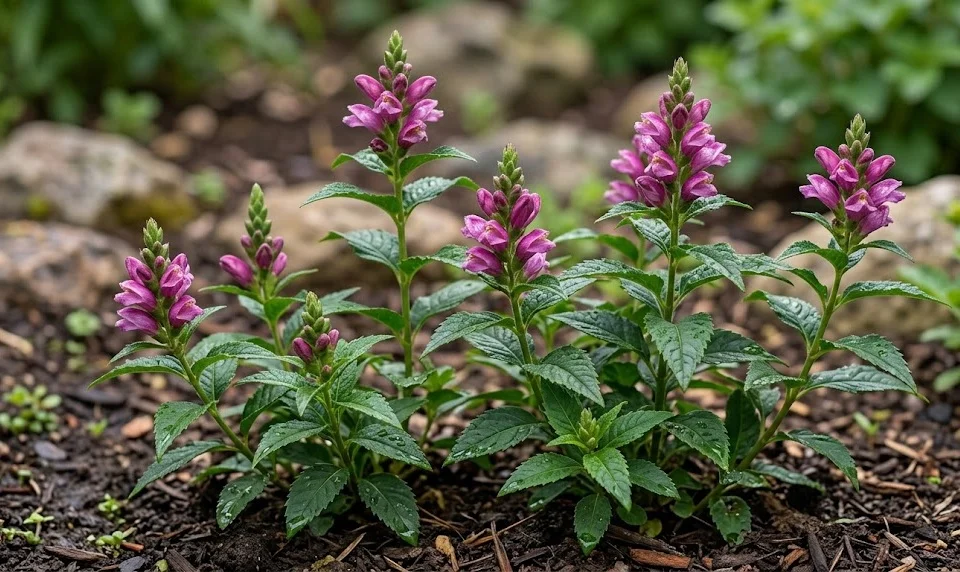

Pink turtlehead is easiest to establish when planting is planned around moisture, soil structure, and seasonal timing. This perennial forms strong clumps when its roots are placed into cool, fertile, consistently damp ground. It can be propagated by division, cuttings, and seed, though division is the most reliable method for garden use. Careful establishment in the first year determines how vigorous and floriferous the plant becomes later.
The best time and place to plant
Spring is often the best season for planting pink turtlehead. The soil is naturally moist, temperatures are moderate, and the plant has a full growing season to root deeply. Autumn planting can also work well in mild regions. Late planting should be avoided where winter arrives early or the soil becomes cold and saturated.
The planting site should be selected before any digging begins. Pink turtlehead prefers a position where the root zone does not dry out in summer. It is suitable for rain gardens, pond margins, damp borders, and woodland-edge plantings. A dry, exposed slope is rarely a good choice unless irrigation is dependable.
Partial shade is ideal in many gardens. Morning sun encourages flowering, while afternoon shade helps prevent moisture stress. In cool climates, full sun may be acceptable if the soil remains fresh. In hot climates, strong afternoon sun can scorch leaves and reduce the plant’s ornamental quality.
Spacing should allow the clump to expand naturally. Crowded planting may look full at first, but it can reduce air circulation later. A generous gap also makes watering, mulching, and division easier. Mature size should always be considered because pink turtlehead becomes more substantial with age.
More articles on this topic
Planting technique and early establishment
The planting hole should be wider than the root ball. This allows surrounding soil to be loosened and improved before roots grow outward. Compost or leaf mold can be mixed into the backfill if the soil is poor. Fresh manure should not be placed directly against the roots because it can burn tender tissue.
The crown should be set at the same depth it grew in the pot. Planting too deeply can trap moisture around the crown and encourage rot. Planting too shallowly can expose roots and cause drying. After positioning the plant, the soil should be firmed gently to remove large air pockets.
Watering immediately after planting is essential. The first watering settles soil around the roots and helps the plant recover from transplanting. During the first season, the soil should remain evenly moist. Even short dry spells can slow establishment before the root system has expanded.
Mulch should be applied after watering. A moderate layer of organic mulch helps protect the root zone from temperature swings and evaporation. It should be kept slightly away from the crown to prevent excessive wetness at the base of the stems. Mulch can be renewed each spring as it breaks down.
More articles on this topic
Propagation by division
Division is the simplest and most dependable way to propagate pink turtlehead. It produces new plants that are identical to the parent plant. This method is especially useful when an established clump has become too dense. Dividing also refreshes older plants and improves flowering.
Spring division is usually preferred. New shoots show where the crown is active, and the plant can recover during the growing season. The clump should be lifted with as much root as possible. A sharp spade or garden knife can then be used to separate strong sections.
Each division should have healthy roots and several growing points. Very small pieces may survive, but they take longer to become attractive garden plants. Damaged, woody, or diseased portions should be discarded. Replanting should be done quickly so that the roots do not dry out.
New divisions need consistent moisture after planting. They should not be allowed to wilt repeatedly during the first few weeks. Temporary shade can help if the weather turns hot after division. Once new growth resumes, the plants can be treated like established specimens.
Propagation by cuttings and seed
Softwood cuttings can be taken from healthy non-flowering shoots in late spring or early summer. The cuttings should be placed in a moist, well-drained propagation medium. High humidity helps reduce water loss while roots develop. Gentle warmth and bright indirect light usually improve success.
Cuttings should not be taken from weak or stressed plants. Healthy parent material gives stronger young plants and lowers the risk of disease. Lower leaves are removed before insertion into the medium. The cutting should remain moist but never sit in stagnant water.
Seed propagation is possible, but it is less predictable for ornamental uniformity. Seedlings may vary in vigor, flower color, and growth habit. Fresh seed can be sown in a prepared seed tray or outdoor nursery bed. Some seed may benefit from a period of cold, moist conditions before germination.
Seed-grown plants take longer to reach flowering size than divisions. They are useful when many plants are needed for naturalistic or ecological plantings. Young seedlings must be protected from drying, weeds, and slug damage. Once they are large enough to handle, they can be transplanted into their final positions.