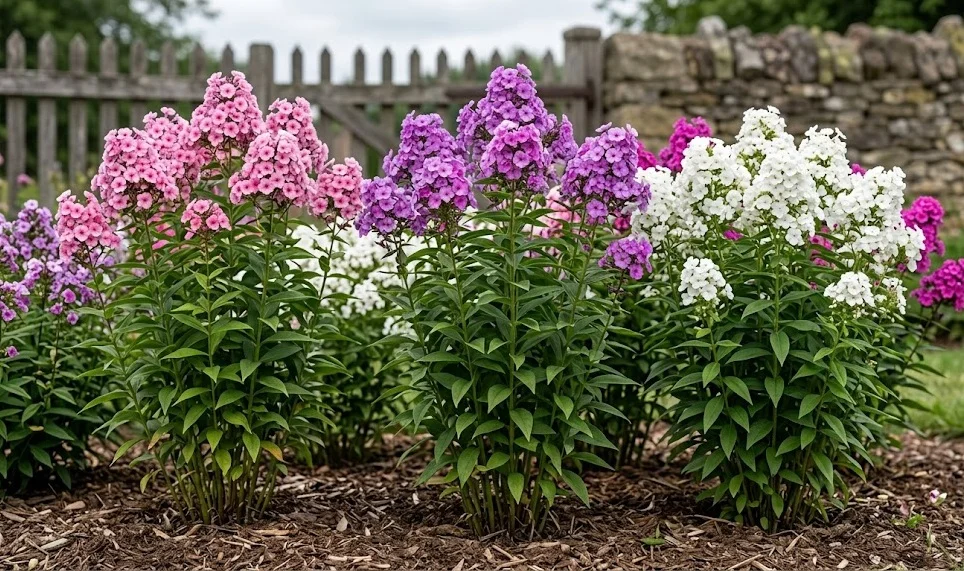

Garden phlox rewards consistent moisture and moderate nutrition with tall stems, clean foliage, and full flower clusters. It is not a plant that thrives on extremes, because drought, waterlogging, and excessive fertilizer can all reduce performance. The best approach is to keep the root zone evenly moist, feed steadily rather than aggressively, and adjust care to the season. When water and nutrients are balanced, garden phlox becomes more resilient, more floriferous, and easier to maintain.
Understanding moisture needs
Garden phlox has a relatively high moisture demand during active growth. Its broad leaves and tall flowering stems use plenty of water, especially in warm weather. If the soil dries too much while buds are forming, the plant may produce smaller flower heads. Long dry periods can also cause lower leaves to yellow and drop.
Even moisture does not mean constantly wet soil. Roots need oxygen as well as water, and saturated ground can damage them. The ideal soil stays cool and damp below the surface but drains after heavy rain. This balance is easiest to achieve in soil improved with compost.
Established plants tolerate short dry spells better than newly planted ones. However, even established clumps perform poorly when drought coincides with flowering. A plant may survive dry conditions but still lose ornamental quality. For a perennial grown mainly for its flower display, survival alone is not the standard to aim for.
The best way to judge watering need is to check the soil rather than the calendar alone. If the top layer is dry but soil a few centimeters down remains slightly moist, watering may not be urgent. If the root zone feels dry, a deep soak is needed. This practical observation prevents both underwatering and unnecessary watering.
More articles on this topic
Watering techniques that reduce disease
Deep, slow watering is ideal for garden phlox. It allows water to penetrate the root zone instead of running away from the surface. A thorough soaking once or twice a week in dry weather is usually better than a light sprinkle every day. Shallow watering encourages shallow roots and leaves the plant more vulnerable to heat.
Water should be applied at soil level whenever possible. Wet leaves can create favorable conditions for powdery mildew and other foliar problems. Although powdery mildew can develop even without free water on leaves, poor watering habits still contribute to stress and disease pressure. Soil-level irrigation is a simple way to keep foliage cleaner.
Morning is generally the safest time to water. The plant can take up moisture before the heat of the day, and any splashed leaves can dry quickly. Evening watering is less desirable in humid areas because leaves may stay damp overnight. In dry climates, evening watering may be less risky, but soil-level application remains important.
Mulch improves watering efficiency by slowing evaporation. Organic mulches such as compost, leaf mold, shredded bark, or strawy garden mulch can be used around established clumps. The layer should be moderate rather than thick and should not cover the crown. Mulch is most useful when combined with deep watering, not used as a replacement for it.
More articles on this topic
Feeding in spring and early summer
Spring feeding supports the rapid growth that garden phlox makes before flowering. As shoots emerge, the plant begins producing stems, leaves, and future flowering points. A layer of compost around the crown provides a gentle nutrient supply and improves soil condition. This is often the most important feeding of the year.
In fertile soil, compost alone may be sufficient. Garden phlox does not need the heavy feeding required by some annual bedding plants. Too much fertilizer can lead to lush foliage that is more prone to flopping and disease. Moderate, steady nutrition gives a better balance between leaves, stems, roots, and flowers.
Where soil is poor, a balanced slow-release fertilizer can be used in spring. The fertilizer should be applied according to directions and kept away from direct contact with tender crowns. Watering after application helps move nutrients into the soil. Overapplication is one of the most common feeding mistakes with perennial phlox.
Early summer is the last point at which many gardeners should consider an additional light feeding. If plants look pale, weak, or slow despite adequate water, nutrition may be part of the problem. A mild liquid feed or a small amount of balanced fertilizer can help before flowering peaks. Once bloom is well underway, watering and deadheading become more important than feeding.
Avoiding overfeeding and nutrient imbalance
Overfeeding garden phlox can cause more problems than underfeeding. Excess nitrogen encourages soft, leafy growth at the expense of sturdy stems. These lush stems may bend, split, or become more vulnerable to mildew. Flowering can also be reduced if the plant invests too much energy in foliage.
Nutrient imbalance sometimes shows in subtle ways. Very dark, floppy growth may indicate too much nitrogen, while pale leaves may suggest deficiency or poor root function. Yellowing can also come from drought, waterlogging, compacted soil, or disease, so fertilizer should not be the automatic answer. Careful observation is more useful than routine feeding without purpose.
Soil testing is valuable in beds where plants repeatedly perform poorly. It can reveal pH problems, low potassium, low phosphorus, or excessive nutrient levels. Adding fertilizer without knowing the soil condition may make the imbalance worse. A test-based correction is more professional and often more economical.
Organic matter helps buffer nutrient availability and improves overall soil behavior. Compost does not only feed the plant; it also improves water retention, drainage, and microbial activity. This is why compost is often more beneficial than a quick chemical boost. A well-managed soil reduces the need for repeated corrective feeding.
Seasonal adjustments and container care
Watering needs change throughout the year. In spring, rainfall may supply much of the moisture, but young shoots still need monitoring. In summer, the plant may require regular deep watering during dry spells. In autumn, watering can gradually decrease as growth slows, but newly planted divisions still need moisture until the soil cools.
Container-grown garden phlox needs more frequent watering than plants in open ground. Pots dry faster because their root zone is limited and exposed to air. A large container with drainage holes is essential, because small pots heat up quickly and restrict root growth. The potting mix should hold moisture but drain well.
Feeding in containers must also be more regular. Nutrients wash out with repeated watering, so a slow-release fertilizer or periodic liquid feeding may be needed. Even then, excessive feeding should be avoided because container plants can become soft and top-heavy. Sturdy growth is more desirable than oversized growth.
As the season ends, container plants should not be left in waterlogged compost. Excess winter wet can damage roots and crowns, especially when combined with freezing conditions. Raising pots slightly off the ground improves drainage. A protected position can help the container root ball avoid extreme freeze-thaw cycles.