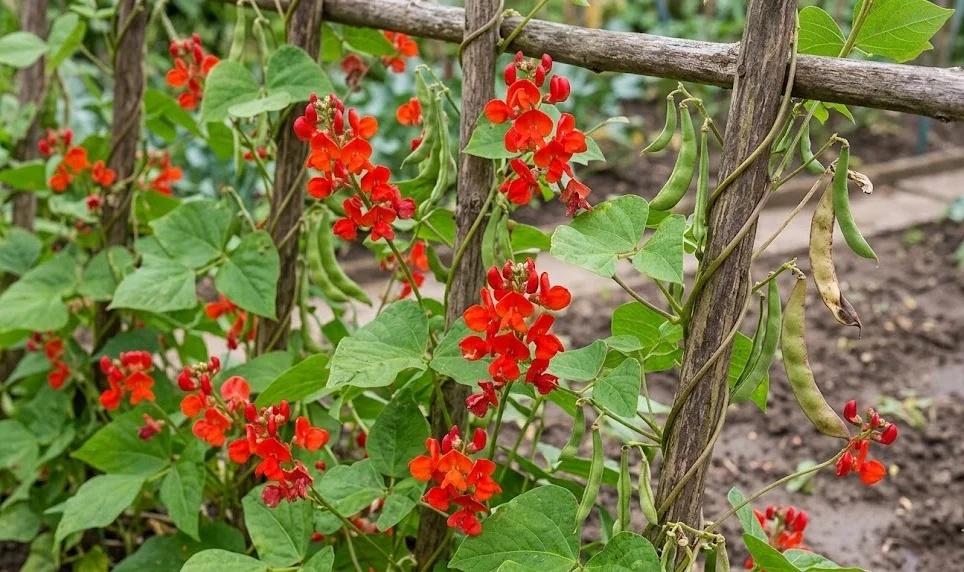

Watering and fertilizing scarlet runner beans correctly is essential because the plant grows fast, flowers heavily, and forms pods over a long period. The crop is not difficult, but it reacts quickly to drought, nutrient imbalance, and inconsistent care. Too little water can cause flower drop and tough pods, while too much nitrogen can produce leafy vines with disappointing yields. A balanced approach keeps the roots active, the foliage healthy, and the harvest steady.
Scarlet runner beans have a high demand for water during active growth. Their large leaves transpire heavily, especially on warm or windy days. Once the vines cover a support, they can dry out the soil faster than expected. Regular monitoring is therefore more useful than following a rigid calendar.
The plant needs the most reliable moisture during flowering and pod formation. Dry soil at this stage can interrupt pollination, cause flowers to shed, and reduce pod size. Even short drought periods can have visible effects when plants are carrying a heavy crop. Consistency is more important than occasional heavy watering after stress has already occurred.
Fertilization should support growth without pushing the plant into excessive foliage production. Beans can form beneficial relationships with nitrogen-fixing bacteria, but that does not eliminate the need for balanced soil fertility. The plant still requires potassium, phosphorus, magnesium, calcium, and trace elements. A thoughtful feeding program begins with soil health rather than quick fixes.
Understanding soil moisture needs
Scarlet runner beans prefer soil that remains evenly moist but never waterlogged. This balance can be difficult in heavy clay or very sandy soils. Clay may hold water too long after rain, while sandy soil can dry rapidly between irrigations. Improving soil structure with organic matter helps both situations.
More articles on this topic
The best way to judge watering need is to check the soil below the surface. The top layer may appear dry while the root zone is still moist, or it may look damp after light rain while deeper soil remains dry. A finger test or small trowel check is often more reliable than appearance alone. Plants should be watered before leaves begin to wilt.
Wilting can be misleading during hot afternoons. Large bean leaves may droop temporarily in heat even when soil moisture is adequate. If the plants recover in the evening, the issue may be heat stress rather than drought. If they remain limp or the soil is dry below the surface, watering is needed.
Mulch greatly improves moisture stability. Organic mulches reduce evaporation, limit weed competition, and protect soil structure from heavy rain. They also encourage biological activity near the soil surface. Mulch should be kept slightly away from the main stem to reduce the risk of rot.
Practical watering methods
Deep watering is better than frequent shallow sprinkling. When water reaches deeper soil layers, roots follow it downward and the plant becomes more resilient. Shallow watering encourages surface roots that dry quickly. A slow soak once or twice a week is often better than a light daily splash, although the exact frequency depends on soil and weather.
More articles on this topic
Watering at the base of the plant is the preferred method. Wet leaves increase the risk of fungal and bacterial diseases, particularly when air circulation is poor. Drip irrigation, porous hoses, or careful hand watering all work well. Overhead watering should be done in the morning if it cannot be avoided.
Container-grown scarlet runner beans need special attention. Large vines in pots use water rapidly and may require daily watering in warm weather. The container must have drainage holes, because standing water causes root problems. A large pot with moisture-retentive compost is far more forgiving than a small decorative container.
Rainfall should not be assumed to meet the plant’s needs. Dense foliage can shed rain away from the root zone, especially when plants are grown against walls or fences. After light rain, the soil near the roots may still be dry. Checking the soil prevents false confidence.
Fertilizing before and during growth
The best fertilizer program begins before planting. Compost or well-rotted organic matter should be added to improve soil structure and supply slow-release nutrients. This creates a steady foundation that supports both root growth and microbial activity. It also reduces the need for frequent corrective feeding later.
A balanced fertilizer can be used where soil fertility is low. The goal is to provide moderate nutrition rather than forcing rapid, lush growth. High-nitrogen lawn-type fertilizers are unsuitable because they can delay flowering and reduce pod production. Beans need enough nitrogen to grow, but not so much that foliage dominates.
Once plants begin flowering, potassium becomes especially valuable. Potassium supports flower quality, pod development, water regulation, and overall plant resilience. A fertilizer formulated for fruiting vegetables can be useful if the plants show signs of nutrient demand. It should be applied according to instructions rather than used heavily.
Liquid feeds can help container plants and beans growing in depleted soil. Because nutrients leach more quickly from pots, regular diluted feeding may be necessary. In open ground, feeding should be less frequent if the soil was well prepared. Observing plant color, growth rate, and flowering gives better guidance than feeding by habit.
Recognizing nutrient problems
Pale leaves may indicate nitrogen shortage, water stress, root damage, or poor soil conditions. It is important not to diagnose too quickly. Adding nitrogen to a waterlogged or compacted bed will not solve the underlying problem. The soil environment should be checked before fertilizer is applied.
Yellowing between leaf veins can suggest magnesium or other micronutrient issues. This is more likely in containers, very sandy soils, or soils with pH imbalance. However, older leaves naturally decline as plants age, so symptoms must be interpreted in context. A pattern across many leaves is more meaningful than one aging leaf.
Poor flowering may result from excess nitrogen, heat stress, inadequate light, or lack of pollinator activity. Fertilizer is only one part of the picture. If plants are lush and dark green but have few flowers, feeding should be reduced. More light, better spacing, and patience may be more helpful.
Weak pod development can be linked to water stress, low potassium, poor pollination, or extreme temperatures. A plant may flower well but still fail to set pods if conditions are unfavorable. Regular watering and pollinator-friendly planting can improve results. Fertilizer alone cannot compensate for environmental stress.
Seasonal adjustments and long-term soil care
Watering should change as the season progresses. Young plants need enough moisture to establish roots, while mature plants need more water to support foliage and pods. Late in the season, watering can be reduced if growth is slowing and rain is frequent. However, plants should not be allowed to suffer drought while still producing harvestable pods.
Fertilizer should also be adjusted according to growth stage. Early growth benefits from balanced fertility, while flowering and podding require support without excessive nitrogen. Heavy late feeding is rarely useful if temperatures are falling and daylight is declining. Overfeeding late in the season can produce soft growth vulnerable to disease.
After the crop finishes, the remains of healthy plants can contribute organic matter to the garden. Some gardeners leave roots in the soil so they can decompose naturally. This helps preserve soil structure and may return some nitrogen to the bed. Diseased material should be removed rather than incorporated.
Long-term success comes from building soil rather than chasing symptoms. Compost, rotation, cover crops, and careful watering all improve future crops. Scarlet runner beans fit well into a diverse vegetable rotation. When the soil is alive, well structured, and evenly moist, the plants respond with stronger growth and better harvests.