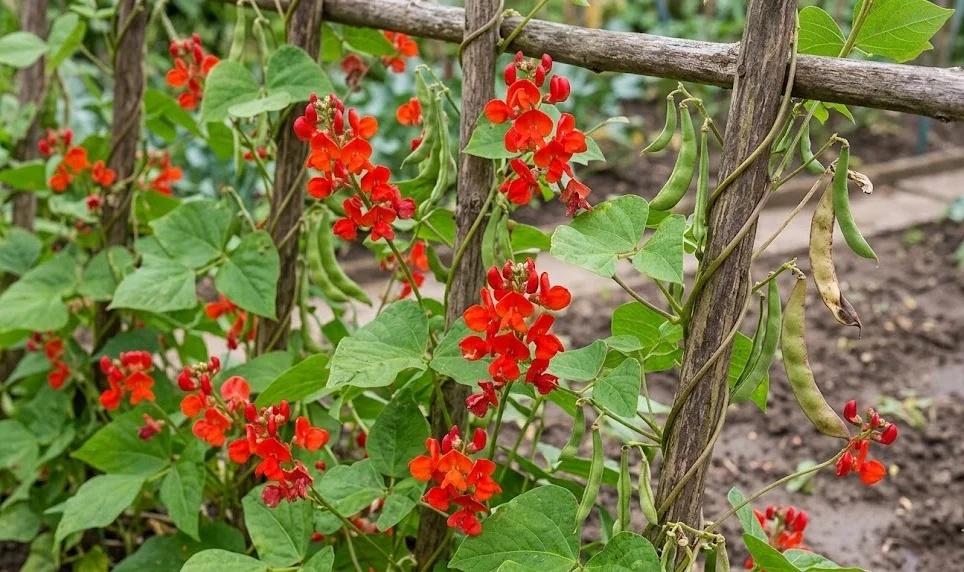

Planting scarlet runner beans well is the foundation of a vigorous, productive crop, because this fast-growing climber depends on warmth, soil preparation, spacing, and support from the earliest stage. Although the plant is forgiving once established, poor sowing conditions can delay germination, weaken seedlings, and reduce later flowering. Propagation is most commonly done from seed, which is simple, economical, and highly reliable when temperatures are suitable. With the right timing and technique, scarlet runner beans quickly become one of the most rewarding vertical crops in the garden.
Scarlet runner beans are usually grown from large, easy-to-handle seeds. Their size makes them suitable for direct sowing, indoor starting, and educational gardens where germination can be observed clearly. The seed contains enough stored energy to produce a strong seedling, but it still needs warmth and moisture to activate growth. Cold, wet soil is the main enemy during the earliest stage.
Timing depends on local climate and the risk of frost. Outdoor sowing should wait until the soil has warmed and the danger of hard frost has passed. In cooler regions, starting seeds indoors a few weeks before the last expected frost can give the plants a useful head start. However, seedlings should not be kept in small pots too long because root restriction can slow establishment.
The planting site should be prepared before seeds or seedlings are placed in the ground. Supports are best installed early so roots are not disturbed later. Compost should be incorporated before planting, and the soil should be watered if it is very dry. A well-prepared bed allows seedlings to transition quickly into active climbing growth.
Direct sowing outdoors
Direct sowing is the simplest method when soil temperatures are reliably mild. Seeds should be planted into loose, moist soil at a depth that protects them from drying out while still allowing easy emergence. In many garden soils, sowing several centimeters deep is appropriate. Heavy clay soils may require slightly shallower sowing to reduce the risk of rot.
More articles on this topic
Spacing matters because scarlet runner beans produce vigorous vines and dense foliage. Crowded plants compete for light, water, and nutrients, and they are more difficult to harvest. Along a trellis or row support, seeds can be spaced evenly so each plant has enough room to climb. If several seeds are sown around a pole, weaker seedlings can be thinned after emergence.
Seeds should be watered gently after sowing. The soil should remain evenly moist but not saturated. Overwatering in cool weather can cause seeds to rot before germination. A light mulch can be added once seedlings have emerged and the soil has warmed.
Protection may be needed against birds, rodents, slugs, and snails. Large bean seeds can be attractive to animals, especially in newly prepared beds. Fine mesh, cloches, or temporary covers can protect the area until seedlings are established. Covers should be removed or raised before the young plants become distorted.
Starting seeds indoors
Indoor sowing is useful in regions with short growing seasons or cool springs. Seeds can be started in individual pots, modules, or biodegradable containers that reduce root disturbance during transplanting. A free-draining seed compost is preferable to heavy garden soil. Warmth is more important than strong fertilizer at this stage.
More articles on this topic
Each seed should be sown with enough depth to remain moist during germination. The compost should be damp but not waterlogged. A warm windowsill, greenhouse, or propagator can speed germination. Once seedlings emerge, they need bright light to prevent weak, stretched growth.
Hardening off is essential before planting indoor-raised seedlings outside. Seedlings grown in protected conditions have tender leaves and stems that can be damaged by sun, wind, or cold nights. Gradual exposure over a week or more helps them adapt. This step reduces transplant shock and improves survival.
Transplanting should be done carefully because beans dislike root disturbance. The entire root ball should be moved intact into the prepared soil. Seedlings should be planted at the same depth they were growing in the pot, unless the stems are slightly leggy and need gentle support. Watering after planting helps settle soil around the roots.
Propagation by seed saving
Saving seed from scarlet runner beans is straightforward when healthy plants are selected. The best seed should come from vigorous plants that flowered well, resisted disease, and produced desirable pods. Saving seed from weak or diseased plants can carry problems into the next generation. Selection is a quiet but important part of garden-scale crop improvement.
Pods intended for seed should be left on the plant until they mature fully. The pods usually become larger, tougher, and eventually dry as the seeds harden inside. In wet autumns, pods may need to be harvested before complete outdoor drying and finished indoors. Good airflow during drying prevents mold.
Once dry, the pods can be shelled and the seeds inspected. Healthy seeds should be firm, well filled, and free from visible damage or mold. Any shriveled, cracked, or suspicious seeds should be discarded. Clean seeds store better and germinate more reliably.
Storage conditions determine whether saved seed remains viable. Seeds should be kept cool, dry, and dark in a labeled container. A paper envelope inside an airtight jar can work well if the seed is fully dry. Labels should include the variety, year, and any useful notes about plant performance.
Establishing young plants after planting
Young scarlet runner bean plants need gentle but consistent care after planting. They should be checked frequently during the first two weeks, because this is when losses from slugs, drought, wind, or cold are most likely. A small setback early in growth can delay climbing and flowering. Quick correction helps the plant recover before the season advances.
The first shoots may need guidance toward their support. Scarlet runner beans twine naturally, but they do not always find the correct direction immediately. A loose tie or careful placement against the cane can help. Once attached, the vine usually climbs strongly without further training.
Mulch can be applied after the soil is warm and seedlings are established. This helps conserve moisture and suppress weeds. Weeds should be removed carefully, because young bean roots are relatively shallow near the soil surface. Hand weeding is safer than deep hoeing close to the stems.
Early feeding should be modest. If the soil was well prepared with compost, additional fertilizer is rarely needed at planting time. Excess nitrogen at this stage can encourage leaves rather than roots and flowers. A steady, balanced start produces stronger plants than aggressive feeding.