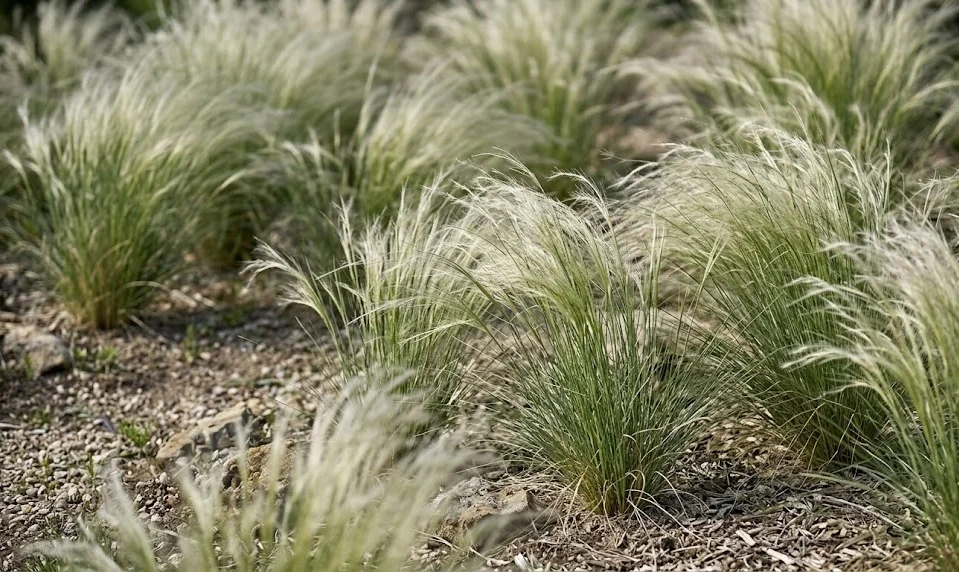

Mexican feather grass thrives when water and nutrients are supplied with restraint rather than abundance. Its natural elegance depends on lean growth, strong roots, and a dry, airy crown. Overwatering and overfertilizing are the two most common mistakes, especially in fertile garden beds or irrigated landscapes. A successful routine gives young plants enough support to establish, then gradually shifts toward low-input maintenance.
Water needs after planting
New plants need consistent moisture during the establishment period. This does not mean the soil should stay wet every day. Instead, water deeply, then wait until the upper layer begins to dry before watering again. Deep watering encourages roots to move outward and downward in search of moisture.
The first month after planting is the most sensitive stage. During this period, the root ball may dry faster than the surrounding soil, especially if the plant came from a peat-based nursery mix. Check both the native soil and the root ball before deciding whether to water. A dry root ball inside moist garden soil can still stress the plant.
Weather conditions should guide the schedule. In mild, cloudy weather, a newly planted grass may need only occasional watering. In hot, windy weather, it may need closer attention until roots anchor into the surrounding soil. Fixed calendar watering is less reliable than observing soil moisture and plant response.
Signs of insufficient water include curling foliage, dull color, and a clump that fails to regain freshness in the evening. However, similar symptoms can also appear when roots are damaged by wet soil. Always check the soil before assuming drought is the cause. Correct watering decisions begin below the surface, not with the foliage alone.
More articles on this topic
Watering established plants
Once established, Mexican feather grass is notably drought tolerant. In open ground, it often survives on rainfall except during extended dry periods. Its fine foliage loses less water than many broad-leaved ornamentals. This makes it valuable for low-water gardens and dry planting schemes.
Established plants should be watered deeply but infrequently when conditions are very dry. A thorough soak every so often is more useful than a daily sprinkle. Frequent shallow watering keeps roots near the surface and can weaken drought resilience. It may also encourage weeds around the crown.
During summer heat, some golden coloring is natural and should not automatically trigger watering. The plant’s seed heads and older leaves often mature into pale straw tones. This seasonal shift can be attractive and is part of its ornamental value. Water only when the soil is dry and the plant shows true stress.
In irrigated gardens, place Mexican feather grass away from plants that require constant moisture. Lawn sprinklers and high-frequency drip systems can keep the crown too damp. If irrigation is unavoidable, use separate zones so the grass receives less frequent watering. Matching irrigation to plant type prevents many long-term problems.
More articles on this topic
Container watering
Container plants require a different approach because pots dry faster than garden soil. Wind, sun, and container material all affect moisture loss. Terracotta pots dry quickly, while plastic or glazed containers retain moisture longer. The watering routine should respond to the pot and the weather.
Use containers with large drainage holes and a gritty potting mix. A beautiful pot without drainage is unsuitable for this grass. Water must be able to move freely through the root zone and exit the container. Standing water around the roots can cause rapid decline.
When watering, soak the pot until water runs from the bottom. This ensures the entire root ball is moistened rather than just the upper surface. Afterward, let the mix dry partly before watering again. Empty saucers after rain or irrigation so the base does not sit in water.
Container plants may need more frequent watering in midsummer, but they still dislike constant wetness. Lift the pot occasionally to learn how it feels when dry and when moist. This simple method helps prevent both drought stress and overwatering. The goal is a cycle of moisture and drying, not permanent saturation.
Fertilizer requirements in garden soil
Mexican feather grass is adapted to modest fertility. It rarely needs regular feeding in a typical garden bed. Rich feeding can produce soft growth that collapses under rain or wind. It can also reduce the refined, airy quality that makes the plant desirable.
If the soil is extremely poor, apply a light dose of slow-release balanced fertilizer in spring. Use less than you would for hungry flowering perennials. Scatter it around the root zone rather than piling it against the crown. Water afterward only if the soil is dry and the product requires activation.
Avoid high-nitrogen fertilizers. These products are designed to push lush leaf growth, which is not the aim for ornamental grasses of this type. Too much nitrogen can make the clump coarse, floppy, and short-lived. A compact, resilient plant is more valuable than rapid bulk.
In mixed borders, fertilizer applied to neighboring plants can drift into the grass’s root zone. Be mindful when feeding roses, vegetables, or heavy-blooming perennials nearby. Keep nutrient-rich amendments away from the base of Mexican feather grass. Lean conditions are not neglect; they are part of correct cultivation.
Organic amendments and nutrient balance
Compost can be useful, but it should be used thoughtfully. In sandy soils, a small amount of compost helps retain enough moisture for young roots. In heavy soils, too much compost may increase water retention and reduce air around the crown. The right amendment depends on the starting soil.
A thin top-dressing in spring can refresh the soil without overwhelming the plant. Keep it several centimeters away from the crown to prevent damp buildup. Fine gravel can be combined with modest organic matter in dry gardens. This maintains drainage while improving root-zone structure.
Do not use fresh manure around Mexican feather grass. It is too rich, too moisture-retentive, and can burn roots if not fully decomposed. Even well-rotted manure is usually unnecessary for this species. Save rich organic feeding for vegetables, fruiting crops, or demanding ornamentals.
Balanced nutrition shows in steady growth, fine foliage, and a clump that holds its shape. Poor nutrition is rarely the main problem unless the soil is extremely depleted. More often, weak growth comes from shade, wet soil, or overcrowding. Diagnose the growing conditions before reaching for fertilizer.