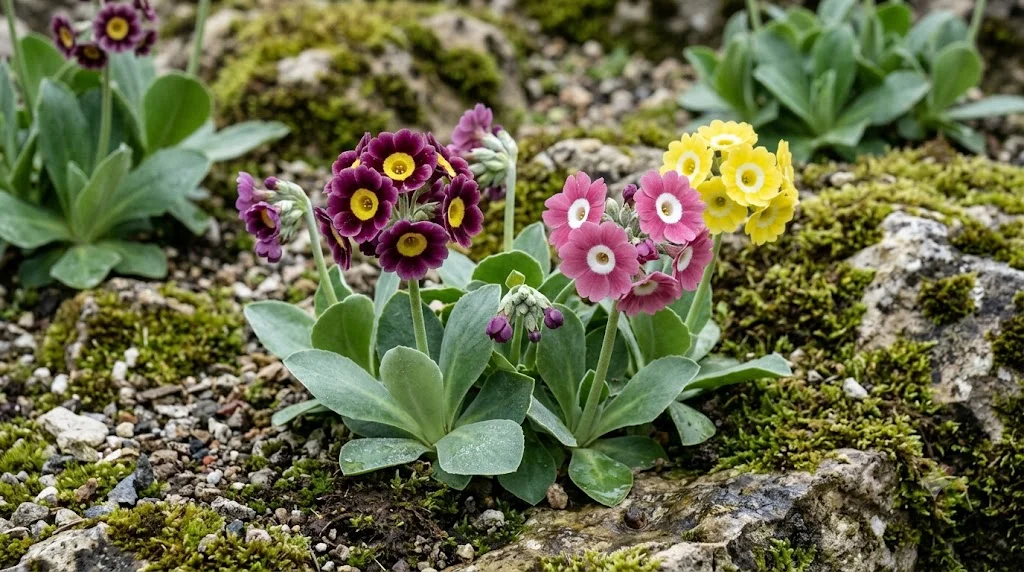

Watering and feeding auricula primrose require restraint because the plant suffers more readily from saturated compost than from brief, moderate dryness. Its fleshy roots need oxygen as well as moisture, and constantly wet conditions quickly reduce root health. The objective is to keep the root zone evenly moist during active growth while allowing slight drying between applications. Nutrients should be supplied in modest amounts that support compact leaves and strong flowers without encouraging soft growth.
The plant’s water use changes considerably during the year. Spring growth and flowering create the highest demand, while cool winter conditions require much less irrigation. Summer heat can dry containers quickly, yet heavy watering in hot, airless conditions may still cause root decline. Successful management therefore depends on observing the compost and plant rather than relying on a fixed calendar.
Water quality can also influence long-term performance. Very hard water may leave mineral deposits on leaves, pots, and the compost surface, especially when applied repeatedly from above. Rainwater is useful where it can be collected cleanly, although ordinary tap water is acceptable for most garden plants. Whatever source is used, the water should reach the roots without flooding the crown.
Fertiliser is most effective when the root system is healthy and actively growing. Feeding a stressed, waterlogged, newly divided, or dormant plant can worsen the problem instead of correcting it. Weak solutions applied at appropriate intervals are safer than concentrated doses. The appearance of the leaves and flowers should guide adjustments throughout the season.
Understanding seasonal watering needs
In early spring, increasing light and rising temperatures stimulate new leaves and flower stalks. Begin checking the compost more frequently as growth accelerates. Water when the upper layer has started to dry but moisture is still present deeper in the pot. Allow the container to drain completely after each application.
More articles on this topic
During flowering, irregular moisture can cause buds to abort or stems to weaken. The compost should not swing repeatedly between extreme dryness and saturation. Plants displayed beneath a roof need manual watering even when outdoor beds are receiving rain. Sheltered pots can dry unexpectedly because surrounding weather conditions create a false impression of available moisture.
After flowering, the plant continues producing roots and foliage, so it still requires regular attention. Water use may remain substantial during cool early summer weather. As temperatures rise, shade helps reduce stress and lowers the speed at which containers dry. Irrigation should be increased only when the compost genuinely loses moisture, not simply because the air feels hot.
In winter, growth slows and evaporation decreases sharply. Water sparingly around the edge of the pot when the compost is becoming dry below the surface. Avoid leaving containers standing in saucers of water during cold weather. A slightly dry plant usually tolerates frost better than one with saturated roots and a wet crown.
Applying water without damaging the plant
Water should be directed onto the compost rather than poured into the centre of the rosette. Moisture trapped between tightly packed leaves encourages spotting and crown rot. This is especially important for farinose cultivars because overhead watering can mark or remove their powdery coating. A narrow-spouted watering can provides useful control around small pots.
More articles on this topic
Apply enough water to moisten the full root zone rather than giving frequent superficial splashes. Shallow watering encourages roots to remain near the surface and can leave the lower compost dry. Once water begins draining from the holes, stop and allow the pot to empty. Discard any water that remains in a saucer after a short period.
Bottom watering can be useful for very dry pots, but containers should not be left soaking for extended periods. Place the pot in shallow water until moisture begins moving upward through the compost. Remove it before the surface becomes saturated and allow it to drain. This method should not become routine if it keeps the lower root zone continuously wet.
Watering is best carried out in the morning whenever possible. Foliage that is accidentally splashed then has time to dry before cool night temperatures arrive. Morning irrigation also prepares the plant for daytime evaporation and active growth. In very warm conditions, an additional check later in the day may be necessary for small containers.
Recognising incorrect watering
Overwatered auriculas may develop yellowing leaves, soft crowns, stalled growth, or a sour smell from the compost. The pot can remain unexpectedly heavy for several days after watering. Roots may turn dark and lose their firm structure as oxygen becomes limited. Immediate action should include reducing irrigation, improving drainage, and checking for decay.
Underwatered plants often lose firmness and develop leaves that droop around the edges. The compost may shrink away from the sides of the pot, allowing water to run through without wetting the root ball. Rehydrate severely dry compost gradually rather than flooding it once. A brief bottom soak followed by thorough drainage can restore even moisture.
Leaf-tip browning can result from inconsistent watering, high salt levels, hot wind, or root damage. It should not automatically trigger more frequent irrigation. Check the moisture below the surface and inspect drainage before changing the routine. The same visible symptom can have several different causes.
A moisture meter can provide additional information, but it should not replace direct observation. Readings vary with compost composition, mineral content, and probe position. Lifting the pot, touching the compost, and watching plant firmness provide valuable practical clues. Combining several indicators leads to more accurate decisions than following a single measurement.
Choosing and applying fertiliser
Auricula primrose requires moderate nutrition rather than rich feeding. A balanced liquid fertiliser diluted below the manufacturer’s standard strength is suitable during active spring growth. Products with very high nitrogen levels should be avoided because they promote soft, oversized leaves. Compact foliage and sturdy flower stems are more desirable than rapid expansion.
Begin feeding only after new growth is clearly underway. A weak application every few weeks is generally sufficient for container plants in fresh compost. Plants in fertile garden soil may need little additional feeding. Always apply liquid fertiliser to moist compost so concentrated salts do not damage dry roots.
As flower buds develop, a feed with slightly more potassium can support bloom quality. This should still be used at low concentration because auriculas are not heavy feeders. Excessive phosphorus and potassium do not compensate for poor light, weak roots, or unsuitable temperatures. Nutrition works effectively only when the wider growing conditions are balanced.
After flowering, one or two light feeds can support new roots and offsets. Feeding should then be reduced as summer heat or autumn cooling slows active growth. Do not continue fertilising through winter dormancy. Late feeding encourages soft tissue that is more susceptible to rot and cold damage.
Preventing salt buildup and nutrient imbalance
Repeated fertiliser applications can leave soluble salts in container compost. White crusting on the surface or around the pot rim is a visible warning. Root tips exposed to high salt concentrations may burn, reducing the plant’s ability to absorb water. Weak growth can therefore result from excessive feeding even when nutrients are abundant.
Occasional thorough watering helps flush accumulated salts from the compost. This should be done only when drainage is excellent and the plant is actively growing. Allow plenty of water to pass through the pot, then leave it to drain completely. Flushing is unsuitable during cold, damp winter weather when the compost will dry slowly.
Repotting replaces exhausted or salt-laden compost and allows direct inspection of the roots. Plants that have remained in the same container for several years may respond poorly to fertiliser because the physical structure of the mixture has deteriorated. Fresh compost often improves growth more effectively than increasing the feeding rate. Repot after flowering or during another cool period of active root development.
Nutrient deficiencies should be diagnosed carefully. Pale foliage may indicate low nitrogen, but it can also result from waterlogged roots, unsuitable pH, or excessive shade. Interveinal yellowing can reflect trace-element problems, although root health must still be checked first. Correcting the underlying growing conditions is more effective than repeatedly applying stronger fertiliser.