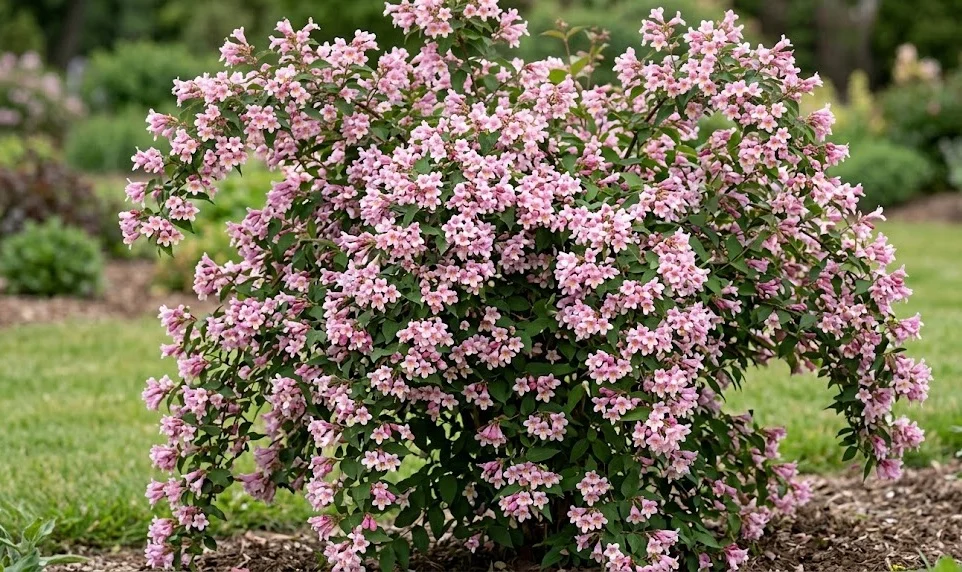

Planting beauty bush well is the foundation for decades of healthy growth and abundant spring flowering. This shrub is forgiving once established, but its early performance depends strongly on site selection, soil preparation, planting depth, and aftercare. Propagation is also practical for skilled home gardeners, especially through cuttings taken at the right stage of growth. With careful technique, beauty bush can be introduced into new borders, multiplied for informal hedges, or preserved from a valued older specimen.
Selecting the planting position
Beauty bush should be planted where it has enough room to develop a broad, arching framework. The mature size can surprise gardeners who place it too close to walls, fences, paths, or compact ornamental shrubs. A cramped position often leads to repeated hard pruning, which reduces flowering and spoils the plant’s natural habit. Planning for mature width from the beginning is the best way to avoid future conflict.
The ideal site receives full sun or light partial shade. Full sun promotes dense flowering and sturdy shoots in most climates. In very hot areas, a little afternoon shade can protect foliage from heat stress and reduce water demand. Too much shade, however, leads to fewer flowers and a loose, open crown.
Good drainage is essential, even though beauty bush is adaptable to different soil types. Roots can tolerate normal moisture fluctuations, but they do not perform well in permanently saturated ground. Heavy clay should be improved across a broad area rather than amended only in the planting hole. The shrub establishes more evenly when roots can move from the planting zone into the surrounding soil without encountering a sharp texture change.
Consider the plant’s visual role before digging. Beauty bush works well as a specimen shrub, a background plant in a mixed border, or part of an informal flowering screen. Its spring display is strongest when branches can be seen from a slight distance. A location that allows the arching stems to catch light will make the flowering effect more graceful and noticeable.
More articles on this topic
Preparing and planting correctly
Before planting, soak the root ball if it is dry. Container-grown shrubs often have peat-based growing media that can repel water when allowed to dry out. A properly moistened root ball helps the plant settle into the soil more quickly. It also reduces transplant shock during the first few weeks after planting.
The planting hole should be wider than the root ball but not unnecessarily deep. Beauty bush should be planted at the same depth it grew in the container or nursery field. Planting too deeply can bury the crown, limit oxygen around upper roots, and encourage stem problems. A wide, shallow preparation encourages roots to spread laterally into loosened soil.
If roots are circling inside the container, they should be teased out gently before planting. Dense circling roots may continue to grow around the root mass rather than expanding into the surrounding soil. Light scoring of a compacted root ball can help stimulate outward growth. The goal is not to destroy the root system, but to interrupt patterns that would restrict establishment.
After backfilling, the soil should be firmed gently to remove large air pockets. Heavy trampling is unnecessary and can compact the soil around young roots. Water thoroughly after planting so soil settles around the root ball. A light mulch layer can then be applied to conserve moisture while keeping the crown clear.
More articles on this topic
Establishment care after planting
The first growing season determines how strongly beauty bush settles into its new position. Regular watering is essential, especially during dry or windy weather. Water should be applied deeply so the root zone is moistened rather than only the surface. Shallow watering encourages weak surface roots and leaves the plant vulnerable during heat.
The shrub should not be heavily fertilized immediately after planting. Freshly disturbed roots need stable moisture and oxygen more than a strong nutrient push. Compost mixed lightly into the surrounding soil or used as a surface dressing is usually enough. If a fertilizer is used, it should be mild and applied according to soil conditions rather than guesswork.
Pruning at planting should be minimal unless there are broken, dead, or badly crossing stems. Cutting the shrub back severely can reduce its ability to photosynthesize and delay establishment. It can also remove the framework that would carry early flowers. Structural pruning is better saved until after the first flowering period or after the plant has regained vigor.
Weed control around the young shrub is important because weeds compete for water and nutrients. Mulch helps, but it should not be piled against the stems. Hand weeding is safer than deep cultivation, which can damage shallow roots. A clean, mulched root zone gives the young plant the best chance to establish evenly.
Propagation by cuttings and division alternatives
Softwood cuttings are one of the most useful methods for propagating beauty bush. They are usually taken in late spring or early summer when new shoots are flexible but not too tender. A cutting with several nodes should be prepared by removing lower leaves and keeping the upper leaves to support photosynthesis. The base can be dipped in rooting hormone to improve consistency, especially in less controlled conditions.
Cuttings root best in a free-draining, moisture-retentive propagation mix. A blend containing perlite, coarse sand, or fine bark can provide oxygen while holding enough moisture around the stem base. Humidity should be maintained, but the medium must not become waterlogged. Bright indirect light is preferable to harsh sun, which can dry cuttings before roots form.
Semi-ripe cuttings can also be taken later in the growing season when shoots have begun to firm. These cuttings may root more slowly than softwood cuttings, but they are often less prone to collapse. They should be placed in a protected environment where temperature and moisture remain steady. Patience is important, because woody shrubs do not always root as quickly as herbaceous plants.
Division is generally not the preferred method for beauty bush because it grows as a woody shrub rather than a clump-forming perennial. Layering can be more practical if a low branch can be bent to the soil and pinned in place. Over time, the buried section may form roots while still attached to the parent plant. Once rooted strongly, it can be separated and transplanted as a young shrub.