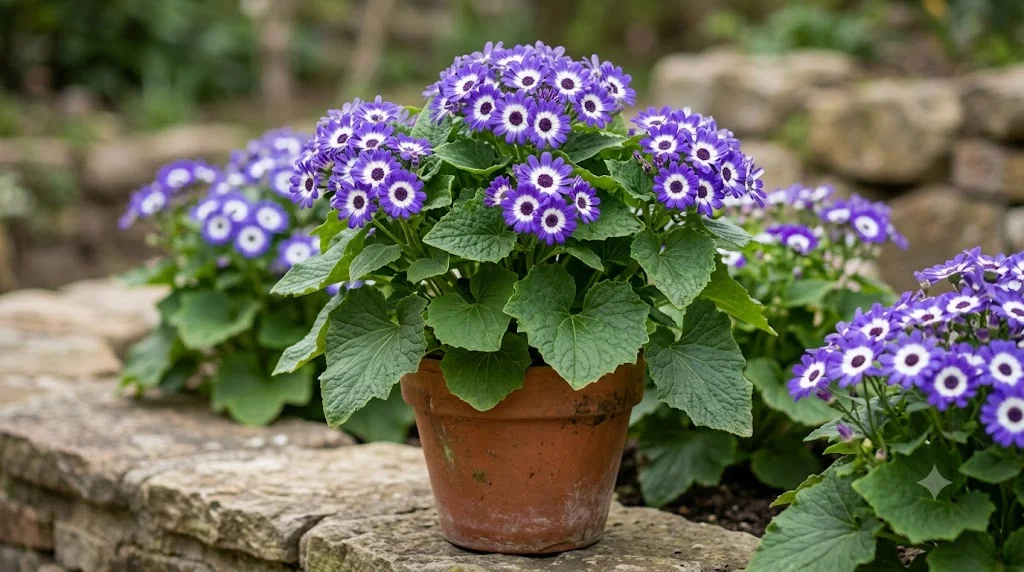

Dense foliage, moist compost, and cool growing conditions make cineraria vulnerable to several fungal diseases and sap-feeding pests. Problems often become serious because early symptoms remain hidden beneath the leaves. Regular inspection, careful watering, and adequate air movement provide the strongest protection. When treatment is needed, early and accurate identification prevents unnecessary damage to the plant.
Preventing disease through good cultivation
Healthy cineraria plants are better able to tolerate minor pest and disease pressure. Provide bright filtered light, cool temperatures, and an evenly moist but aerated root environment. Weak plants growing in heat or deep shade produce soft tissue that is easily attacked. Good cultivation is therefore the first stage of pest and disease management.
Space plants so that air can circulate between their leaves. Crowded foliage remains damp for longer after watering and creates favourable conditions for fungal spores. Remove dead petals and yellow leaves before they begin to decay. Clean plant debris should not be left on the compost surface.
Water the compost directly and avoid pouring water over the canopy. Wet leaves are especially vulnerable when temperatures are cool and air movement is limited. Morning watering is preferable because accidental splashes can dry during the day. Evening watering should be performed carefully and only when necessary.
Use clean pots, tools, trays, and propagation media. Pathogens can survive on previously used equipment or in old compost. Disinfect cutting tools after removing diseased material. Never reuse heavily infected potting medium for new plants.
More articles on this topic
Grey mould and other foliar diseases
Grey mould is one of the most common diseases affecting cineraria. It appears as brown, soft patches that may become covered with grey, dusty fungal growth. Spent flowers and damaged leaves are often infected first. The disease spreads rapidly in cool, humid, poorly ventilated conditions.
Remove affected flowers and leaves as soon as symptoms appear. Place the material directly into a bag rather than carrying it over healthy plants. Improve ventilation and reduce unnecessary leaf wetness. Severely infected plants should be isolated to limit the movement of spores.
Powdery mildew may appear as a pale, flour-like coating on leaf surfaces. Unlike many other fungi, it can develop even when leaves are not visibly wet. Crowding, fluctuating humidity, and poor air circulation favour its establishment. Infected tissue may become distorted, yellow, or prematurely dry.
Leaf spots can have fungal or bacterial causes and may look similar during early development. Circular brown areas, dark margins, or water-soaked lesions should be treated seriously. Avoid overhead watering and remove affected leaves with clean tools. When symptoms spread despite improved care, a product approved for ornamental plants may be required.
More articles on this topic
Root and crown rots
Root rot usually begins when the compost remains saturated for too long. Damaged roots become brown or black, lose firmness, and may develop an unpleasant smell. The foliage often wilts even though the growing medium is wet. Yellowing and collapse follow as the root system loses its ability to supply the plant.
Remove the plant from its pot and inspect the roots when rot is suspected. Trim away soft tissue using a sterile tool, provided that enough healthy roots remain. Repot into fresh, open compost and a clean container with reliable drainage. Water cautiously until new root activity becomes evident.
Crown rot affects the central area where the leaves and stems emerge. It is encouraged by deep planting, water trapped around the leaf bases, and contaminated compost. Dark, soft tissue at the crown is a serious symptom. Once decay has spread through the central growing point, recovery is unlikely.
Prevent root and crown diseases by planting at the correct depth and emptying saucers after watering. Do not apply water when the compost is already wet. Cool temperatures reduce evaporation, so irrigation may be needed less frequently than expected. The root environment should remain moist but never stagnant.
Aphids, whiteflies, and spider mites
Aphids cluster around soft shoots, buds, and the undersides of young leaves. They remove sap and may cause curling, distortion, and sticky honeydew deposits. Black sooty mould can grow on this honeydew, making the foliage appear dirty. Ant activity around a plant can also indicate an aphid infestation.
Small aphid colonies can often be removed by wiping or rinsing affected areas carefully. Heavily infested shoots may be cut away when this does not destroy the plant’s shape. Insecticidal soap or another product approved for ornamental plants can be applied according to its label. Thorough coverage is important because hidden insects can quickly rebuild the population.
Whiteflies rise in a small cloud when an infested plant is disturbed. Their pale immature stages remain attached to the underside of leaves and are easily overlooked. Like aphids, they produce honeydew and weaken the plant through sap removal. Yellow sticky traps can help reveal adult activity but rarely control an established infestation alone.
Spider mites are favoured by warm, dry air and may become troublesome when cineraria is kept near heating. Early symptoms include fine pale stippling and a dull appearance to the leaves. Fine webbing develops when populations become large. Isolate the plant, improve humidity appropriately, and use a suitable miticide or soap treatment when necessary.
Integrated control and recovery
Isolate a newly purchased plant for a short observation period before placing it among established plants. This reduces the chance of introducing pests to an indoor collection. Inspect both leaf surfaces, flower stems, and the crown. Even a healthy-looking plant may carry a small hidden population.
Begin with the least disruptive effective control method. Physical removal and improved growing conditions may be enough for a minor problem. More extensive infestations can require repeated applications of an approved treatment. A single spray rarely reaches every insect, egg, or sheltered leaf surface.
Always test a treatment on a small part of the plant when label guidance permits. Cineraria leaves can be sensitive to oils, soaps, and concentrated sprays. Apply products away from strong sunlight and extreme temperatures. Follow all stated intervals, dilution rates, and safety instructions.
After control measures, continue inspecting the plant for several weeks. New growth should emerge without distortion, and pest numbers should steadily decline. Remove leaves that cannot recover, but avoid stripping the plant unnecessarily. Recovery depends on preserving enough healthy foliage while correcting the conditions that allowed the problem to develop.