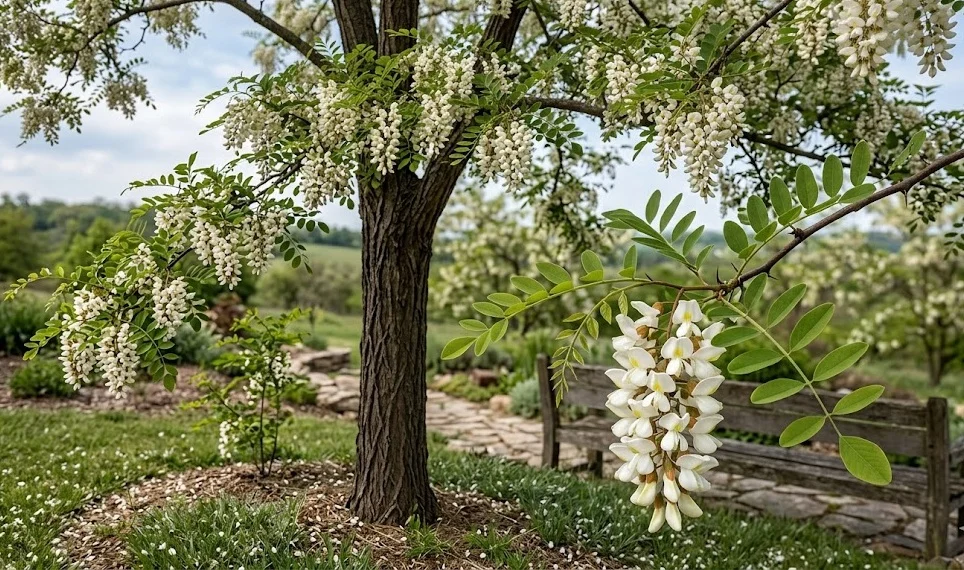

Formative pruning is the most critical stage of maintenance, taking place during the first few years of a black locust’s life. The primary goal is to establish a strong central leader and a well-balanced framework of scaffold branches. By making small, strategic cuts now, you prevent major structural failures and expensive repairs in the future. It is much easier and safer to prune a young sapling than a massive, mature tree.
You should look for branches that are growing at sharp angles to the main trunk, as these are often weak points. These narrow “V-shaped” crotches are prone to splitting under the weight of snow or high winds. Removing these early encourages the tree to develop wider, stronger branch attachments that can handle much more stress. Aim for a “U-shaped” connection between the branches and the trunk for maximum structural integrity.
Another important part of formative pruning is the removal of any competing leaders that might try to take over. A black locust should ideally have one clear, vertical trunk that reaches toward the sky. If two or more stems are fighting for dominance, the tree’s energy is divided and the structure becomes unstable. Select the straightest and strongest stem to be the leader and prune back the others to a side branch.
Lower branches should also be removed gradually over several years to lift the canopy and provide clearance. This is especially important if the tree is located near a walkway, a road, or a building. Do not remove too many lower branches at once, as the leaves on these limbs provide energy for trunk thickening. A good rule of thumb is to ensure that at least two-thirds of the tree’s height is covered in living branches.
Structural maintenance
As the tree matures, the focus of pruning shifts from shaping to maintaining health and safety. Regular inspections will reveal dead, damaged, or diseased wood that should be removed as soon as possible. Dead branches are not only unsightly but can also become a hazard if they fall during a storm. They also provide a gateway for wood-rotting fungi to enter the main trunk of the tree.
More articles on this topic
Thinning the canopy is another useful maintenance technique that allows more light and air to pass through the tree. An overly dense crown can act like a sail in the wind, increasing the risk of the tree being blown over. By strategically removing some of the inner branches, you reduce wind resistance and improve the health of the remaining foliage. This process also helps light reach the interior of the tree, preventing the inner branches from dying off.
You should also keep an eye out for branches that are rubbing against each other or growing back toward the center of the tree. Rubbing creates wounds in the bark that never heal properly and can eventually lead to rot or pest infestations. Removing the less desirable of the two rubbing branches will solve the problem and improve the overall appearance. Pruning for clarity and space ensures that every part of the tree has the room it needs to thrive.
Large-scale structural pruning on mature trees is a task that often requires the skills of a professional arborist. Working at heights with heavy equipment is dangerous and requires specialized knowledge of tree biology and physics. A professional can identify hidden defects and make precise cuts that a typical gardener might miss. Investing in professional care every few years is a wise way to protect the value and safety of your large trees.
Rejuvenation techniques
The black locust is famous for its ability to sprout vigorously from the stump after being cut down, a process known as coppicing. This ancient technique has been used for centuries to produce a continuous supply of small-diameter wood for fuel and fencing. When a mature tree is cut back to the ground, it reacts by sending up dozens of new, fast-growing shoots. These shoots can grow several meters in a single season, fueled by the massive, established root system.
More articles on this topic
If you are using coppicing, you will need to thin out the new sprouts after the first or second year. Select the three or four strongest stems and remove the rest to allow them to develop into usable poles. This cycle can be repeated every few years, providing a sustainable source of durable wood for various farm and garden projects. It is an incredibly efficient way to manage a woodlot and take advantage of the tree’s natural resilience.
Pollarding is a similar technique where the branches are cut back to a certain height every few years rather than the whole tree being cut to the ground. This results in a “knobby” appearance at the ends of the main branches where the new growth emerges. Pollarding is often used in urban areas to keep large trees at a manageable size while still providing shade and greenery. It requires consistent commitment, as the tree will need to be pruned every one to three years to maintain the effect.
When performing heavy rejuvenation pruning, it is vital to use sharp, clean tools to ensure quick healing. Ragged cuts or torn bark can lead to infections that may kill the stump or the remaining branches. The best time for this type of work is in the late winter or early spring just before the buds begin to break. This timing allows the tree to use its stored energy to quickly cover the wounds with new growth.