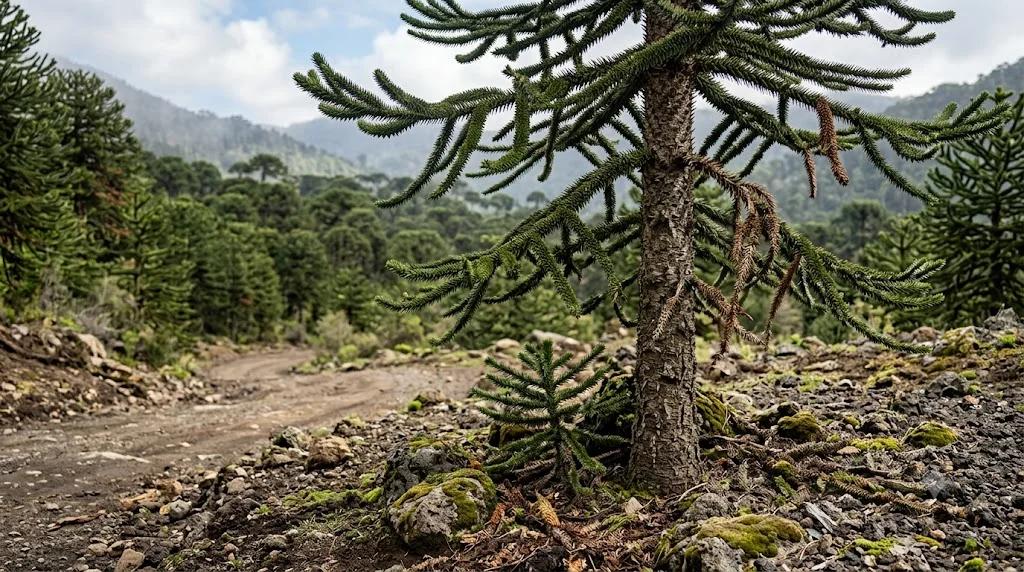

Balanced watering is one of the most important factors in maintaining a healthy monkey puzzle tree, especially during establishment. The tree prefers soil that remains moderately moist but still contains enough air for healthy root function. Feeding should be restrained and should support steady, firm growth rather than rapid, soft extension. Both irrigation and fertilisation must be adjusted to the soil, weather, plant age, and visible condition of the foliage.
Assessing the tree’s actual water needs
Water requirements are greatest during the first two or three growing seasons after planting. At this stage, the roots remain concentrated near the original root ball and cannot yet draw moisture from a large soil volume. The surface may look damp while the centre of the root ball is already drying. Checking the soil at several depths gives a more accurate picture than judging by appearance alone.
Established trees usually withstand short dry periods better because their roots extend more widely. However, tolerance of temporary dryness should not be confused with a preference for drought. Repeated moisture shortages can reduce shoot extension and cause progressive browning of exposed branches. Trees growing in thin, sandy, or compacted soils are especially vulnerable.
Local weather strongly influences irrigation frequency. Windy conditions can remove moisture rapidly even when temperatures are moderate. Hot sunshine, low humidity, and dry soil together create the greatest stress. Cloudy weather and cool nights reduce water loss, so a fixed calendar-based schedule may easily lead to overwatering.
Soil texture also changes how often irrigation is needed. Sandy soils drain quickly and generally require more frequent applications. Clay holds water longer but may become saturated and oxygen-poor after heavy watering. Loam provides a more forgiving balance, although even good soil can dry during prolonged summer heat.
More articles on this topic
Watering newly planted and young trees
Apply water slowly over the full root-zone area rather than directing a strong jet against the trunk. Slow irrigation allows moisture to penetrate instead of running across the surface. A temporary soil basin can be useful during the first season, provided it does not hold water continuously after rain. As roots spread, the watered area should be widened beyond the original planting hole.
Deep watering encourages roots to follow moisture into the surrounding soil. Shallow daily watering keeps only the upper layer damp and may promote a weak surface root system. The soil should be moistened thoroughly and then allowed to regain some aeration before the next application. It should never be allowed to become powder-dry around a recently planted tree.
Container-grown specimens require even closer monitoring because their roots cannot explore the surrounding ground. On warm days, a pot can dry much faster than garden soil. Water should drain freely from the base, and the container must not stand permanently in a full saucer. Large containers are more stable than small ones but still require regular checks.
Mulch helps protect young roots from rapid drying and extreme temperature changes. A layer of organic material also limits competition from weeds and turf. The mulch should remain loose and should not form a wet collar around the trunk. Its depth must be checked each year because repeated additions can gradually bury the root flare.
More articles on this topic
Adjusting irrigation through the seasons
In spring, increasing temperatures and new growth gradually raise the tree’s water demand. Natural rainfall may still be sufficient, but young trees should be checked during dry, windy periods. Watering is particularly valuable when the upper soil begins to dry before the deeper roots are fully active. Saturating cold spring soil unnecessarily can delay root recovery.
Summer is the most demanding season in many gardens. Irrigation should be applied early in the day or during the cooler evening period to reduce evaporation. Watering the soil is more effective than repeatedly spraying the foliage. Overhead irrigation may also leave water trapped among dense leaves, especially when air circulation is poor.
Autumn watering supports root activity and prepares the tree for winter. If rainfall is limited, a thorough irrigation before the ground becomes cold can reduce winter desiccation. The aim is to leave the soil moist, not waterlogged. Water demand falls as temperatures decline, so frequency should be reduced accordingly.
During winter, established outdoor trees normally rely on natural precipitation. Newly planted trees may still need water during unusually dry, mild periods when the soil is not frozen. Irrigation should never be applied onto frozen ground because it cannot penetrate effectively. Containers placed under roof overhangs must be checked because they may receive little natural rain.
Feeding without encouraging weak growth
Monkey puzzle trees generally need only modest fertilisation in reasonably fertile garden soil. Excess nitrogen can produce rapid extension that is soft, vulnerable to weather damage, and visually unbalanced. A slow, steady growth rate is more desirable than a sudden flush. Feeding should be based on plant performance and soil condition rather than routine enthusiasm.
A balanced, slow-release fertiliser can be applied in spring when growth begins. The product should be spread over the root zone according to its instructions and kept away from direct contact with the trunk. Watering after application helps move nutrients into the upper soil. Additional feeding later in the season is usually unnecessary in ordinary garden conditions.
Well-decomposed compost can provide a gentler source of nutrients while improving soil structure. It is best applied as a thin surface layer beneath the mulch rather than dug deeply around established roots. Fresh manure and highly concentrated organic products should not touch the root ball. These materials can release excessive salts, ammonia, or heat during decomposition.
Late-season feeding with nitrogen-rich products should be avoided in cool climates. New growth produced near autumn may not harden sufficiently before frost. Potassium and other nutrients contribute to normal plant function, but they should not be applied blindly in heavy doses. A soil analysis is more useful than guesswork when a persistent deficiency is suspected.
Diagnosing watering and nutrient problems
Drought stress often begins with dull foliage, browning tips, and reduced shoot growth. The symptoms may be most visible on the windward or sunniest side of the tree. Severe dryness can cause entire branch sections to decline. Before watering heavily, the soil should be checked to confirm that lack of moisture is genuinely the cause.
Waterlogging can produce surprisingly similar symptoms because damaged roots cannot supply the foliage. Yellowing, browning, weak growth, and branch dieback may all occur in saturated soil. A sour smell, persistent surface water, or blackened roots suggests inadequate aeration. Adding more fertiliser to a waterlogged tree will not solve the underlying problem.
Nutrient deficiencies may cause pale growth, reduced vigour, or abnormal foliage colour. However, these signs can also result from damaged roots, unsuitable soil pH, drought, or compaction. The entire growing environment should be assessed before applying corrective products. Laboratory soil testing can identify pH and nutrient imbalances when symptoms persist.
Fertiliser scorch commonly appears after excessive application or when concentrated feed is placed near dry roots. Foliage may brown rapidly, and salts can accumulate in container compost. Thorough leaching may help a container plant when drainage is good, but garden trees require careful moisture management and time. Prevention through accurate measurement is much safer than attempting to reverse severe salt injury.