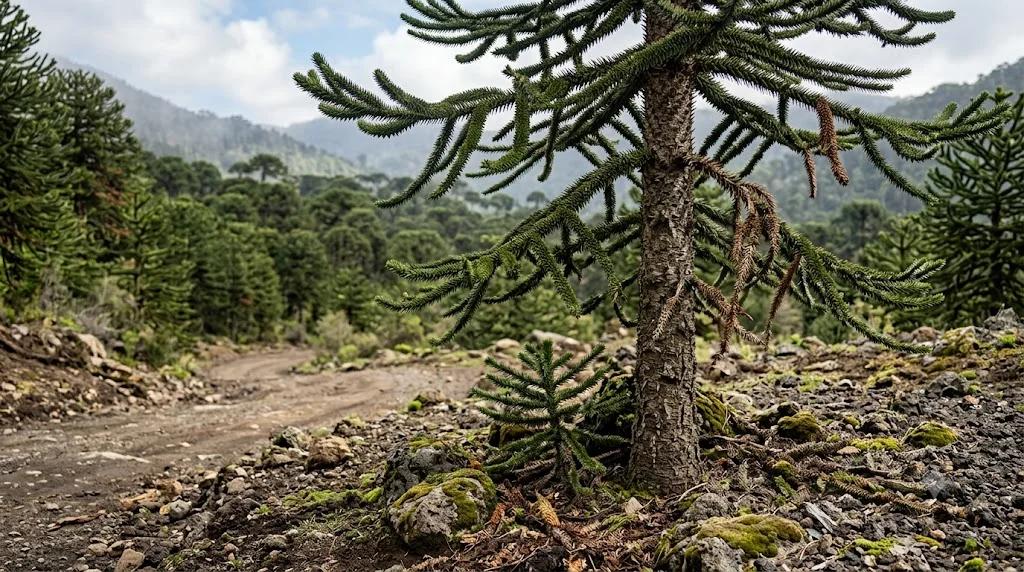

A monkey puzzle tree develops its strongest, most balanced crown when it receives abundant natural light. Full sun is generally preferred, particularly in cool or mild climates where summer heat is not extreme. Young plants can tolerate some light shade, but prolonged low light often produces weak, uneven, or sparse growth. The ideal position combines excellent brightness with protection from intense reflected heat and severely drying winds.
Choosing between full sun and partial shade
Full sun encourages compact growth and regular tiers of branches around the trunk. An open position also helps the central leader remain upright and dominant. Trees shaded from one side may gradually lean or develop a lopsided crown. This imbalance becomes more noticeable as the tree matures.
In cooler maritime climates, all-day sun is usually beneficial. Temperatures remain moderate, and the foliage can photosynthesise effectively without excessive heat stress. Reliable soil moisture is still necessary because evergreen foliage loses water throughout the growing season. Wind exposure may be more limiting than sunlight in such regions.
Partial shade can be helpful for newly planted trees in climates with hot summers. Light protection from the strongest afternoon sun may reduce dehydration while roots establish. The shade should remain open and bright rather than dense or permanent. Deep shade beneath mature trees creates competition as well as insufficient light.
A position near a south- or west-facing wall can become excessively hot in warm regions. Masonry stores and reflects heat onto the foliage, while nearby paving increases root-zone temperatures. Even a sun-loving conifer can suffer under these conditions. Greater distance from reflective surfaces and deeper mulching can moderate the environment.
More articles on this topic
Recognising insufficient or excessive exposure
A tree receiving too little light may produce extended, less compact growth. Branch tiers can become irregular as shoots reach toward the brightest opening. Lower branches may decline more quickly when they remain heavily shaded. The crown may also become thin on the side facing a building or dense vegetation.
Uneven light is often more problematic than mild overall shade. A tree planted close to a tall hedge may receive light only from one direction. As the crown expands, correcting the imbalance becomes increasingly difficult. Future growth of neighbouring plants should therefore be considered before choosing the site.
Excessive sun is rarely harmful by itself in a cool climate, but intense heat and drought can cause scorching. Foliage may bronze or brown on the most exposed side. Drying is often concentrated at branch tips or around the upper crown. Checking soil moisture helps distinguish heat stress from infectious disease.
Sudden exposure can also damage foliage. A young tree moved directly from a shaded nursery area into intense sun may experience temporary scorch. Gradual acclimatisation is particularly useful for container-grown plants. Increasing exposure over several weeks allows the foliage and roots to adjust.
More articles on this topic
Managing light in gardens and containers
Select a permanent outdoor position whenever possible because monkey puzzle trees eventually become too large to move. The site should provide open sky above the central leader. Overhanging branches from other trees may damage the leader and reduce light. Pruning neighbouring vegetation is often safer than repeatedly cutting the monkey puzzle tree.
Young container specimens can be rotated periodically to promote even exposure. Rotation should be gradual, especially when one side has remained shaded for a long time. The pot should stand where it receives bright outdoor light and good air movement. Indoor windows rarely provide suitable long-term conditions.
Greenhouse cultivation may protect seedlings, but intense sunlight can raise temperatures rapidly behind glass. Ventilation and light shading may be necessary during hot periods. Seedlings should not remain in soft, humid greenhouse conditions indefinitely. Gradual hardening prepares them for outdoor sun, wind, and temperature changes.
Winter light remains important because the tree is evergreen. A bright, sheltered outdoor position is preferable to a dark storage area. Temporary frost protection should not block light for extended periods. Any fleece or screen used during severe weather should be removed or opened when conditions improve.