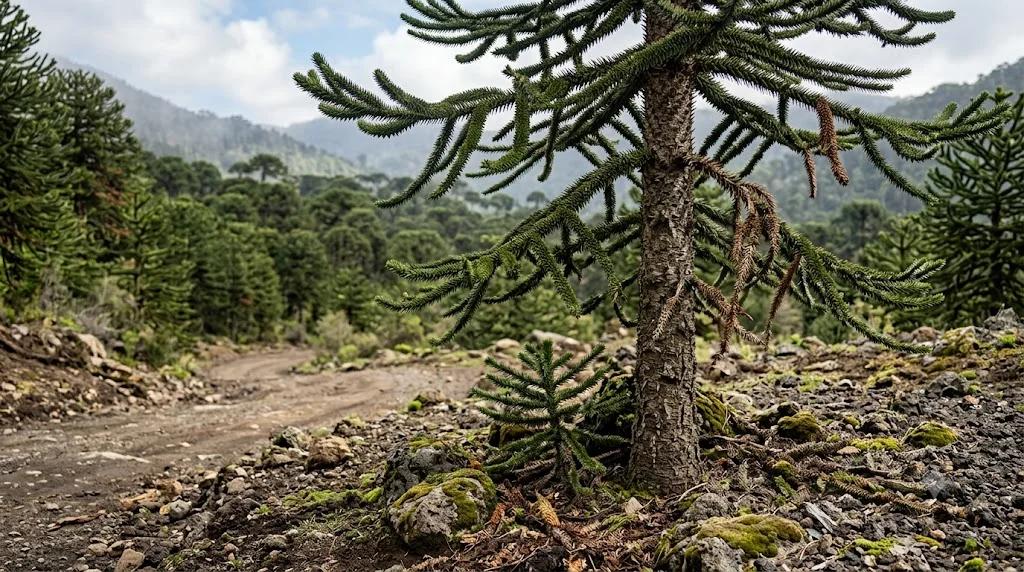

Planting a monkey puzzle tree is a long-term decision because a healthy specimen may remain in the garden for generations. Successful establishment depends on careful site selection, correct planting depth, gentle root handling, and dependable moisture during the first few years. Propagation is possible from seed, although the process requires patience and correctly handled fresh material. Vegetative methods are less reliable and may produce plants with an unsuitable growth habit if the cutting is taken from a side branch.
Preparing the site and planting hole
Choose a position that can accommodate the tree’s eventual height, broad lower branches, and sharply pointed foliage. The site should be open enough for the crown to develop evenly without repeated pruning. Keep the tree away from overhead cables, building foundations, narrow entrances, and heavily used paths. A generous distance from nearby trees also reduces future competition for light and soil moisture.
Before digging, examine how water moves through the site after heavy rain. A place where water remains for several days is unsuitable unless drainage can be improved over a much wider area. Digging a planting hole and filling it with loose material will not solve a surrounding drainage problem. In some gardens, planting on a broad, gently raised mound is safer than placing the root ball below the natural soil level.
The planting hole should be wider than the root ball but no deeper than necessary. A broad hole encourages roots to spread into loosened surrounding soil. The base should remain firm so that the tree does not sink after watering. Glazed sides created by a spade in wet clay should be roughened to help roots penetrate beyond the hole.
Large quantities of rich compost should not be packed into the planting hole. A sharp contrast between the amended hole and the native soil can discourage roots from growing outward. The excavated soil may be improved lightly with well-decomposed organic matter when it is extremely poor. Structural drainage problems must be corrected separately rather than hidden beneath organic amendments.
More articles on this topic
Planting the tree correctly
Container-grown monkey puzzle trees can be planted during mild conditions when the soil is workable. Spring is often preferred in colder regions because the roots then have a full growing season to establish. Autumn planting can succeed in mild, moist climates where the soil does not freeze deeply. Planting during heatwaves, drought, or waterlogged conditions should be avoided.
Water the container thoroughly before removing the tree. Support the root ball carefully and avoid pulling the plant by its trunk or branches. If roots circle densely around the pot, loosen only the outermost roots with minimal disturbance. Severe root cutting can slow establishment and increase the risk of moisture stress.
Place the tree so that the top of the root ball is level with, or slightly above, the surrounding soil. Check the tree from several directions to ensure that the trunk is upright. Backfill in stages, gently firming the soil by hand to remove large air pockets. Heavy stamping should be avoided because it can compact the soil and damage fine roots.
Water deeply immediately after planting, even when the soil already feels damp. This settles loose soil around the roots and reveals whether the tree remains stable. Apply a broad layer of organic mulch while leaving a clear gap around the trunk. Where staking is necessary, install the support without driving it through the root ball.
More articles on this topic
Propagating monkey puzzle trees from seed
Seed propagation is the most practical way to produce naturally shaped monkey puzzle trees. Seed quality is crucial because viability declines when seeds are stored badly or allowed to dry excessively. Fresh, plump seeds from a reliable source usually offer the best results. Since the species has separate male and female trees, seeds are produced only when a mature female tree has received viable pollen.
Seeds can be sown individually in deep pots that provide room for the developing root. A free-draining mixture containing quality seed compost and coarse mineral material helps maintain both moisture and aeration. The seed is often positioned with the pointed end angled downward or partly inserted into the medium. It should not be buried so deeply that prolonged wetness causes decay.
Maintain cool to mild temperatures and keep the compost evenly moist. Excessive warmth combined with saturation encourages fungal problems, while dry compost can stop germination. Germination time varies, and some seeds develop more slowly than others. Pots should be protected from rodents, birds, and slugs, which may damage the nutritious seeds or young shoots.
Seedlings produce a strong root system early and should not remain crowded in shallow containers. Transplanting must be done before the roots become badly restricted or tangled. Handle seedlings by the potting medium or lower stem rather than by the delicate growing tip. Young plants require bright light, shelter from severe frost, and careful moisture management.
Understanding the limitations of cutting propagation
Cuttings are considerably more difficult than seeds and are not normally the preferred method for home propagation. Material taken from horizontal side branches may continue to grow sideways rather than developing a normal upright trunk. This tendency is related to the original orientation and growth function of the shoot. A rooted side cutting may therefore remain irregular even when it appears healthy.
Suitable cutting material must come from an upright leading shoot if a normal tree form is required. Removing such material from a young plant can ruin the shape of the parent specimen. Mature trees may also be difficult or unsafe to access. For these reasons, specialist nurseries generally use carefully selected propagation material and controlled conditions.
Cuttings need high humidity, clean tools, a sterile, airy rooting medium, and stable temperatures. Even under suitable conditions, rooting can be slow and losses may be high. Excess moisture causes basal decay, while low humidity leads to rapid dehydration. Rooting hormones may assist callus and root formation but cannot compensate for unsuitable cutting material.
Gardeners who want several well-formed trees usually achieve better results with fresh seed or nursery-grown seedlings. Seed-raised plants also preserve the species’ natural central-leader habit more reliably. The disadvantage is that seedlings take time to reach a substantial size and their sex remains unknown until maturity. Patience is therefore an essential part of propagating this remarkable conifer.