Pruning and cutting back a monkey puzzle tree

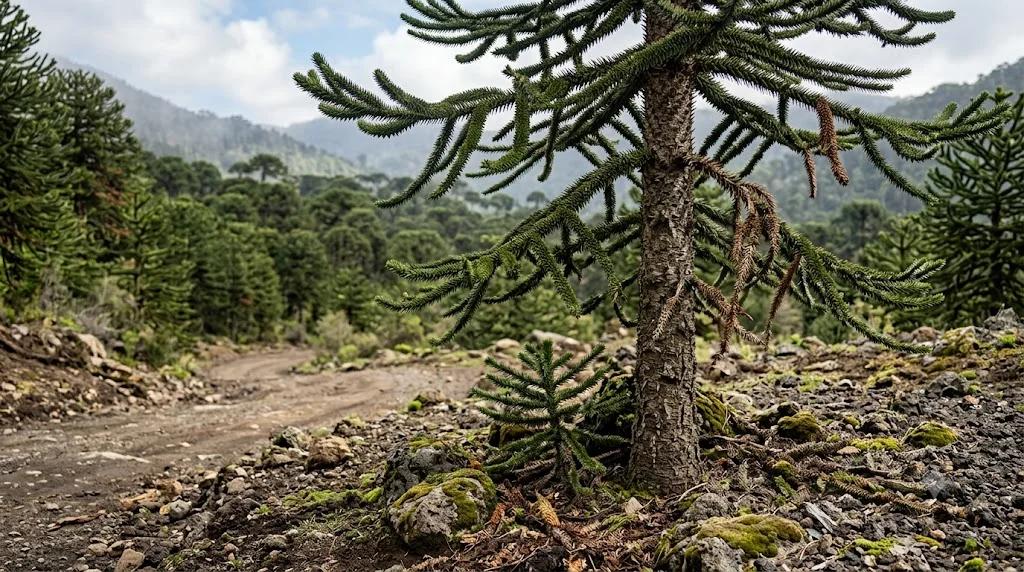
A monkey puzzle tree naturally forms a strong central trunk and regular tiers of branches, so it usually needs very little pruning. Unnecessary cutting can permanently alter its architectural shape and create wounds that heal slowly. Pruning should therefore be limited to dead, broken, dangerous, or clearly diseased material. The central leader and healthy branch tiers should be preserved whenever possible.
Understanding what should and should not be pruned
The central leader is the most important shoot on the tree. It controls height growth and maintains the characteristic single-trunk form. Cutting it can stimulate several competing upright shoots and create a distorted crown. The leader should only be treated when it has been severely damaged and corrective work is unavoidable.
Healthy lower branches should not be removed merely to create a cleaner trunk. They contribute to the natural shape of young and middle-aged trees. Removing them exposes the trunk suddenly and may reduce the tree’s visual balance. Branches also do not regenerate readily from old bare wood.
Dead branches can be removed when their condition is certain. A dead shoot is usually dry, discoloured, and lacking healthy tissue beneath the bark. Care must be taken because old foliage remains extremely sharp. Thick gloves, eye protection, and stable access equipment are essential.
Broken branches should be cut back cleanly to an appropriate branch junction or collar. Ragged stubs collect moisture and may decay. Cuts should not be made flush against the trunk because the branch collar supports natural wound closure. Large branches require professional handling to prevent bark tearing and personal injury.
More articles on this topic
Timing and technique for safe pruning
Light corrective pruning is usually best carried out during a dry period when active growth is not under severe stress. Wet conditions increase the chance of contaminants being transferred by tools. Extremely cold weather should also be avoided because frozen branches are brittle. Work during very hot, dry periods can place additional strain on the tree.
Tools must be sharp enough to make a clean cut. Secateurs may be suitable for small dead shoots, while larger branches require a pruning saw. Blades should be cleaned before use and between diseased areas. Crushing or splitting the tissue creates a larger wound and slows recovery.
The foliage points outward in every direction and can penetrate ordinary clothing. Approach branches slowly and plan each movement before cutting. Ladders should not be rested insecurely against flexible limbs. Mature tree work is best left to trained arborists with suitable protective equipment.
Wound paints and sealants are generally unnecessary for ordinary pruning cuts. They can trap moisture or interfere with natural drying. A correctly placed clean cut is more important than coating the surface. If a serious disease is present, treatment decisions should follow a reliable diagnosis.
More articles on this topic
Correcting damage without destroying the natural form
Storms, heavy snow, or accidental impact may break the leader of a young tree. Several shoots may then turn upward and compete to replace it. One well-positioned shoot can sometimes be selected as the new leader. Competing shoots should be managed gradually rather than removed aggressively all at once.
A replacement leader may need gentle support while it becomes vertical. Soft ties can attach it to a temporary cane without constricting the shoot. The support should be checked frequently and removed once the leader is stable. Tight wire or rigid bindings can cut into the bark.
Trees that have become too large for their site cannot be kept permanently small through routine topping. Cutting back major limbs destroys the tiered form and can leave large, poorly closing wounds. It may also encourage unstable replacement growth. Proper site selection is the only dependable way to accommodate mature size.
Where a mature tree creates a genuine safety or structural conflict, professional assessment is necessary. Selective branch removal may reduce a specific hazard, but drastic reduction is rarely aesthetically or biologically successful. In some cases, removal and replacement with a more suitable species is safer than repeated severe pruning. Decisions should consider the tree’s health, location, heritage value, and long-term stability.