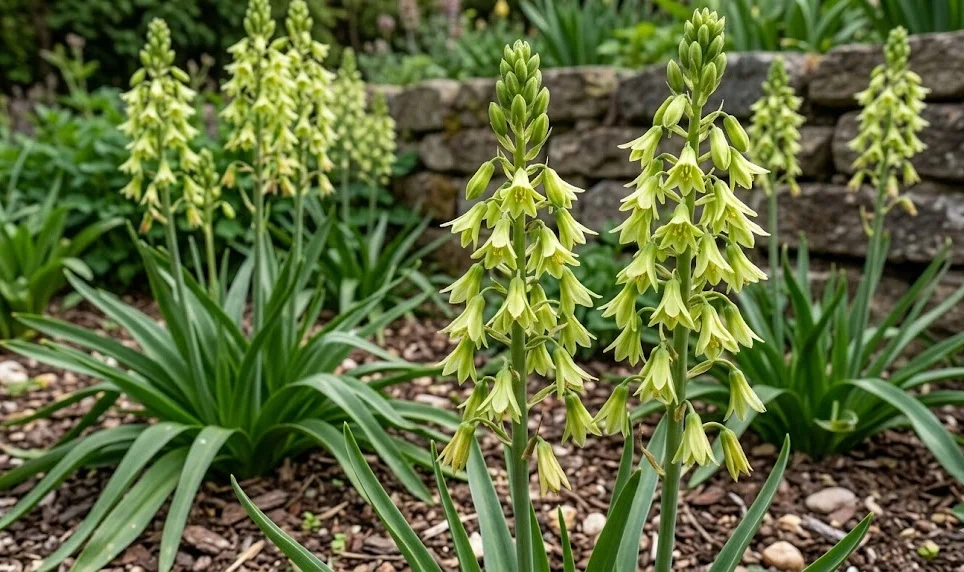

Overwintering green-flowered giant chincherinchee requires protection from frost, careful moisture control, and an understanding of whether the plant is actively growing or resting. In many climates, the safest approach is to cultivate it in a movable container and keep it in a bright, frost-free place during its growth period. Cold alone can damage tender tissues, but cold combined with wet compost is even more dangerous. Successful winter care therefore balances suitable temperature, ample light, ventilation, and restrained watering.
The plant’s winter behaviour depends partly on its seasonal rhythm and the conditions under which it has been grown. Some specimens begin active growth as temperatures cool, while others remain dormant for longer. Visible growth should guide care more than the calendar. A bulb producing leaves needs different treatment from a fully dormant one.
Before cold weather arrives, inspect the bulb, leaves, and compost for pests or disease. Problems are harder to manage in enclosed winter quarters where plants are grouped closely. Remove dead material and clean the outside of the pot. Do not repot unnecessarily unless drainage has failed or rot is suspected.
Choose the winter location before night temperatures become dangerous. Sudden frost can damage leaves and flower buds in a single evening. Moving plants early also allows them to adapt gradually to lower indoor light levels. Avoid repeatedly transferring them between warm rooms and cold outdoor conditions.
Overwintering actively growing plants
An actively growing plant needs the brightest available frost-free position. A cool greenhouse, conservatory, or bright enclosed porch is usually ideal. Warm living rooms often provide insufficient light relative to their temperature. This imbalance causes weak, elongated foliage and increases pest susceptibility.
More articles on this topic
Maintain temperatures that are cool but safely above freezing. Brief exposure to near-freezing conditions may injure soft leaves even if the bulb survives. A stable environment is preferable to strong daytime heating followed by very cold nights. Place a minimum-maximum thermometer nearby to monitor fluctuations.
Water only when the upper compost has begun to dry. Evaporation is slower in winter, so intervals may be much longer than during warm weather. Morning watering allows excess surface moisture to disperse before night. Keep water out of the central crown and empty saucers immediately.
Ventilation remains important on mild days. Open vents or windows briefly when conditions permit, but avoid exposing the plant to icy draughts. Moving air discourages grey mould and helps the compost dry evenly. Do not crowd the pot among dense evergreen foliage.
Storing dormant bulbs
A fully dormant bulb can be kept much drier than an actively growing specimen. The leaves should be allowed to yellow naturally before they are removed. Once the foliage is dry, routine watering can stop. The container should then be protected from rainfall and accidental irrigation.
More articles on this topic
Dormant pots may be stored in a dry, ventilated shed, greenhouse, or frost-free utility area. Complete darkness is acceptable only while no growth is present. Check regularly for emerging shoots, because new growth requires immediate access to light. Delayed detection can produce pale, stretched leaves.
The bulb can remain in its pot during storage if the compost is clean and free draining. Lifting is useful when the medium has become compacted or pests are suspected. Bare bulbs should be kept dry and cushioned to prevent bruising. They should never be sealed in airtight plastic, which traps moisture and encourages rot.
Inspect stored bulbs every few weeks. Healthy bulbs remain firm, while extensive softening or darkening requires attention. Minor shrivelling may be corrected later when growth resumes. Unnecessary winter watering is more dangerous than slight moisture loss in a mature dormant bulb.
Managing light and humidity indoors
Winter light is often the limiting factor for actively growing plants. Place the pot close to a bright window without pressing leaves against cold glass. Clean glazing improves light transmission during short days. Artificial grow lighting may be useful where natural light is consistently weak.
Rotate the pot modestly while only leaves are developing. This helps maintain balanced growth and prevents strong leaning. Once a flower spike forms, avoid frequent rotation because the stem may twist toward changing light. A stable orientation supports straighter flowering.
High humidity combined with cool temperatures creates favourable conditions for fungal disease. Space plants so air can circulate between their leaves. Avoid misting, as the species does not require wet foliage. Humidity should be managed through ventilation rather than spraying.
Very dry heated air can also cause problems, particularly for actively growing leaves. Brown tips may appear when roots dry too quickly or the plant is placed near a radiator. Move the pot away from direct heat sources. A cool bright position usually provides a more suitable balance than a hot room.
Returning plants to outdoor conditions
Do not move the plant outdoors merely because daytime temperatures feel mild. Night temperatures may still fall low enough to cause damage. Wait until the risk of frost has passed and conditions are reliably stable. Harden the plant gradually rather than exposing it abruptly.
Begin by placing the pot outdoors in bright shade for part of the day. Increase exposure to morning sun over one or two weeks. Foliage grown behind glass is sensitive to sudden ultraviolet intensity. Gradual acclimatisation prevents bleaching and dry scorch patches.
Continue to monitor rainfall after the move. Spring storms can saturate a container that was previously watered under controlled conditions. Place the pot beneath cover if prolonged rain is expected. Free drainage remains essential even after frost danger has ended.
Outdoor placement should match the plant’s growth stage. A specimen approaching dormancy needs protection from repeated summer rain rather than increased irrigation. An actively growing plant requires light and moderate moisture. Observing the leaves ensures that seasonal care remains appropriate.