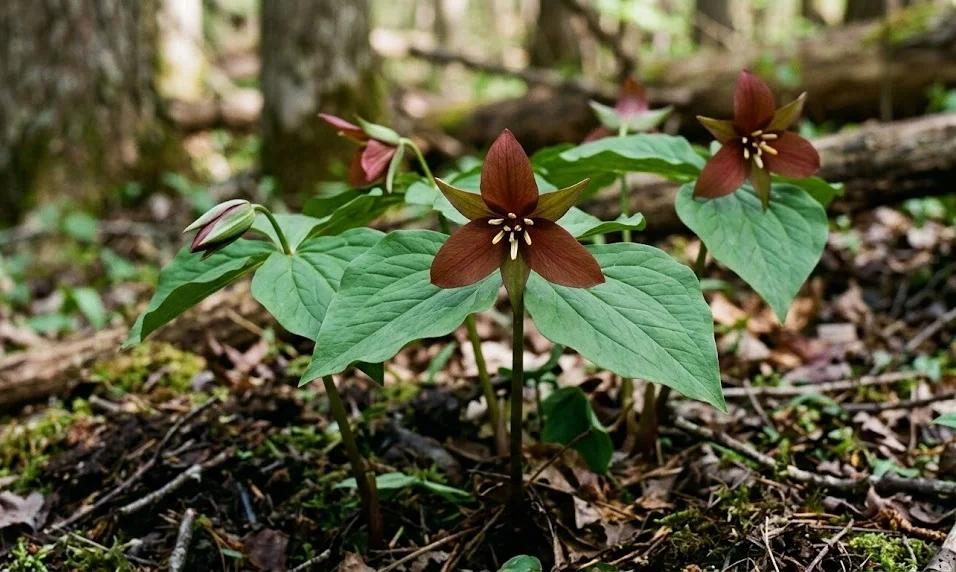

Red trillium is a long-lived woodland perennial valued for its three broad leaves and distinctive deep red flowers. It grows slowly, dislikes unnecessary disturbance, and rewards patient gardeners with increasingly impressive clumps over time. Successful cultivation depends on recreating the cool, humus-rich conditions found beneath deciduous trees. Once established in a suitable position, the plant generally requires less intervention than many conventional border perennials.
Understanding its natural growth cycle
Red trillium emerges from underground rhizomes in early spring, often before surrounding trees develop a full canopy. The shoots rise quickly while light still reaches the woodland floor. Each mature flowering stem carries a whorl of three leaves beneath a single flower. After flowering, the plant continues using its foliage to replenish energy reserves within the rhizome.
The flower is usually maroon, reddish brown, burgundy, or occasionally greenish red. Its scent can be noticeably earthy or musky, an adaptation that helps attract certain pollinating insects. Although the aroma may not appeal to every gardener, it is generally strongest only at close range. The visual effect is subtle, naturalistic, and particularly attractive in shaded planting schemes.
After the seed has developed, the foliage gradually turns yellow and dies back. This is a normal stage of dormancy rather than evidence that the plant has failed. The underground rhizome remains alive throughout summer, autumn, and winter. Marking the position can prevent accidental digging while no growth is visible.
Young plants may need several years before producing their first flowers. Even flowering specimens can remain compact for a long period while the rhizome establishes a stronger root system. Red trillium should therefore be regarded as a permanent woodland investment rather than a quick seasonal display. Consistent conditions are more valuable than frequent attempts to stimulate rapid growth.
More articles on this topic
Choosing a suitable garden position
The best planting site resembles the edge of a deciduous woodland. It should receive gentle spring light followed by dappled or partial shade as trees leaf out. Protection from strong afternoon sun is especially important in warm climates. A north-facing or east-facing position often provides a useful balance of light and coolness.
Avoid exposed sites where wind repeatedly dries the foliage and soil. Red trillium performs best in a sheltered area with stable humidity around the leaves. Nearby shrubs, ferns, and other woodland perennials can provide valuable protection. However, the plant should not be crowded by aggressive ground covers or dense, fibrous roots.
The soil must drain freely while remaining evenly moist during the active growing season. Heavy clay can be improved with leaf mould, composted bark, and other coarse organic materials. Extremely sandy soil needs generous quantities of humus to increase moisture retention. Waterlogged ground is unsuitable because stagnant moisture encourages rhizome decay.
Choose the permanent location carefully before planting. Established trilliums resent transplantation and may take several seasons to recover from root disturbance. They are most successful where the soil will not be cultivated, compacted, or repeatedly replanted. A quiet woodland border, shaded courtyard bed, or naturalistic garden corner is usually ideal.
More articles on this topic
Preparing rich woodland soil
Red trillium prefers soil containing abundant decomposed organic matter. Leaf mould is particularly valuable because it imitates the litter layer found beneath deciduous trees. Well-rotted garden compost can also improve soil structure and biological activity. Fresh manure should be avoided because it may be too rich, saline, or chemically aggressive.
A slightly acidic to neutral reaction is suitable for most plants. Extremely alkaline soil can restrict nutrient availability and may lead to weak or pale growth. Gardeners on strongly calcareous ground can create a raised woodland bed using suitable loam and leaf mould. Regular additions of organic mulch will help preserve the desired conditions.
Soil preparation should extend beyond the immediate planting hole. A wide area of improved ground allows the rhizome and roots to spread gradually. Digging should be completed before planting so that the trillium is not disturbed later. Remove perennial weeds thoroughly, especially those with creeping roots or underground runners.
The finished soil should feel loose, dark, and moisture-retentive without becoming sticky or saturated. After heavy rain, excess water should move away rather than remaining around the rhizome. During dry weather, the organic matter should help prevent sudden moisture loss. This balance between aeration and moisture retention is central to long-term success.
Managing moisture through the seasons
Spring moisture is particularly important because this is when stems, leaves, flowers, and new roots are actively developing. The soil should remain consistently damp but never flooded. Newly planted specimens need closer monitoring because their roots have not yet spread into surrounding ground. Water slowly so moisture penetrates the entire root zone.
A surface mulch reduces evaporation and protects the shallow rhizome from rapid temperature changes. Leaf mould, shredded leaves, or composted bark can be applied in a thin, even layer. Keep thick, wet material from pressing directly against emerging stems. Renew the mulch when it becomes incorporated into the soil.
Once the foliage begins to yellow naturally, water demand decreases. Dormant plants do not need the same moisture levels as actively growing specimens. Nevertheless, the ground should not become severely desiccated for prolonged periods. Occasional watering may be necessary beneath trees that remove large quantities of moisture during summer.
Autumn rainfall usually restores moisture before winter dormancy. Check that fallen leaves are not forming a dense, airless mat over the planting area. A light layer is beneficial, but compacted wet debris can encourage rot and shelter slugs. Gently redistribute excessive material without digging into the soil.
Feeding without forcing excessive growth
Red trillium is not a heavy-feeding perennial. In naturally fertile woodland soil, annual mulching may provide all the nutrients it requires. Slow decomposition releases minerals gradually and supports beneficial soil organisms. This gentle process suits the plant better than strong, fast-acting fertilisers.
Where soil is poor, a mild organic feed can be applied as growth begins. Choose a balanced product intended for woodland plants, bulbs, or herbaceous perennials. Use less than the maximum rate recommended on the label. Excess nitrogen can produce soft leaves while weakening long-term resilience.
Avoid feeding after the foliage has begun to decline. Late fertilisation cannot prevent natural dormancy and may interfere with the normal seasonal cycle. Nutrients applied at the wrong time may also encourage unwanted growth in neighbouring weeds. Spring remains the most appropriate period for supplementary feeding.
Observe the plant before assuming that fertiliser is necessary. Small size may reflect youth, recent transplantation, drought, or unsuitable light rather than nutrient deficiency. Pale leaves can result from excessive sun, waterlogged roots, or alkaline soil. Correcting the underlying growing conditions is usually more effective than adding additional fertiliser.
Protecting emerging shoots and foliage
The first shoots are vulnerable to slugs, snails, and accidental damage. Inspect the planting area frequently as temperatures begin to rise in spring. Remove hiding places such as boards, dense piles of debris, and overturned pots. Wildlife-friendly barriers or biological controls can be used where feeding damage becomes serious.
Foot traffic should be prevented around the dormant and emerging plants. The rhizomes and new shoots can be damaged even when nothing is visible above ground. Stepping stones or a clearly defined path can protect the colony. Small labels placed at the edge of the clump are also useful.
Avoid hoeing close to the plant because the rhizome lies relatively near the soil surface. Weeds should be removed by hand while they are small. Pull carefully so surrounding trillium roots are not loosened. Persistent weeds are best controlled over time rather than through deep cultivation.
Late frost can occasionally injure newly expanded leaves or flower buds. Plants beneath a light tree canopy are often naturally protected from rapid temperature changes. In exposed gardens, temporary horticultural fleece can be placed over emerging growth during severe frost warnings. Remove the covering during mild daylight hours so air can circulate freely.
Long-term care and companion planting
Mature plants should be left undisturbed whenever possible. Their clumps expand slowly through rhizome growth and occasional seedlings. A settled colony can remain attractive for decades under favourable conditions. Repeated division is unnecessary and can significantly delay flowering.
Good companions include ferns, woodland sedges, foamflowers, bloodroot, Virginia bluebells, and other non-invasive shade perennials. These plants share similar preferences for humus-rich soil and seasonal moisture. Their foliage can fill spaces after the trillium enters dormancy. Choose companions that will not overwhelm the slow-growing rhizomes.
Deciduous shrubs can provide useful overhead shade while allowing valuable light to reach the ground in early spring. Avoid planting directly beneath shallow-rooted trees that create extreme competition for water. Large maples and thirsty conifers can make establishment difficult. A position near, rather than immediately against, mature tree trunks is generally safer.
Patience remains the most important element of red trillium care. Minor annual changes may be difficult to notice, but healthy plants gradually become stronger and more floriferous. Record the emergence date, flowering performance, and condition of the foliage each year. These observations make it easier to recognise genuine problems and refine the growing environment.