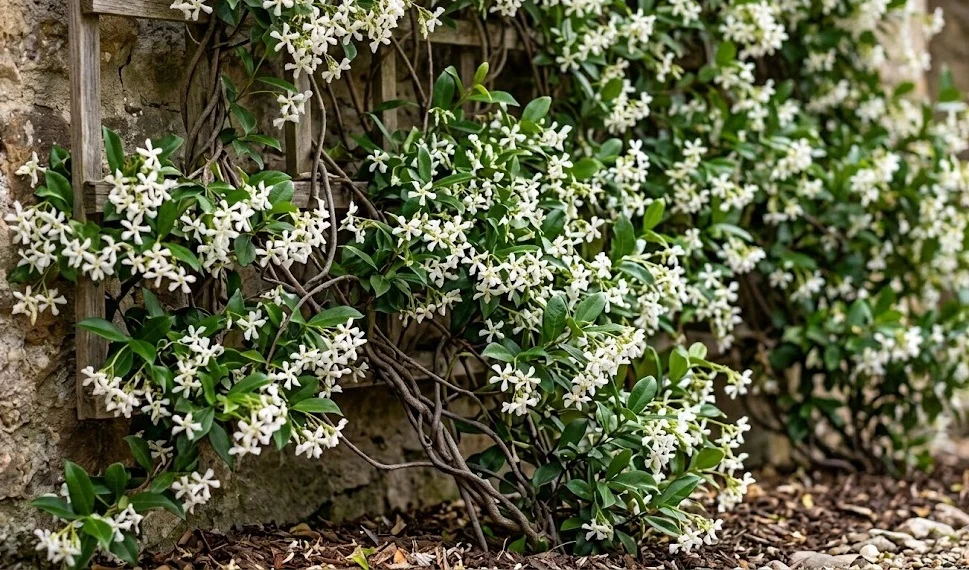

Star jasmine is valued for its glossy evergreen foliage, twining habit, and intensely fragrant white flowers. It performs best when its basic needs are kept steady rather than excessive. Good care begins with the right position, balanced watering, and soil that drains freely. With consistent attention, the plant can become a long-lived climber, screen, ground cover, or container feature.
Choosing the right growing position
Star jasmine thrives in a warm, sheltered position where its leaves are protected from drying winds. A wall, fence, pergola, or trellis often creates the ideal microclimate. The plant appreciates brightness, but it also benefits from some protection during the harshest afternoon heat. In cooler gardens, a south-facing or west-facing wall can improve growth and flowering.
Air movement is important, but exposed, windy sites can stress the plant. Constant wind increases water loss from the evergreen leaves. This can lead to browning, leaf drop, or weak flower formation. A sheltered position helps the plant keep its dense, polished appearance.
Star jasmine can grow in the ground or in a large container. In open soil, it develops a stronger root system and usually needs less frequent irrigation after establishment. In pots, the growing medium dries faster and nutrients are depleted more quickly. Container plants therefore need closer monitoring through the active growing season.
Support is also part of successful positioning. Although star jasmine twines naturally, young shoots often need guiding at first. Soft ties help direct the stems without cutting into them. Once the framework is established, the plant usually covers its support with little intervention.
More articles on this topic
Soil conditions and drainage
Star jasmine prefers fertile, well-drained soil with a loose structure. Heavy, compacted soil holds too much water around the roots. This can reduce oxygen availability and increase the risk of root problems. Improving the soil before planting is one of the most useful long-term care steps.
Garden compost, leaf mould, or mature organic matter helps improve both sandy and clay-based soils. In sandy soil, organic matter increases moisture retention and nutrient holding capacity. In clay soil, it improves structure and encourages better drainage. The goal is soil that stays lightly moist but never waterlogged.
The plant is fairly adaptable once established, but poor drainage remains a major weakness. If water stands in the planting hole after rain, the site should be corrected before planting. Raised beds, improved soil structure, or a slightly elevated planting mound can help. These measures protect the root system during wet seasons.
For containers, use a high-quality peat-free multipurpose compost mixed with drainage-supporting material. A pot must always have drainage holes at the base. A layer of crocks is less important than a free-draining medium and an open outlet for excess water. The container should be large enough to buffer moisture and temperature changes.
More articles on this topic
Watering throughout the seasons
Newly planted star jasmine needs regular watering while roots establish. The first growing season is especially important because the plant is still exploring the surrounding soil. Deep watering is better than frequent shallow sprinkling. It encourages roots to grow downward and improves drought resilience.
Established plants in open ground usually tolerate short dry periods. However, flowering and shoot growth are better when moisture remains even. During long hot spells, dry soil can cause buds to abort or leaves to curl. A slow soak at the root zone is the most effective response.
Container-grown star jasmine dries out faster than plants in the ground. Warm walls, dark pots, and windy balconies can increase water loss. Check the top few centimetres of compost before watering. If it feels dry, water thoroughly until excess drains from the base.
Winter watering should be cautious. Evergreen leaves still lose some moisture, especially in dry wind, but the plant uses far less water in cold weather. Wet compost in winter can be more harmful than slight dryness. Water only when the root ball is becoming dry and temperatures are mild.
Feeding for strong growth and flowering
Star jasmine is not a heavy feeder, but it responds well to moderate nutrition. Feeding supports glossy foliage, new shoots, and abundant flowering. Overfeeding, especially with nitrogen-rich fertiliser, can create soft leafy growth at the expense of flowers. A balanced approach is more effective than aggressive feeding.
In spring, apply a slow-release balanced fertiliser around the root zone. This provides steady nutrition as growth resumes. A mulch of compost can also release nutrients gradually. Keep mulch away from the stem base to prevent dampness against the crown.
Container plants need more regular feeding because nutrients wash out through drainage. A balanced liquid feed every few weeks during active growth can be useful. Stop feeding late in the season so new growth can firm up before cold weather. Soft late growth is more vulnerable to winter damage.
Yellowing leaves may suggest nutrient issues, but diagnosis should be careful. Waterlogging, cold stress, drought, and root restriction can also cause pale foliage. Correct the growing conditions before adding more fertiliser. Feeding cannot solve problems caused by poor drainage or damaged roots.
Training and routine shaping
Star jasmine naturally produces long, flexible shoots that need early guidance. Training begins by spreading young stems across the chosen support. This creates a broad framework instead of a congested cluster at the base. A well-spaced structure allows better air flow and more even flowering.
Use soft plant ties, flexible garden twine, or clips that do not damage the stems. Ties should be checked regularly as shoots thicken. Tight ties can cut into the plant and restrict sap flow. Looser support keeps the plant secure while allowing natural expansion.
Once the framework is established, trimming is mostly about control and tidiness. Remove wayward stems that grow into paths, windows, gutters, or neighbouring plants. Light shaping after flowering helps preserve the natural form. Heavy pruning is rarely needed unless the plant has become overgrown.
As a ground cover, star jasmine needs a different approach. Shoots should be allowed to spread, but stray stems can be shortened to keep edges clean. Occasional thinning prevents a thick mat from trapping too much moisture. This keeps the planting healthier and easier to manage.
Protecting foliage and flowers
The evergreen leaves of star jasmine are attractive, but they can show stress quickly. Brown tips often appear after wind exposure, drought, cold damage, or salt-laden air. The plant may recover well if the underlying cause is corrected. Damaged leaves can be removed once new growth appears.
Flowering depends on maturity, light, and steady care. Young plants sometimes need time before they bloom generously. Too much shade can reduce flowering even if leaf growth remains healthy. A bright sheltered position is usually the best way to improve bud formation.
Avoid moving container plants repeatedly during bud development. Sudden changes in light, moisture, or temperature can stress the plant. Consistency is especially important in late spring and early summer. Stable conditions help buds open evenly and maintain fragrance.
Pests are usually manageable when the plant is vigorous. Scale insects, aphids, and mealybugs may appear, especially on sheltered plants. Regular inspection allows early action before infestations spread. Healthy growth and good air flow are the best foundation for pest resistance.
Long-term maintenance
A mature star jasmine can remain attractive for many years with light annual care. The main tasks are checking support, refreshing mulch, watering during drought, and pruning after flowering. This rhythm keeps the plant productive without forcing excessive growth. Regular small actions are better than occasional drastic correction.
Older plants may become woody at the base. This is normal for a climber, especially when the upper growth receives most of the light. Underplanting or careful training can soften the appearance. If rejuvenation is needed, pruning should be gradual rather than severe.
In colder regions, winter protection becomes part of long-term care. Roots should be insulated with mulch, and containers may need wrapping. Plants near walls usually suffer less frost damage than those in open positions. Choosing the right site from the start reduces future problems.
Observation is the most valuable habit in star jasmine care. Leaf colour, shoot length, flower quantity, and soil moisture all reveal how the plant is responding. Adjust watering, feeding, and pruning according to these signs. This practical, responsive care produces a resilient and beautifully scented plant.

