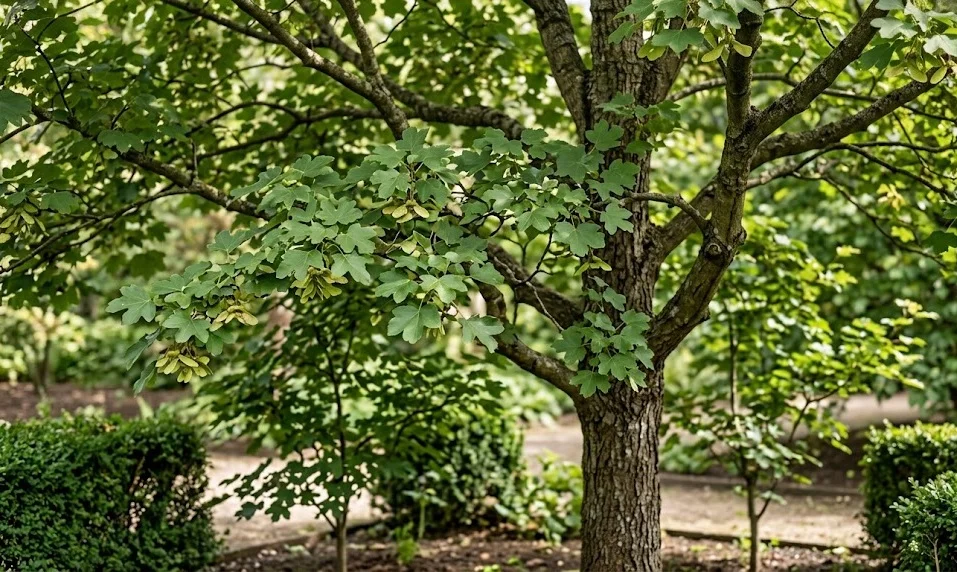

Pruning is a vital part of caring for a field maple, whether you are maintaining a formal hedge or a majestic standalone specimen tree. The best time for major structural pruning is during the dormant season, typically between late autumn and early spring, before the sap begins to flow. Pruning during this time minimizes the risk of “bleeding” sap, which can be messy and might attract unwanted pests to the fresh wounds. Understanding the natural growth cycle of the tree is the first step towards successful and professional-level maintenance.
For routine trimming of hedges, you can perform a light clipping in early summer after the first flush of growth has finished. This helps maintain the neat, architectural shape of the hedge throughout the rest of the growing season and encourages denser branching. Avoid heavy pruning in late summer or autumn, as this can stimulate new growth that will not have time to harden before the winter frosts. Timing your interventions correctly ensures that the tree remains healthy and vigorous year after year.
Using the right tools is essential for making clean, precise cuts that heal quickly and do not damage the surrounding bark of the tree. You should invest in a high-quality pair of sharp bypass pruners for smaller twigs and a sturdy lopper for thicker branches. For major structural work on larger trees, a specialized pruning saw is the safest and most effective tool to use for the job. Always ensure your tools are clean and sharp before you start, as dull blades can crush the wood and invite fungal infections.
Sanitization of your tools between trees is a professional practice that prevents the spread of diseases throughout your garden or landscape. A simple wipe with rubbing alcohol or a mild bleach solution is all that is needed to ensure your tools are sterile and safe to use. This is particularly important if you have recently worked on a tree that showed signs of disease or pest infestation. Taking these extra few minutes of preparation will protect the long-term health of all the plants in your care.
Shaping and structural pruning
When pruning a standalone field maple, your primary goal should be to encourage a strong, balanced, and aesthetically pleasing structural framework. Start by removing the “three Ds”: any wood that is dead, damaged, or diseased, as these parts can compromise the tree’s health. Next, look for branches that are crossing or rubbing against each other, as these create wounds that can serve as entry points for pathogens. By thinning out these problem areas, you improve air circulation and light penetration throughout the entire canopy.
More articles on this topic
Developing a single, strong central leader is important for the long-term stability and height of a young field maple in most garden settings. If you notice competing leaders, select the strongest and straightest one and remove or shorten the others to subordinate them. This ensures that the tree grows upwards with a solid central trunk rather than becoming a multi-stemmed shrub with weak crotches. As the tree matures, this strong central structure will be much more resistant to damage from high winds or heavy snow.
The “feathering” technique is often used on young trees to encourage a thicker trunk while still maintaining a clear main stem for the future. This involves leaving small, temporary branches along the trunk to provide extra leaves for photosynthesis and nutrient production. These small branches are gradually removed over several years as the tree grows taller and the main trunk becomes more robust and stable. This patient approach results in a much stronger and healthier tree that is better adapted to its environment.
Always aim to make your cuts just outside the “branch collar,” which is the slightly swollen area where a branch meets the trunk or a larger limb. This collar contains specialized cells that are responsible for sealing the wound quickly and protecting the internal wood from decay. Never make “flush cuts” that remove the collar, as this creates a larger wound that the tree will struggle to close effectively. Professional-style pruning is about working with the tree’s natural healing processes to ensure long-term structural integrity.
Hedging and topiary applications
The field maple is one of the best deciduous species for creating formal hedges due to its dense growth habit and high tolerance for regular clipping. When establishing a new hedge, you should prune the young plants back by about a third immediately after planting to encourage bushy growth from the base. Over the next few years, continue to tip-prune the side shoots to fill in the gaps and create a solid wall of green foliage. This early training is essential for creating a hedge that is thick and private right down to the ground level.
More articles on this topic
The ideal shape for a field maple hedge is slightly wider at the bottom than at the top, a shape often referred to as a “taper” or “batter.” This ensures that sunlight can reach the lower branches, preventing them from dying back and leaving unsightly gaps at the base of the hedge. If the top is wider than the bottom, it will cast a shadow on the lower parts, leading to thin and weak growth over time. A well-shaped hedge is not only more attractive but also much healthier and easier to maintain.
For a very formal look, you can use a string line and a spirit level to ensure your horizontal and vertical lines are perfectly straight and even. Regular clipping, perhaps once or twice a year, will keep the hedge looking sharp and prevent it from becoming too woody or overgrown. If the hedge does become too large, the field maple responds very well to “hard” renovation pruning, where it is cut back severely to the main stems. It will quickly produce new, vigorous growth, allowing you to reshape and rejuvenate the entire hedge over a season or two.
The fine texture of the field maple’s leaves also makes it suitable for simple topiary shapes or more creative “cloud pruning” techniques. You can train the tree into spheres, cubes, or even more complex forms with a bit of patience and regular attention to detail. This versatility allows the field maple to fit into both traditional cottage gardens and very modern, minimalist landscape designs. No matter how you choose to shape it, the tree’s resilience and adaptability make it a pleasure to work with.
Rejuvenation and maintenance pruning
Over time, even the most well-cared-for field maple may benefit from a bit of rejuvenation pruning to restore its vigor and aesthetic appeal. This is especially true for older trees that have become overly dense or have lost their lower branches due to shading from neighboring plants. By selectively removing some of the older, less productive wood, you encourage the tree to produce fresh, new shoots from the interior. This process should be done gradually over two or three years to avoid shocking the tree or removing too much of its leaf area at once.
Thinning the canopy is a specific maintenance technique used to reduce the overall weight of the branches and allow more wind to pass through safely. This is particularly important for large, mature trees located near buildings or in windy, exposed areas where branch failure could be a risk. You should focus on removing smaller branches from the outer edges of the canopy rather than “topping” the tree or removing large, structural limbs. A professional arborist can help you identify which branches are the best candidates for removal to achieve the desired effect.
Crown lifting is another useful technique that involves removing the lower branches to create more space under the tree for walking, sitting, or planting other species. This also provides a clearer view of the tree’s beautiful corky bark, which is one of its most attractive features during the winter months. You should lift the crown gradually over several years, ensuring that at least two-thirds of the tree’s total height remains as a full, leafy canopy. This maintains the tree’s health and balance while achieving your practical and aesthetic goals for the space.
Finally, always take a moment to step back and look at the tree from several different angles before making any major cuts to its structure. Pruning is as much an art as it is a science, and it is much easier to remove a branch than it is to wait for it to grow back. By following these professional guidelines and taking a thoughtful, patient approach, you will ensure that your field maple remains a healthy and beautiful part of your garden for many years to come. Your tree will reward your careful attention with a lifetime of shade, color, and structural elegance.