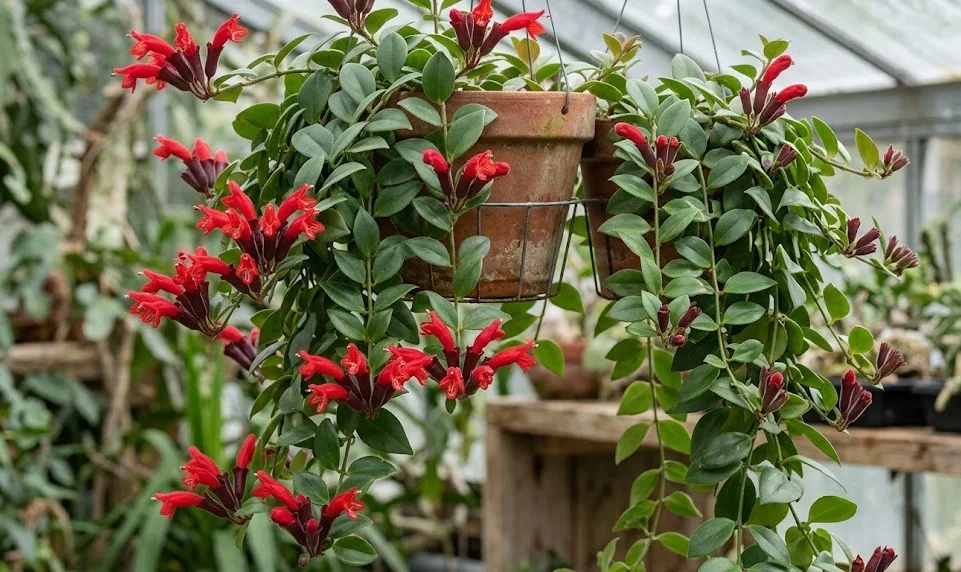

Pruning the trailing lipstick plant keeps it compact, balanced, and productive. Without occasional trimming, older stems can become long, sparse, or uneven. Careful cutting encourages branching and helps maintain the full curtain-like form that makes the plant so attractive. The best pruning is selective and thoughtful rather than severe and frequent.
When and why to prune
The best time to prune is during active growth, usually in spring or early summer. The plant recovers more quickly when light and warmth are increasing. Light trimming can also be done after flowering to tidy the shape. Heavy pruning during winter is less ideal because regrowth is slower.
Pruning encourages side shoots. When a stem tip is removed, dormant buds below the cut may begin to grow. This creates a denser plant with more potential flowering points in the future. Regular light pinching is often better than waiting until the plant becomes untidy.
Cutting back is also useful when stems become bare near the base. Older hanging plants sometimes develop long trails with foliage only at the ends. Shortening selected stems can stimulate fresher growth closer to the pot. Combining pruning with propagation can renew the whole display.
Pruning should not remove all mature growth at once. Flowers often develop on established stems, so overly drastic cutting can delay blooming. A balanced approach keeps enough healthy growth while improving structure. This preserves both appearance and flowering potential.
More articles on this topic
How to prune cleanly and safely
Use sharp, clean scissors or pruning shears. Dull tools crush stems and create ragged wounds. Clean tools reduce the risk of spreading disease between plants. Wiping blades before and after pruning is a simple but important habit.
Cut just above a node or pair of leaves. This is where new branching is most likely to occur. Leaving long bare stubs can look untidy and may dry back. A neat cut helps the plant redirect energy efficiently.
Remove damaged, yellowing, weak, or pest-infested growth first. This improves appearance and reduces hiding places for pests. Then shorten overly long stems to restore balance. Step back often to assess the shape before making additional cuts.
Avoid pruning a stressed plant heavily. If the plant is suffering from root rot, severe dehydration, or pest infestation, correct the main problem first. Light removal of damaged material is fine, but major shaping should wait. A healthy plant responds to pruning far better than a weakened one.
More articles on this topic
Using pruned stems for renewal
Healthy pruned stems are excellent propagation material. Cuttings with several nodes can be rooted to create new plants. This is especially useful when an older basket has lost density. Young rooted cuttings can later be planted back into the same container for a fuller effect.
Before rooting, remove the lower leaves from each cutting. Nodes should be placed in water or a light propagation medium. A warm, bright position with indirect light supports root development. High humidity can help, but fresh air remains important.
Several rooted cuttings can be grouped together in one pot. This creates a lush appearance faster than relying on one plant to branch. It also gives growers a backup if the original plant declines. Propagation is therefore both decorative and practical.
Pruning and renewal should be seen as part of long-term care. A trailing lipstick plant can remain attractive for many years if old growth is refreshed gradually. The goal is not to force a perfect shape but to guide natural trailing growth. With clean cuts and patient aftercare, the plant becomes fuller, healthier, and more floriferous.