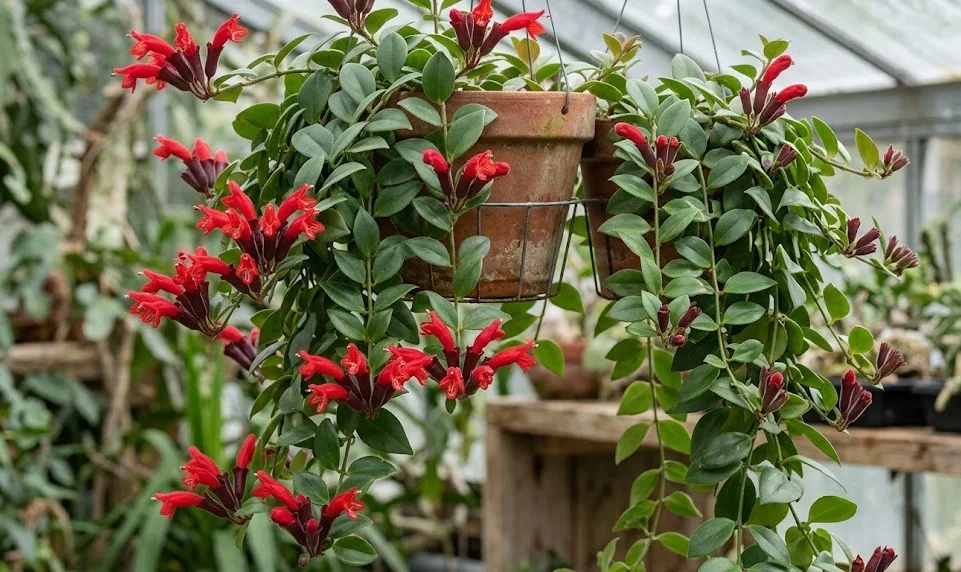

The trailing lipstick plant is one of those houseplants that looks refined without feeling fragile, but it rewards growers who understand its tropical habits. Its long, arching stems, glossy foliage, and tubular red flowers make it especially valuable in hanging baskets and elevated planters. Although it is often described as easy once established, it dislikes harsh light, cold drafts, heavy compost, and erratic watering. The best results come from steady warmth, filtered brightness, airy roots, and a care routine that changes slightly with the seasons.
Understanding its natural growth habit
The trailing lipstick plant grows as an epiphytic tropical plant, which means it is adapted to living with excellent air movement around its roots. In the home, this matters because the plant does not enjoy dense, waterlogged soil. Its roots need moisture, but they also need oxygen. A compacted potting mix is one of the quickest ways to weaken an otherwise healthy specimen.
Its stems naturally trail rather than stand upright, so the plant should not be forced into a rigid shape. Hanging baskets, wall-mounted planters, shelves, and tall plant stands all suit its growth habit. When the stems can fall freely, the foliage receives better light and the plant looks fuller. Crowding the stems against a wall can reduce airflow and increase the risk of pests.
The leaves are thick, smooth, and slightly succulent in texture, but the plant should not be treated like a cactus or true succulent. It stores some moisture in its foliage, yet it still comes from humid, warm environments. This is why it prefers moderate watering rather than long dry periods. Allowing the root ball to dry completely too often can lead to leaf drop and poor flowering.
Flowering usually appears on mature, well-lit growth rather than on weak, shaded stems. The red tubular blooms emerge from darker calyxes, creating the “lipstick” effect that gives the plant its common name. A plant that produces plenty of leaves but no flowers is often receiving too little light or too much nitrogen. Balanced care encourages both attractive foliage and reliable blooming.
More articles on this topic
Choosing the right indoor position
A bright position with indirect light is ideal for the trailing lipstick plant. It can tolerate some gentle morning sun, especially in autumn and winter, but strong midday or afternoon sun may scorch the leaves. The best location is often near an east-facing window or slightly back from a south- or west-facing window. A sheer curtain can help soften intense light while still allowing enough brightness for flowering.
Low light rarely kills the plant quickly, but it usually reduces its quality over time. Stems may stretch, leaves may become smaller, and flowering may stop altogether. In a very shaded room, the plant can remain alive but appear thin and tired. This is why it should be placed where it receives clear, bright daylight for several hours each day.
The plant also dislikes sudden changes in exposure. Moving it from a dim corner directly into strong light can cause stress and leaf damage. A gradual transition over one or two weeks is safer when changing its position. This is especially important after winter, when sunlight becomes stronger and longer.
Artificial grow lights can be useful in darker homes or offices. A full-spectrum light placed above or slightly in front of the plant can support compact growth. The light should not be so close that it overheats or dries the foliage. Consistent daily exposure under a timer is better than irregular bursts of intense light.
More articles on this topic
Managing temperature and humidity
Warm, stable temperatures are essential for strong growth. The trailing lipstick plant performs best in typical indoor warmth, especially when temperatures remain roughly between 18 and 26 degrees Celsius. It may tolerate slightly cooler nights, but prolonged cold conditions can slow growth and damage buds. Sudden drops below comfortable room temperature should be avoided.
Cold drafts are a common hidden problem with this plant. Windowsills, entrance halls, unheated conservatories, and poorly insulated rooms may become too cold at night. The plant may respond with yellowing leaves, bud drop, or limp growth. Even when daytime conditions seem suitable, nighttime cold can undermine overall health.
Humidity helps the plant maintain glossy foliage and reduces stress during active growth. It does not require greenhouse-level humidity, but very dry air can cause brown leaf edges and weak flower development. Grouping plants together, using a pebble tray, or running a humidifier can improve conditions. Misting alone is less reliable because the effect is short-lived and wet leaves may encourage fungal problems if airflow is poor.
Good airflow should accompany higher humidity. A stagnant, damp corner is not the same as a healthy tropical environment. The goal is a room where the air feels fresh but not drafty. This balance helps prevent both spider mites in dry air and fungal issues in overly still conditions.
Watering with consistency and restraint
The trailing lipstick plant prefers its potting mix to become slightly dry near the surface before the next watering. It should not sit permanently wet, but it should not be neglected until the root ball becomes bone dry. A practical approach is to check the top few centimetres of the mix with a finger. When that upper layer feels dry but the pot still has slight weight, watering is usually appropriate.
Water thoroughly rather than giving frequent small sips. A complete watering allows moisture to reach the full root zone and helps flush out excess salts. After watering, allow surplus water to drain freely from the pot. Never leave the plant standing in a saucer of water for long periods.
Seasonal adjustment is important. During spring and summer, the plant may use water more quickly because light, warmth, and growth are stronger. In autumn and winter, growth slows and the potting mix dries more slowly. Continuing a summer watering schedule through winter often causes root stress.
The quality of the potting mix affects watering more than many growers realise. A bark-rich, open mix dries more evenly and gives roots access to air. A heavy peat-based mix can stay wet deep inside the pot even when the surface appears dry. This is why both watering routine and substrate choice must work together.
Feeding for foliage and flowers
Regular but moderate feeding supports healthy growth and flowering. During the active growing season, a balanced liquid houseplant fertiliser can be applied at reduced strength. Feeding too strongly may produce lush, soft foliage that is more vulnerable to pests. It can also lead to salt accumulation in the potting mix.
A fertiliser with balanced nutrients is usually suitable for routine care. When flowering is the goal, avoiding excessive nitrogen is important. Too much nitrogen encourages leaves and stems at the expense of buds. A formula with adequate potassium can support stronger flowering when light and temperature are also correct.
Feeding should be reduced or paused during winter if the plant is not actively growing. Plants absorb fewer nutrients in cooler, darker conditions. Fertiliser left unused in the soil can irritate roots and cause leaf tip burn. It is better to resume feeding gently in spring when new shoots begin to appear.
Occasional flushing helps maintain a healthy root environment. Watering until liquid drains freely through the pot can remove some accumulated mineral salts. This is especially useful if tap water is hard or fertiliser has been used regularly. A clean, airy root zone encourages better long-term performance than heavy feeding alone.
Encouraging flowering and dense growth
Flowering depends on maturity, light, steady care, and healthy stems. A young cutting may need time before it blooms reliably. Even a mature plant may refuse to flower if kept too dark. Bright filtered light is usually the most important factor for bud formation.
Slightly tighter root conditions can sometimes encourage flowering. This does not mean the plant should be severely root-bound or starved, but it does not need an oversized pot. A pot that is too large can hold excess moisture and encourage root problems. A modest container that matches the root system is usually better.
Pinching and light pruning can improve density. When stem tips are trimmed after flowering or during active growth, the plant often responds by branching. More branches can eventually mean more flowering points. Heavy pruning, however, may delay blooms because it removes mature growth.
Stress should be kept low when buds are forming. Sudden relocation, cold drafts, irregular watering, and overfertilising can all lead to bud drop. Once buds appear, the plant benefits from stable conditions. Gentle, predictable care is more effective than dramatic interventions.
Long-term maintenance and problem prevention
Repotting is needed only when the plant has clearly outgrown its container or the potting mix has broken down. Signs include roots circling tightly, water running straight through without moistening the mix, or a sour smell from old compost. Repotting is best done in spring or early summer. This gives the plant time to recover during active growth.
Cleaning the foliage keeps the plant attractive and improves light absorption. Dust can gather on the glossy leaves, especially indoors. A soft damp cloth is usually enough to wipe the leaves gently. Leaf-shine products should be avoided because they can clog natural leaf surfaces and attract dust.
Routine inspection helps catch pests before they become serious. Mealybugs, spider mites, aphids, and scale insects can appear, particularly on stressed plants. Check leaf undersides, stem joints, and new growth regularly. Early removal with a damp cloth or appropriate insecticidal soap is far easier than treating a heavy infestation.
A well-grown trailing lipstick plant becomes more impressive with age. Older stems can be refreshed through selective pruning, and cuttings can be used to create replacement plants. With bright indirect light, airy soil, careful watering, and moderate feeding, it can remain ornamental for many years. Its best care is not complicated, but it does require observation and consistency.