
Planting Chilean jasmine correctly gives the climber the stable root environment it needs for years of flowering and vigorous seasonal growth. The process involves more than placing the root ball in soil, because drainage, planting depth, support, temperature, and aftercare all influence establishment. Propagation is equally rewarding, although success depends on selecting healthy material and maintaining controlled humidity. Whether starting with a nursery plant or raising a new specimen from cuttings, careful preparation greatly improves the outcome.
Preparing the planting site
Choose a warm, sheltered location before preparing the soil. The plant should have enough space for its roots and enough vertical structure for its shoots to climb. Avoid low points where rainwater collects after storms. A position near a sun-warmed wall is often ideal in cooler climates.
Dig a planting area considerably wider than the nursery root ball so that surrounding soil can be loosened. Compacted ground restricts new root growth and may hold water around the planting hole. Mix well-rotted compost through the excavated soil rather than placing a concentrated layer directly beneath the roots. This creates a gradual transition between the planting hole and the native ground.
Drainage should be tested when the soil is heavy or the site has previously remained wet. A hole filled with water should drain within a reasonable period rather than staying saturated for many hours. If drainage is poor, planting on a slight mound or in a raised bed is safer than relying on a thin layer of gravel. Gravel at the bottom of a poorly drained hole can simply create a reservoir.
Install the main support before planting whenever possible. Driving stakes or fixing wires after the root system is in place can damage newly established roots. The support must be strong enough to carry wet foliage and withstand wind. It should also allow easy access for tying, pruning, and inspection.
More articles on this topic
Planting in open ground and containers
Water the nursery plant thoroughly before removing it from its pot. A moist root ball is less likely to crumble and exposes fewer fine roots to drying air. If roots are tightly circling the container, tease them apart gently with your fingers. Severely congested roots may be loosened with several shallow vertical cuts.
Place the plant at approximately the same depth at which it was growing in the nursery container. Planting too deeply can keep the stem base wet and reduce oxygen around the upper roots. Position the root ball so that its upper surface remains level with the surrounding soil after settling. Backfill gradually and firm the soil with your hands rather than compacting it heavily with your feet.
After planting, water slowly and deeply to settle soil around the roots. Add more soil if gaps or depressions appear as the water drains. A shallow watering basin can be formed around garden-grown plants during the first season. This helps direct moisture toward the developing root zone.
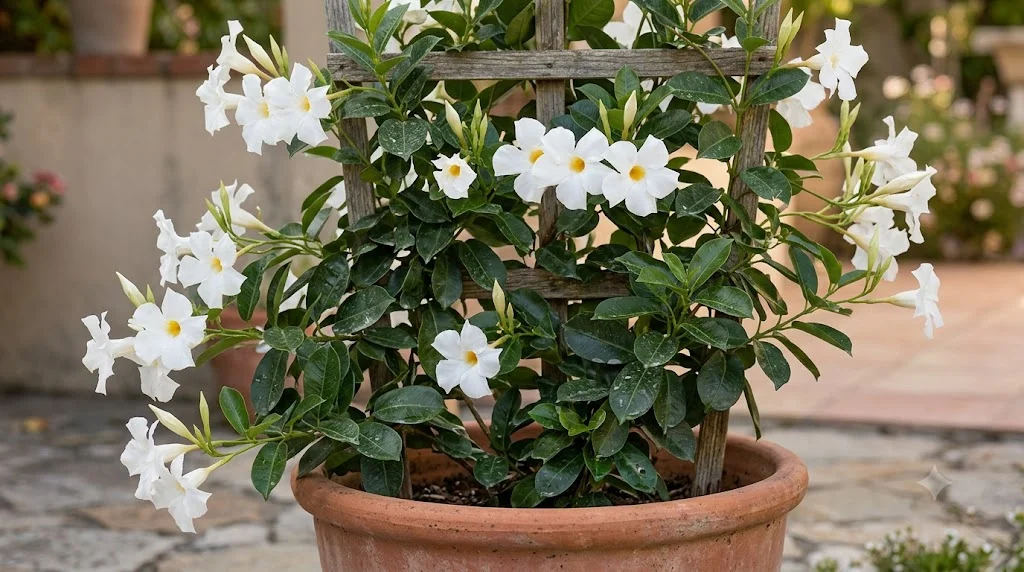
For container planting, select a pot with generous drainage and sufficient weight for stability. Fill it with a structured, moisture-retentive compost that does not collapse quickly. Leave several centimetres between the compost surface and the rim to make watering easier. Secure the climbing frame firmly so that it does not move independently of the container.
More articles on this topic
Propagating from stem cuttings
Softwood or semi-ripe cuttings are commonly used to propagate Chilean jasmine. Select healthy, non-flowering shoots that show no sign of pests, nutrient deficiency, or disease. Cuttings taken from vigorous but not excessively soft growth usually root more reliably. Early summer is often suitable because the shoots are active and temperatures are favourable.
Make each cutting just below a leaf node using a clean, sharp blade. Remove the lower leaves while retaining a small number at the top. Large leaves may be reduced slightly if they lose moisture rapidly, but excessive trimming removes useful photosynthetic tissue. A cutting approximately eight to twelve centimetres long is generally manageable.
Insert the prepared cuttings into a free-draining propagation medium. A mixture containing fine compost and perlite or horticultural grit provides both moisture and air around the developing roots. Several cuttings can share a pot as long as their leaves do not overlap heavily. Firm the medium gently around each stem to eliminate large air gaps.
Maintain high humidity without keeping the medium saturated. A transparent cover can reduce water loss, but it should not rest directly against the leaves. Ventilation is needed to prevent fungal growth and excessive condensation. Bright, indirect light and steady warmth support rooting while limiting stress.
Aftercare for new plants
Freshly planted specimens need consistent moisture while their roots expand into the surrounding soil. Allowing the root ball to dry completely can stop establishment, even when the nearby soil still appears damp. Water should be applied over the original root zone as well as the loosened soil around it. Gradually extend the watered area as roots spread.
Newly rooted cuttings must be acclimatised slowly to lower humidity. Open the propagation cover for longer periods over several days rather than removing it abruptly. A cutting that wilts slightly may recover, but repeated severe wilting weakens new roots. Maintain bright shade during this transition.
Once cuttings show clear new growth, they can be potted individually. Handle them by the leaves or root ball rather than squeezing their fragile stems. Use a small pot at first because a large volume of wet compost can encourage root problems. Keep the young plants protected from strong sun until growth resumes.
Young Chilean jasmine plants should be trained early onto slender supports. Pinching may encourage branching, but it should be used sparingly if rapid vertical growth is required. Feed only after the roots are established and active. Overfeeding young plants can produce weak shoots before the root system is ready to support them.