
Ensuring that your Chinese holly survives the coldest months of the year is a vital part of its overall care and long-term health. You must recognize that while this species is hardy, the combination of freezing temperatures, dry winds, and winter sun can be a major challenge for evergreen foliage. A professional approach to overwintering involves preparing the plant long before the first frost arrives and providing protection throughout the season. By taking these steps, you ensure that the plant emerges in the spring with its glossy leaves and structural integrity intact.
Winter protection is not just about the cold; it is primarily about managing the moisture levels within the plant and the soil. You should understand that evergreens continue to lose water through their leaves even when the ground is frozen and the roots cannot take up more. This phenomenon, known as winter desiccation, is the leading cause of “winter burn” on holly leaves. Your goal as a caretaker is to minimize this water loss and provide a stable environment for the roots and stems.
A well-prepared plant is much more likely to survive extreme winter conditions without significant damage or dieback. You should focus on hardening off the new growth in the autumn and ensuring the plant has ample reserves of nutrients and moisture. The physical placement of the holly in your landscape also plays a role in how much winter protection it will ultimately require. A plant in a sheltered spot will naturally fare better than one exposed to the full force of northern winds.
As a professional gardener, you should have a plan for different winter scenarios, from heavy snow loads to periods of unseasonable warmth. You need to be ready to step in with temporary structures or additional mulch if the weather becomes particularly harsh. Monitoring the plant throughout the winter months allows you to catch any problems early and make adjustments as needed. With the right overwintering strategy, your Chinese holly will be a resilient and beautiful feature of your winter landscape.
Hardening off and autumn preparation
The process of overwintering actually begins in the late summer and early autumn as the days start to get shorter. You should stop applying high-nitrogen fertilizers by mid-August to discourage the production of soft, tender new growth. This allows the current season’s stems to mature and develop a thick layer of bark that can withstand freezing temperatures. If the plant is still pushing out new leaves when the first frost hits, those parts are almost certain to be damaged.
More articles on this topic
Cleanliness in the garden is an essential part of preventing diseases from overwintering and attacking the plant in the spring. You should remove any fallen leaves, berries, or other debris from around the base of the holly before the snow starts to fall. This reduces the number of places where fungal spores and pest eggs can hide during the cold months. A clean garden bed also makes it easier to apply a fresh layer of mulch, which is your most important tool for root protection.
A thorough, deep watering in the late autumn is one of the kindest things you can do for an evergreen before the ground freezes. You should ensure that the soil is moist to a depth of at least 12 inches to provide a reservoir of water for the winter. This is especially important if the autumn has been unusually dry or if the plant is located in a spot that gets a lot of sun. A well-hydrated holly is much more resistant to the drying effects of winter winds and low humidity.
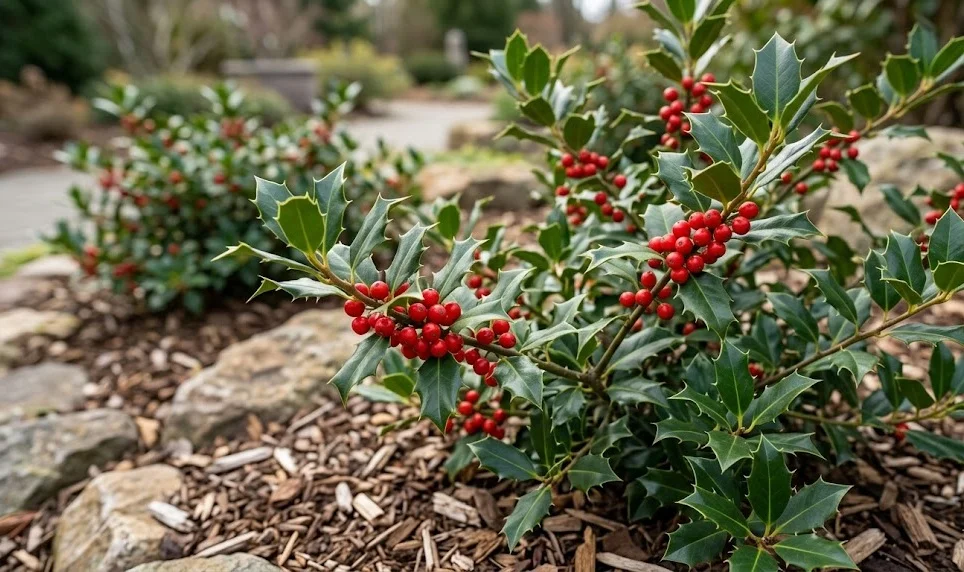
Applying a thick layer of organic mulch is the final step in your autumn preparation routine for the Chinese holly. You should use materials like wood chips, pine needles, or shredded bark to create a barrier that is two to three inches deep. This mulch acts as insulation, keeping the soil temperature more stable and preventing the frequent freeze-thaw cycles that can heave roots out of the ground. Be careful to keep the mulch a few inches away from the trunk to prevent moisture from sitting against the bark.
Protecting the foliage from winter burn
Winter burn occurs when the leaves lose moisture faster than the frozen roots can replace it, leading to brown, crispy edges. You can help prevent this by applying an anti-desiccant spray to the foliage in the late autumn or early winter. These products create a thin, waxy coating on the leaves that slows down the rate of transpiration without interfering with the plant’s breathing. It is often necessary to re-apply these sprays during a mid-winter thaw for continued protection through the season.
More articles on this topic
If your holly is planted in a particularly exposed or windy location, a physical windbreak may be necessary to protect it. You should use materials like burlap or specialized garden fabric to create a screen on the windward side of the plant. Avoid wrapping the plant too tightly, as you still want air to be able to circulate through the branches to prevent fungal issues. A simple frame made of wooden stakes can hold the burlap in place and provide a sturdy barrier against the harshest gusts.
The winter sun can be surprisingly intense and can cause the leaves to warm up and become active, only to freeze again at night. You should consider providing some temporary shade for plants that are located in full southern exposure during the winter months. This “sunscald” can damage the bark as well as the leaves, leading to long-term structural issues for the shrub. Using a lattice screen or even a nearby evergreen tree can provide the dappled light that is much safer for the holly.
Monitoring the plant after a heavy snowfall is also a part of a professional winter care routine for large shrubs. You should gently brush off heavy, wet snow from the branches to prevent them from bending or snapping under the weight. Always use an upward motion with a broom or your hands to avoid putting even more downward pressure on the wood. If a branch does break, you should prune it cleanly as soon as the weather permits to prevent further tearing of the bark.
Managing moisture and temperature fluctuations
In regions with fluctuating winter temperatures, the ground may freeze and thaw several times throughout the season. You should be aware that these cycles can be very stressful for the root system and can even push smaller plants out of the ground. Maintaining a consistent layer of mulch is the best way to mitigate these temperature swings and keep the roots at a steady temperature. A professional gardener always checks the mulch levels after a major thaw to see if any adjustments are needed.
If the winter is unusually warm and dry, you may actually need to water your holly even in the middle of January. You should check the soil moisture levels whenever the ground is not frozen to see if the plant is in need of a drink. Providing a bucket of water during a warm spell can help the plant recover some of the moisture it lost during the colder periods. This is especially important for young plants that do not have the deep root systems of more mature specimens.
Ventilation is still important during the winter, even when you are trying to keep the plant warm and protected. You should ensure that any covers or screens you use allow some air movement to prevent the buildup of humidity. Stagnant air inside a burlap wrap can lead to mold or even attract pests that are looking for a sheltered spot to spend the winter. A professional approach always balances the need for protection with the biological requirement for fresh air.
As the winter begins to transition into spring, you should be careful not to remove your protective measures too early. Late-season frosts can be just as damaging as mid-winter freezes, especially if the plant has started to wake up and push out new growth. You should wait until the danger of a hard freeze has passed before taking down windbreaks or removing anti-desiccant coatings. A gradual transition is always the safest way to bring your holly out of its winter dormancy.
Post-winter assessment and recovery
Once the spring arrives and the ground has completely thawed, it is time for a thorough assessment of how the holly fared. You should look for any signs of winter burn, branch breakage, or root heaving that may have occurred during the season. Pruning out any dead or damaged wood should be your first priority to prevent pests and diseases from moving in. A clean, healthy plant will be much better equipped to start the new growing season with vigor.
The first few waterings in the spring should be deep and thorough to help flush any accumulated salts out of the root zone. If you used salt on nearby walkways during the winter, this step is especially critical for the health of your holly. You should also check the pH of the soil to see if any adjustments are needed after the winter months. Providing a fresh application of compost or a light dose of fertilizer will give the plant the energy it needs for its initial flush of growth.
Observing how the plant responds to the return of warmer weather will tell you a lot about the success of your overwintering strategy. You should see the buds beginning to swell and new, green growth appearing within a few weeks of the spring thaw. If the plant seems slow to recover or shows significant dieback, you may need to reconsider your protection methods for the following year. Every winter is a learning experience that helps you become a more effective and professional caretaker.
Ultimately, the goal of overwintering is to ensure that the Chinese holly remains a permanent and beautiful part of your garden for many years. You should take pride in the fact that your hard work has helped the plant survive the harshest time of the year. Sharing your winter protection techniques with other gardeners can help build a more resilient community of evergreen enthusiasts. With the right approach, your holly will continue to thrive and bring joy to your landscape season after season.