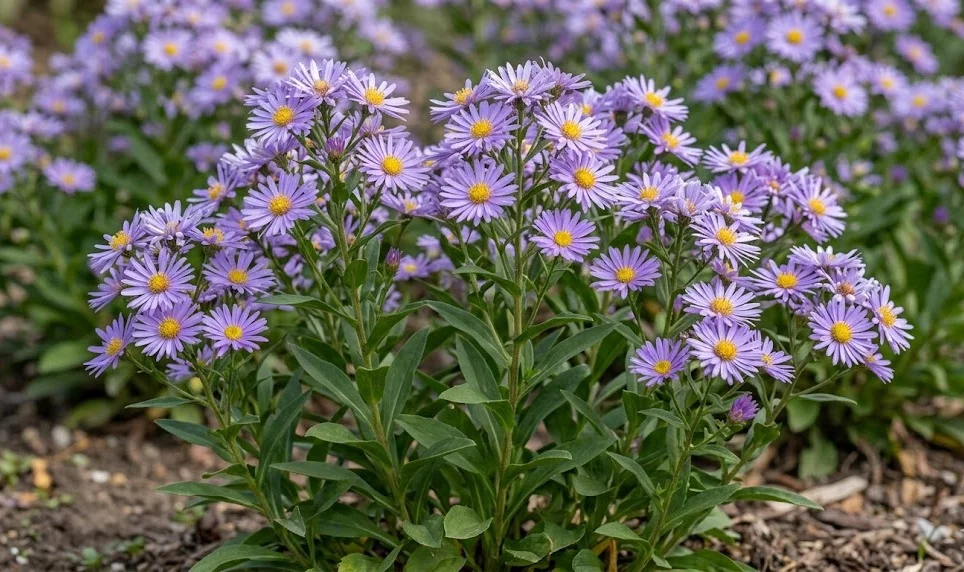

Italian aster is a sun-loving perennial, and light quality has a direct effect on its shape, strength, and flowering. When it receives enough sun, it tends to grow compactly and produce a generous late-season display. When light is insufficient, stems stretch, flowering weakens, and disease risk can increase. Understanding its light needs is one of the simplest ways to grow it well.
Full sun as the ideal condition
Full sun is the preferred condition for Italian aster. In practical garden terms, this usually means at least six hours of direct sunlight each day. Morning and midday sun are especially valuable because they dry foliage and support strong photosynthesis. The result is a plant with better energy reserves and more flower buds.
Strong light helps keep stems shorter and firmer. Plants grown in shade often lean toward the light and may need support. In open sunny sites, the natural clump form is usually more attractive. This reduces maintenance and improves the overall appearance of the border.
Flowering is closely connected to light exposure. A plant in full sun generally produces more buds and richer colour. In shade, flowering may be sparse or delayed. The plant may survive, but it will not show its full ornamental value.
Sun also plays a role in disease prevention. Leaves that dry quickly after rain are less likely to suffer from mildew and other fungal issues. Open light and air work together to keep the plant healthier. This is why a bright site is not only decorative but practical.
More articles on this topic
Tolerating partial shade
Italian aster can tolerate light partial shade, especially in regions with intense summer heat. A site with morning sun and light afternoon shade may still produce good results. This can be useful in gardens where midday heat is severe. However, the shade should be open and bright rather than dense.
The quality of shade matters greatly. Shade from high, open-branched trees is very different from shade cast by walls or evergreen shrubs. Moving air and reflected light can make partial shade more acceptable. Dark, enclosed shade is much less suitable.
In partial shade, careful maintenance becomes more important. Plants may need wider spacing to improve airflow. Feeding should be restrained because lush growth in shade becomes weak quickly. Watering should also be measured, as shaded soil dries more slowly.
If flowering is disappointing, light should be the first factor to review. Many gardeners try fertiliser before considering sunlight, but this often worsens the problem. More food cannot compensate for inadequate light. Moving the plant to a brighter position may transform its performance.
More articles on this topic
Managing light in mixed borders
In a mixed border, neighbouring plants can change the available light over time. Young shrubs, ornamental grasses, and tall perennials may gradually shade Italian aster. What was once a sunny spot can become crowded after a few seasons. Regular border editing helps maintain good conditions.
Place Italian aster where it will not be overwhelmed by taller companions. It pairs well with plants that allow light and air to pass through. Upright grasses, airy salvias, and open-structured perennials are often good partners. Dense, spreading plants can smother its lower growth.
Seasonal sun angles should also be considered. Late-season flowering depends on the light available in summer and early autumn. A site that is sunny in spring may become shaded later by tree canopies. Observe the garden at different times before choosing a permanent position.
If a plant begins leaning or flowering poorly, it may be signalling that the light has changed. Dividing and replanting can solve the issue when the clump is still healthy. Choose a brighter, more open location for the strongest divisions. This keeps the plant productive rather than merely alive.