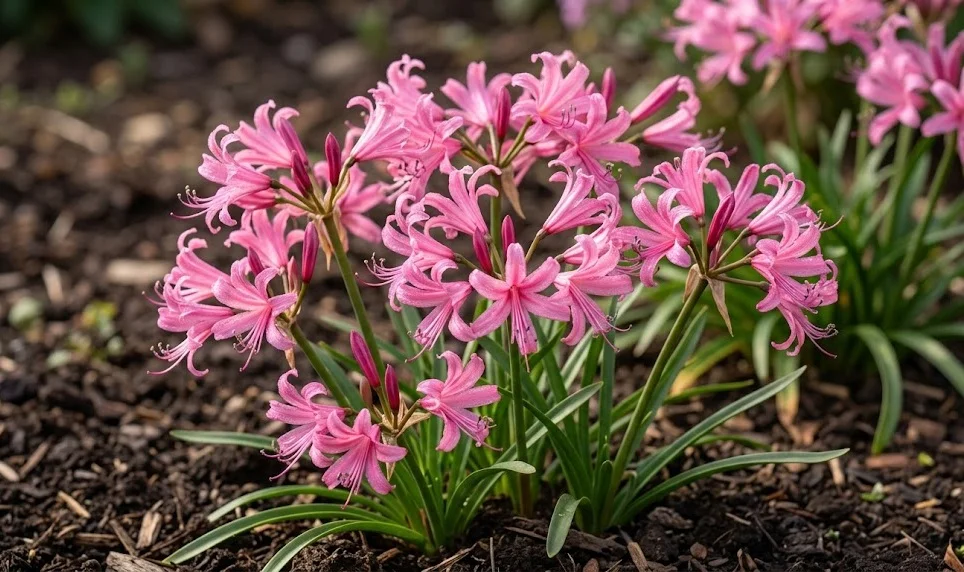

Bowden lily is one of those autumn-flowering bulbs that rewards patience, good drainage, and a little restraint. Its flowers appear when many summer perennials are already fading, bringing clear pink, sparkling blooms into borders, gravel gardens, and sheltered courtyards. Although it looks delicate, it is a resilient plant when its basic rhythm is respected. The key is to treat it as a bulb that prefers warmth, sun, and dry periods rather than constant pampering.
Understanding the growth cycle
Bowden lily grows from a true bulb that stores energy through its fleshy scales. This storage organ allows the plant to survive dry spells and cool seasons, but it also makes drainage especially important. If the bulb sits in waterlogged soil, the risk of rot rises quickly. A healthy bulb should feel firm, heavy, and clean at the base.
The plant usually produces strap-like leaves after flowering or during the cooler part of the year, depending on the local climate. These leaves are not decorative in the same way as the flowers, but they are essential for next season’s bloom. They gather light, build carbohydrates, and refill the bulb’s reserves. Removing them too early weakens flowering in later years.
Flowering typically comes in late summer or autumn, often after a warm, dry spell followed by a change in moisture. The tall stems rise before or alongside fresh foliage, creating a graceful, almost unexpected display. Each stem can carry several narrow-petalled flowers with a bright, polished quality. This late timing makes Bowden lily valuable in gardens where seasonal continuity matters.
Its natural habit explains much of its care. It does not enjoy heavy feeding, soggy ground, or frequent disturbance. Once settled, it often flowers better when left alone for several years. A gardener’s best work is usually done before planting, by choosing the right site and preparing the soil carefully.
More articles on this topic
Choosing the best position
Bowden lily needs a sunny, warm position to flower reliably. Full sun is ideal in cooler regions, especially where summers are not consistently hot. In very warm gardens, light afternoon shade can help reduce stress without compromising bloom. The aim is strong light with good air movement and no prolonged dampness around the bulbs.
A south-facing or west-facing border is often suitable. Planting near a wall, stone path, or gravel surface can create a useful pocket of stored warmth. This reflected heat helps ripen the bulbs and supports flower initiation. In exposed gardens, a sheltered corner can make a noticeable difference.
Avoid low areas where cold air and water collect. Bowden lily may survive in such places for a while, but flowering will usually be poor. Wet winter soil is especially damaging because the bulb remains vulnerable while growth is slow. Raised beds, slopes, and containers are safer choices where soil is naturally heavy.
The plant combines well with grasses, late-flowering perennials, and silver-leaved Mediterranean herbs. These companions usually prefer similar open, well-drained conditions. They also help disguise the foliage when it is not at its best. Good planting partners make the display look intentional throughout the year.
More articles on this topic
Preparing the soil
The most important soil requirement is drainage. Bowden lily prefers soil that allows excess water to move away quickly, especially in winter. Sandy loam, gritty loam, or amended garden soil works well. Heavy clay should be improved deeply rather than only on the surface.
Coarse grit, sharp sand, fine gravel, or mineral-rich compost can improve structure. The goal is not to make the soil poor, but to make it open and breathable. Organic matter should be used moderately because overly rich, wet compost can hold too much moisture. A balanced, crumbly texture is better than a soft, spongy one.
Soil fertility should be moderate. Too much nitrogen encourages lush leaves at the expense of flowers. A small amount of mature compost or a low-nitrogen bulb fertiliser is usually enough. Bowden lily performs best when growth is firm rather than forced.
The pH can be slightly acidic to neutral or mildly alkaline, provided drainage is good. The plant is more sensitive to physical soil conditions than to small pH differences. Compacted soil should be loosened before planting. Roots need oxygen as much as they need moisture and nutrients.
Watering through the seasons
Watering should follow the plant’s seasonal rhythm. Newly planted bulbs need enough moisture to help roots establish, but they should never be soaked repeatedly. Once growth begins, the soil can be kept lightly moist. Deep but infrequent watering is better than frequent shallow watering.
During active leaf growth, water supports photosynthesis and bulb recovery. If the weather is dry for several weeks, occasional irrigation can help maintain strong leaves. The soil should partly dry between waterings. Constant dampness creates weak growth and invites disease.
In summer dormancy or semi-dormancy, the plant needs much less water. This dry rest is important for bulb health and flower preparation. In open ground, natural rainfall may be enough or even too much in wet climates. In containers, watering should be reduced carefully rather than stopped so abruptly that roots shrivel.
Autumn watering should be moderate. A little moisture can encourage flower stems and new roots, but excess water is dangerous as temperatures fall. Mulching with gravel rather than thick organic mulch can help keep the bulb neck dry. The best watering practice is controlled, seasonal, and observant.
Feeding for reliable flowering
Bowden lily does not need heavy feeding. A light application of a balanced bulb fertiliser in early active growth is usually sufficient. The nutrient focus should be on potassium and phosphorus rather than high nitrogen. These elements support root strength, bulb reserves, and flower formation.
Liquid feeding can be useful for container plants. Use a dilute feed every few weeks while leaves are actively growing. Stop feeding once foliage begins to yellow naturally. Feeding dormant bulbs is ineffective and can increase salt buildup in pots.
In garden soil, overfeeding is a common mistake. Lush foliage may look promising, but it can delay ripening and reduce bloom. Bulbs that grow too softly are also more vulnerable to cold and rot. A leaner regime usually produces sturdier plants.
Compost can be applied sparingly around the planting area, not piled against the bulb neck. Mature, well-broken compost is better than fresh manure. Fresh organic material can burn roots, attract pests, and hold excessive moisture. A restrained feeding plan suits the plant’s natural character.
Routine maintenance
The most important routine task is protecting the foliage until it dies back naturally. Leaves should remain in place while they are green because they feed the bulb. Cutting them too soon reduces next year’s flowering potential. Yellowing leaves can be removed once they detach easily.
Spent flower stems may be cut after blooming if seed is not required. Removing them keeps the planting neat and prevents unnecessary energy use. However, the stem should be cut above the foliage and not pulled from the bulb. Pulling can damage the basal plate.
Weeding is also important because Bowden lily dislikes competition around its bulb zone. Shallow-rooted weeds steal moisture and nutrients during active growth. Deep-rooted weeds can disturb bulbs when removed. A light gravel mulch helps suppress weeds without trapping too much moisture.
Established clumps should not be divided too often. The bulbs often flower better when slightly crowded and settled. Disturbance interrupts root systems and can delay flowering for one or two seasons. Division is best reserved for overcrowded clumps or declining performance.
Long-term garden performance
Bowden lily becomes more impressive with age when conditions are right. A small planting can gradually form a generous clump with many flowering stems. This slow increase is part of its charm. It is not an instant bedding plant, but a long-term garden feature.
Flowering may be irregular during the first years after planting. Bulbs need time to settle, produce strong roots, and adapt to the garden’s climate. A non-flowering year does not always mean failure. Strong leaves are often a sign that the plant is building reserves.
Winter protection may be needed in colder or wetter regions. A dry mulch, a rain shadow, or container culture can improve survival. The bulb tolerates cold better when it is dry and deeply rooted. Wet cold is far more dangerous than dry cold.
The best results come from consistency. Choose the site carefully, avoid overwatering, feed lightly, and let the foliage complete its work. Bowden lily then becomes a dependable late-season highlight. Its refined flowers bring elegance to the garden at a time when every fresh bloom feels especially valuable.