
Amur maple is valued in gardens for its adaptable nature, compact growth, and vivid autumn colour. It performs well as a specimen tree, informal hedge, multi-stemmed shrub, or small landscape tree in both urban and rural settings. Good care begins with understanding its natural rhythm, because this plant responds best to steady moisture, good light, and moderate pruning rather than excessive intervention. When its basic needs are met, it becomes a reliable, long-lived feature with strong seasonal character.
Growth habit and garden value
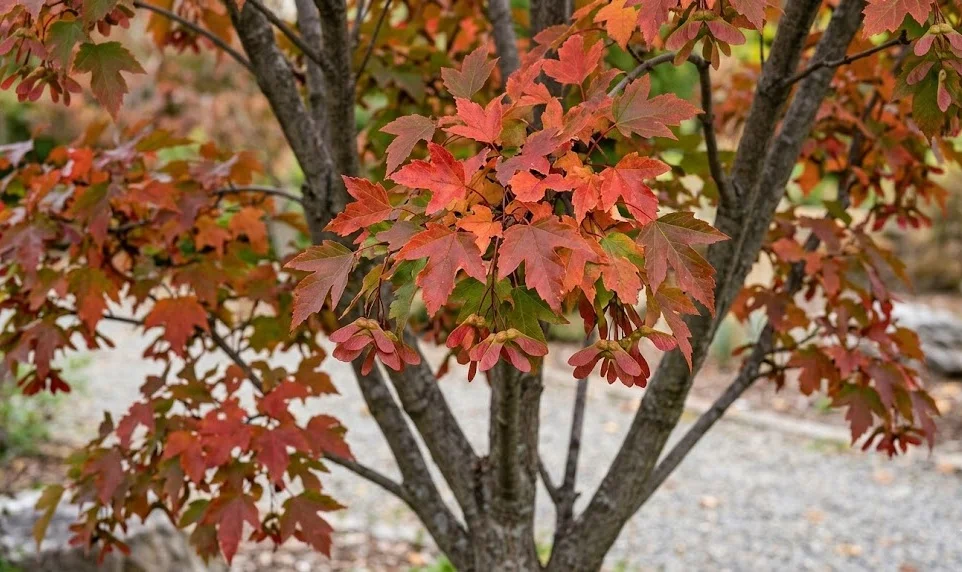
Amur maple usually develops as a large shrub or small tree with a rounded, spreading crown. In many gardens it reaches a manageable size, making it suitable for spaces where larger maples would become too dominant. Its fine branching gives it an elegant winter outline, especially when grown as a multi-stemmed specimen. The plant is particularly appreciated for its fiery red, orange, and scarlet autumn foliage.
The leaves are smaller than those of many ornamental maples, which gives the plant a refined texture. During spring and summer, the foliage is fresh green and creates a calm background for perennials, grasses, and flowering shrubs. In autumn, the colour can become remarkably intense when the plant receives enough sunlight and avoids drought stress. This seasonal transformation is one of the main reasons gardeners choose it.
The plant can be trained in several ways depending on the design goal. It may be allowed to form a natural shrub, shaped into a small tree, or maintained as a dense screen. This flexibility makes it useful in mixed borders, entrance areas, windbreaks, and wildlife-friendly plantings. Its moderate growth rate also makes it easier to manage than faster-growing trees.
Amur maple is generally tough, but it should not be treated as completely maintenance-free. Young plants need careful watering, weed control, and structural guidance during establishment. Mature plants require less attention, yet they still benefit from observation and occasional corrective pruning. Good care is mostly about consistency rather than heavy yearly work.
More articles on this topic
Soil requirements and site preparation
Amur maple adapts to many soil types, but it grows best in fertile, well-drained ground. A loamy soil with a balanced structure supports steady root development and healthy shoot growth. Heavy clay can be improved with compost and careful cultivation, while very sandy soil benefits from added organic matter. The main goal is to create soil that holds moisture without remaining waterlogged.
Before planting, the site should be cleared of perennial weeds and compacted layers should be loosened. Roots need oxygen as much as moisture, so dense, sealed soil can slow establishment. Mixing mature compost into the planting area improves microbial activity and helps young roots explore the surrounding ground. It is better to improve a broad area than to enrich only the planting hole.
Soil pH is not usually a serious limitation for this species. It tolerates slightly acidic to neutral conditions and often manages in mildly alkaline soils as well. However, extreme alkalinity may reduce nutrient availability and cause pale foliage. If the soil is very calcareous, adding organic matter and maintaining mulch can help moderate stress.
Drainage is especially important during winter and early spring. Standing water around the root zone can weaken roots and make the plant more vulnerable to disease. If the site is low and wet, planting on a slight mound can improve root conditions. A healthy root environment is the foundation of long-term care.
More articles on this topic
Watering and moisture management
Young Amur maples need regular watering during the first two or three growing seasons. The aim is to keep the root zone evenly moist, not constantly saturated. Deep watering is more effective than frequent shallow sprinkling because it encourages roots to grow downward. A plant with deep roots becomes more resilient during dry weather.
During summer heat, the soil should be checked beneath the mulch rather than judged only by the surface. The top layer may look dry while deeper soil still contains adequate moisture. If the soil is dry several centimetres down, a slow soaking is useful. Watering early in the morning reduces evaporation and gives the foliage time to dry if any water reaches the leaves.
Mature plants are moderately drought tolerant, but prolonged dryness can reduce autumn colour and cause leaf scorch. Drought stress may also lead to premature leaf drop, especially on exposed sites. Even established specimens benefit from occasional deep watering during long dry spells. This is particularly important in urban gardens where reflected heat and compacted soil increase stress.
Mulching is one of the simplest ways to stabilise moisture. A layer of bark, leaf mould, or composted wood chips helps reduce evaporation and suppress weeds. The mulch should be kept away from direct contact with the trunk to prevent bark problems. Renewing it each year keeps the root zone cool and biologically active.
Feeding and nutrient balance
Amur maple does not need heavy fertilisation in ordinary garden soil. Excess nitrogen can produce soft, overly vigorous shoots that are more prone to damage. A moderate feeding approach supports balanced growth, strong wood, and better seasonal colour. In most gardens, compost and mulch provide enough nutrition.
If growth is weak and the foliage looks pale, the soil should be assessed before fertiliser is applied. Poor drainage, drought, root damage, or compaction can cause symptoms that resemble nutrient deficiency. Applying fertiliser without correcting those problems rarely improves the plant. Healthy soil structure is often more important than additional nutrients.
A slow-release, balanced fertiliser may be used in spring when the plant clearly needs support. It should be applied according to the product instructions and watered in well. Feeding late in the season is not recommended because it may encourage tender growth before winter. The best time to support growth is when the plant is naturally entering active development.
Organic feeding suits Amur maple particularly well. Mature compost, leaf mould, and decomposed manure improve the soil gradually without forcing growth. These materials also support beneficial organisms around the roots. Over time, this creates a stable growing environment and reduces the need for corrective care.
Pruning and shape control
Pruning should focus on structure, health, and proportion rather than constant shaping. Amur maple naturally forms an attractive outline if it has enough space. Removing dead, damaged, crossing, or inward-growing branches helps maintain a strong framework. Light, thoughtful pruning is usually better than severe cutting.
The best time for structural pruning is late winter or early spring before strong growth begins. At this stage, the branch framework is easy to see, and cuts can be made with precision. Heavy pruning during active sap flow may cause bleeding, although this is usually not fatal. Clean, sharp tools reduce tearing and promote better wound closure.
If the plant is grown as a small tree, the lower branches can be removed gradually over several years. Sudden removal of many lower branches may expose the trunk and stress the plant. A gradual approach produces a more natural crown and stronger stem development. The final shape should match both the plant’s habit and the surrounding design.
Hedge-grown Amur maple can tolerate more frequent trimming, but it should still not be clipped too harshly. Repeated tight shearing may create dense outer growth and bare inner wood. A slightly informal hedge allows light to reach more of the plant. This keeps the foliage fuller and the plant healthier over time.
Seasonal maintenance through the year
Spring care begins with checking winter damage and refreshing the mulch layer. Dead twigs can be removed once it is clear which buds are swelling. The soil should be kept evenly moist as new growth begins. This is also a good time to inspect the base of the plant for bark injury or rodent damage.
In summer, the main tasks are watering, weed control, and monitoring for stress. Leaves that curl, scorch, or drop early may indicate drought, heat reflection, or root problems. Weeds and grass competing around the root zone should be removed carefully. A clean, mulched base reduces competition and improves water efficiency.
Autumn is the season when the plant shows its greatest ornamental value. Good colour is encouraged by adequate sunlight, steady moisture, and healthy foliage during summer. Fallen leaves can be composted if they are not diseased. If the plant has carried heavy seed crops, young seedlings should be removed where unwanted.
Winter maintenance is minimal, but observation remains useful. Heavy snow can bend flexible branches, especially on young multi-stemmed plants. Snow should be brushed off gently rather than shaken violently. In exposed gardens, young trunks may benefit from protection against frost cracks and animal browsing.
Long-term landscape care
A well-placed Amur maple can remain attractive for many years with moderate care. Its size, colour, and texture make it suitable for gardens that need seasonal interest without excessive maintenance. The plant works especially well near paths, lawns, courtyards, and mixed shrub borders. Its strong autumn colour gives structure to the garden at the end of the growing season.
Spacing is important because the plant needs room to develop its natural crown. Crowding it between large shrubs or buildings can reduce air movement and distort its form. When planted too close to hard surfaces, drought stress may become more severe. Giving it adequate space from the beginning reduces future pruning pressure.
Gardeners should also consider local ecological behaviour. In some regions, Amur maple can self-seed freely and may become invasive near natural areas. Seedlings should be monitored and removed where they are not wanted. Responsible maintenance keeps the plant useful without allowing it to spread beyond the intended design.
The best care combines restraint with regular observation. Amur maple does not require constant attention, but it rewards timely watering, good soil care, and careful pruning. When treated as a living structural element rather than a disposable ornamental, it becomes more valuable each year. Its beauty lies in the balance between toughness, elegance, and seasonal drama.