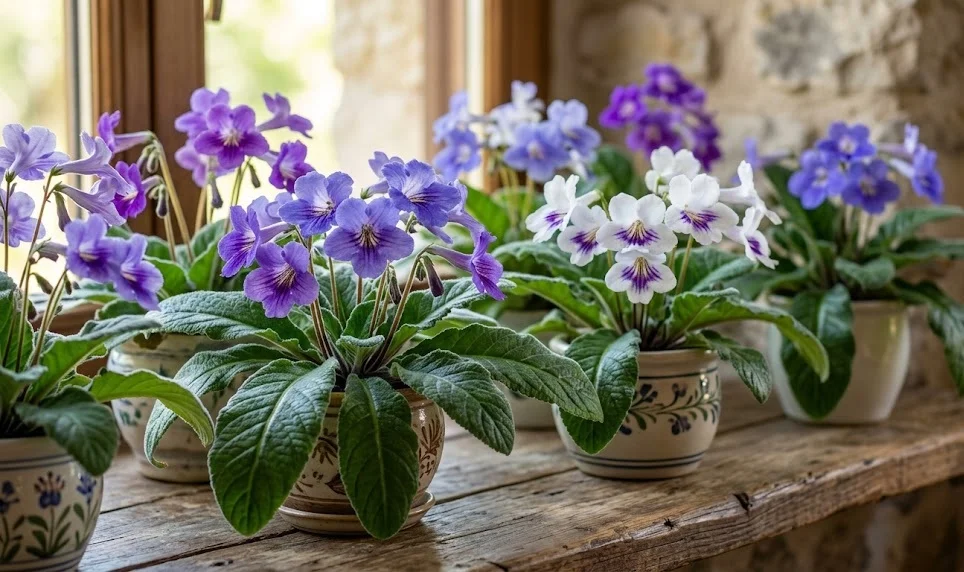

Finding the “sweet spot” for lighting is one of the most important aspects of growing a healthy Cape primrose. In their native habitat, these plants grow on the forest floor or on rocky ledges where they receive filtered sunlight. This means they crave bright light but can be easily damaged by the intense, direct rays of the sun. You should aim for a location that provides plenty of indirect illumination throughout the day.
An east-facing window is often considered the ideal location because it provides gentle morning sun that isn’t too hot. If you only have a south-facing window, you will need to protect the plant with a sheer curtain to diffuse the light. Without this protection, the leaves can quickly develop brown, “sun-scorched” patches that will never heal. Observing how the light moves through your room during different times of the day will help you choose the best spot.
If you notice your plant’s leaves becoming very dark green and the stems becoming long and thin, it is likely not getting enough light. Conversely, leaves that turn pale or yellowish-green may be receiving too much light, causing the chlorophyll to break down. The goal is to maintain a healthy, mid-green color and a compact growth habit. A well-lit plant will also produce more flower buds and have a much longer blooming season.
Artificial lighting is a fantastic option if your home doesn’t have enough natural light to support healthy growth. Modern LED grow lights are very efficient and can be adjusted to provide the exact spectrum of light the plant needs. You should keep the lights on for about twelve to fourteen hours a day to mimic a long summer day. Position the light about thirty centimeters above the foliage to prevent any heat damage while ensuring maximum brightness.
Using artificial light effectively
When using grow lights, the quality of the light is just as important as the quantity. Look for “full-spectrum” lights that provide a balance of blue light for leaf growth and red light for flowering. Many growers find that a simple T5 fluorescent bulb or a specialized LED panel works wonders for their collection. These lights allow you to grow beautiful plants even in the darkest corners of your home or in a basement.
More articles on this topic
The distance between the light source and the plant is a critical variable that you should monitor closely. If the light is too far away, the plant will stretch toward it, becoming “leggy” and unattractive. If it is too close, the heat from the bulbs—even LEDs—can dry out the leaves and cause stress. Most growers find that a distance of twenty to forty centimeters is a good starting point for most setups.
You can use a timer to ensure your plants get a consistent “day” and “night” cycle every twenty-four hours. Consistency is key, as sudden changes in light duration can disrupt the plant’s internal flowering hormones. Some varieties are more sensitive to day length than others, but generally, a twelve-hour day is sufficient for year-round blooming. This automated approach takes the guesswork out of the daily routine and ensures your plants are always happy.
Reflective surfaces can also help you make the most of the light you have available. Placing your plants in front of a white wall or using a reflective tray can bounce light back onto the undersides of the leaves. This ensures that the entire plant receives illumination, not just the parts facing the window or the bulb. It is a simple trick that can significantly improve the overall health and symmetry of your specimens.
Signs of light-related stress
Learning to read the signals your plant sends is the best way to adjust your lighting strategy. If you see the leaves curling downward and hiding under one another, the plant is trying to protect itself from too much light. This is an early warning sign that you should move the plant further from the light source or add a diffuser. If you ignore this signal, the next stage will be permanent leaf burn and a decline in overall health.
More articles on this topic
On the other hand, a plant that is “reaching” for the light will have long, weak leaf stalks and very few flowers. The leaves may also appear larger than normal as the plant tries to increase its surface area to catch every available photon. While large leaves can be attractive, they are often a sign that the plant is struggling to produce enough energy for blossoms. Moving the plant to a brighter location will usually trigger a new flush of flower buds within a few weeks.
If your plant only blooms on one side, it is a clear indication that the light source is one-sided. To maintain a beautiful, symmetrical plant, you should rotate the pot by a quarter-turn every week. This ensures that every leaf gets its fair share of energy and prevents the plant from leaning heavily in one direction. It is a small habit that makes a big difference in the professional appearance of your indoor garden.
Seasonal changes in light can also catch even experienced growers off guard. A window that is perfect in the winter may become a “heat trap” in the summer as the sun’s angle changes. You should be prepared to move your plants around your home throughout the year to follow the best light. Staying flexible and observant is the hallmark of a successful gardener who works with nature rather than against it.