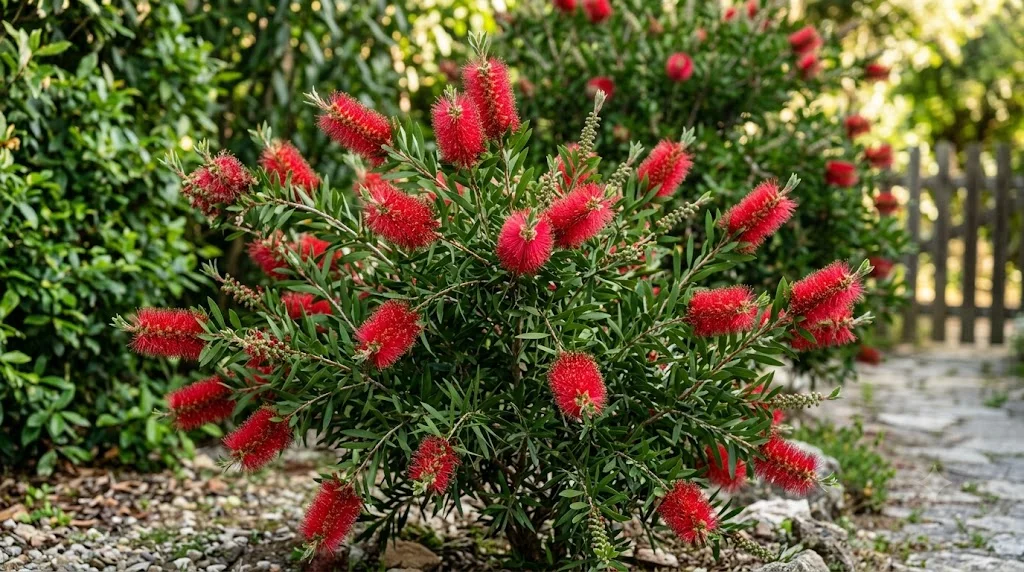

Correct planting gives lemon bottlebrush the drainage, stability, and root space it needs to establish rapidly. Propagation can be achieved from seed, but semi-ripe cuttings usually produce more predictable plants that closely resemble the parent. Warmth, clean materials, and careful moisture management are essential during both planting and propagation. Attention during the first growing season has a lasting influence on the plant’s future shape and resilience.
Preparing the planting site
Choose a site that receives at least six hours of direct sunlight on most days. Shelter from cold winds is especially important in regions with cool springs or unpredictable autumn weather. The mature spread should be considered so that nearby structures and plants are not crowded later. Allowing adequate space also improves airflow through the developing crown.
Examine the soil before digging the planting hole. Water should drain freely rather than collecting around the root zone after rain. Heavy soil can be improved over a wide area with coarse organic matter and mineral drainage material. Altering only the planting hole may create a basin that traps water around the roots.
The planting hole should be wider than the root ball but no deeper than its existing height. Planting too deeply can suffocate surface roots and keep the lower stem persistently wet. The upper surface of the root ball should remain level with, or slightly above, the surrounding ground. Loosening the sides of the hole helps new roots move into the adjacent soil.
Water the plant thoroughly before removing it from its nursery container. Gently tease out circling roots without breaking the root mass excessively. Position the plant upright and backfill with the excavated soil, firming only enough to remove large air pockets. Finish by watering deeply to settle the soil naturally around the roots.
More articles on this topic
Establishing newly planted specimens
Newly planted lemon bottlebrush should receive consistent moisture while roots extend into the surrounding ground. The original root ball can dry more quickly than the adjacent soil, so both areas should be checked. Deep watering is preferable to frequent surface sprinkling because it encourages downward root growth. Waterlogging must still be avoided, especially in cool weather.
A broad mulch layer helps conserve moisture and suppress competition from weeds. Keep the mulch several centimetres away from the trunk or main stems. Direct contact can retain excessive moisture and create conditions favourable to decay. Replenish the layer when it becomes thin, compacted, or mixed into the soil.
Tall or top-heavy plants may need temporary staking in exposed positions. Stakes should prevent excessive root movement without holding the trunk completely rigid. A small amount of natural movement encourages the development of stronger supporting tissue. Ties must be checked regularly and removed once the roots provide sufficient stability.
Strong fertiliser is unnecessary immediately after planting and may damage tender new roots. A light application of a balanced, slow-release product can be used once active growth is established. Organic matter incorporated into the broader soil area may provide enough nutrition during the first season. The priority should remain steady rooting rather than rapid top growth.
More articles on this topic
Propagating from cuttings
Semi-ripe cuttings taken from healthy, non-flowering shoots generally offer the most reliable propagation method. Select firm current-season growth that is beginning to mature but has not become fully woody. Each cutting should carry several nodes and a healthy growing tip. Early morning collection reduces moisture loss before preparation.
Use a sterile, sharp blade to cut just below a node. Remove the lower leaves while retaining a small group near the tip. Large remaining leaves can be shortened if they lose moisture rapidly. Avoid taking material from plants showing signs of pests, disease, nutrient deficiency, or drought stress.
Insert the prepared cuttings into a free-draining propagation mixture containing fine bark, perlite, sand, or similar material. The medium should be moist but never saturated. Rooting hormone may improve uniformity, although clean conditions and stable moisture are equally important. Firm the medium gently around each cutting so that the base remains in close contact with it.
Place the cuttings in bright, indirect light with warm, humid conditions. A propagator or clear cover can reduce water loss, but regular ventilation is necessary to prevent fungal growth. Rooting may take several weeks and should not be judged by early leaf appearance alone. New resistance to a gentle pull and fresh shoot development usually indicate successful root formation.
Growing from seed and caring for young plants
Seed propagation is useful when many plants are required or when variation is acceptable. Fresh seed usually germinates more reliably than material stored for long periods. Sow it thinly on the surface of a fine, sterile seed-starting medium. Because the seed is small, only a very light covering should be applied.
Maintain even moisture with a fine mist or bottom-watering method. Heavy watering can displace seed or compact the upper layer of the medium. Warm temperatures and bright, filtered light encourage steady germination. The tray should remain ventilated to reduce damping-off and algal growth.
Seedlings can be transplanted when they have developed several true leaves and are large enough to handle safely. Lift them by a leaf rather than pulling on the delicate stem. Pot each seedling into a small container filled with a porous growing medium. Keep the young plants sheltered from harsh midday sun until they resume active growth.
Young plants benefit from gradual exposure to outdoor conditions. Begin with a protected position and extend the time outdoors over one or two weeks. Sudden exposure to strong sun, wind, or cold nights can scorch or weaken tender foliage. Once hardened, the plants can be managed like established container specimens while receiving slightly more attentive watering.