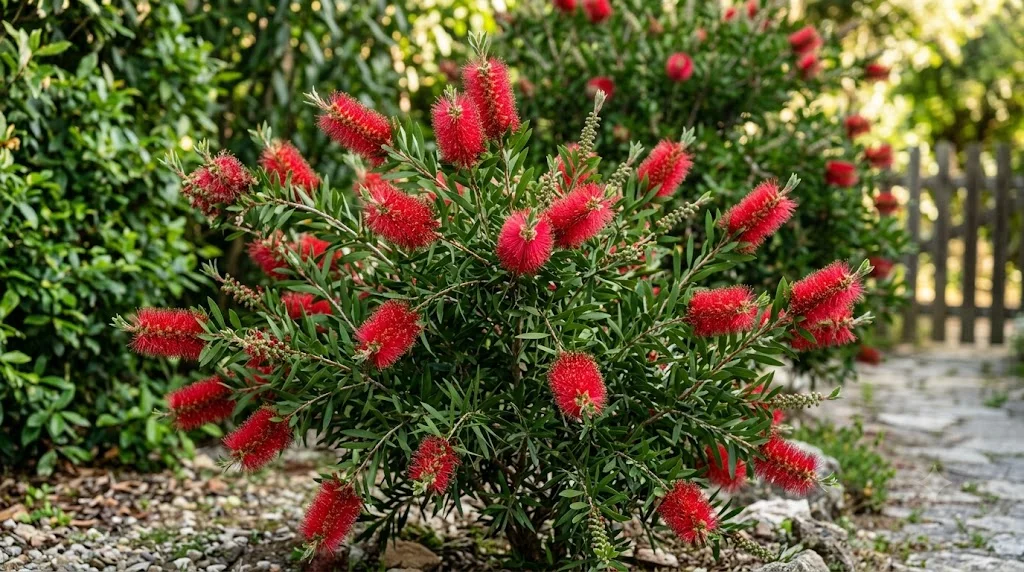

Lemon bottlebrush is an evergreen shrub or small tree admired for its vivid red flower spikes, aromatic foliage, and naturally graceful form. It grows vigorously when provided with strong light, free-draining soil, and consistent moisture during the active season. Although established plants tolerate short dry periods, regular care produces denser foliage and a more impressive floral display. Understanding its subtropical character is the key to keeping the plant healthy in gardens, containers, conservatories, and bright indoor spaces.
Understanding its natural growth habit
Lemon bottlebrush develops as a densely branched shrub or a small multi-stemmed tree, depending on how it is trained. Mature specimens may reach several metres in height where winters remain mild and growing conditions are favourable. Young branches are flexible and often carry narrow leaves that release a fresh citrus fragrance when rubbed. Its natural growth habit should be considered before choosing a permanent planting position.
The plant belongs to a group of Australian shrubs adapted to bright sunlight, irregular rainfall, and relatively lean soils. These conditions explain its preference for excellent drainage and its ability to withstand brief dry spells after establishment. However, tolerance should not be confused with complete independence from care. Newly planted or container-grown specimens require considerably more attentive watering than mature plants growing in open ground.
Flowering usually occurs most strongly from late spring into summer, although warm climates may encourage several smaller flushes. The cylindrical flower clusters are formed from numerous projecting stamens, creating the familiar brush-like appearance. Healthy shoots exposed to sufficient sunlight produce the greatest number of flower buds. Weak, shaded, or excessively fertilised growth tends to carry fewer blooms.
The root system is fibrous and capable of spreading through a broad volume of soil. In well-drained ground, this allows the plant to locate moisture efficiently and recover quickly after hot weather. Roots growing in containers are more restricted and therefore react faster to drought, waterlogging, and sudden temperature changes. Pot cultivation consequently demands closer observation throughout the year.
More articles on this topic
Selecting the right growing position
A warm, sheltered, and sunny location offers the best foundation for vigorous development. The plant should ideally receive direct sunlight for most of the day, particularly during spring and summer. A south-facing or west-facing position is often suitable in cooler regions, provided that reflected heat does not dry the root ball too rapidly. Protection from persistent cold winds helps preserve both foliage and developing flower buds.
Outdoor specimens perform well near sunlit walls, courtyards, terraces, and sheltered borders. Masonry surfaces absorb warmth during the day and release it gradually after sunset, creating a favourable microclimate. This extra warmth can extend the growing season and support better ripening of new shoots before winter. Adequate air circulation must still be maintained to prevent stagnant, humid conditions around the foliage.
In frost-prone regions, container cultivation is frequently the safest option. A movable pot allows the shrub to enjoy outdoor sun during the warm months and sheltered accommodation during winter. The container should be heavy enough to prevent the crown from tipping over during strong winds. Broad-based pots also give the spreading roots greater stability and improve moisture distribution.
Indoor cultivation is possible, but only in exceptionally bright conditions. A large window, heated conservatory, or glazed sunroom usually provides better results than an ordinary living room. Dry indoor air and insufficient winter light can lead to leaf drop, weak growth, and pest problems. Whenever temperatures permit, moving the plant outdoors improves light exposure and natural air movement.
More articles on this topic
Creating suitable soil conditions
Lemon bottlebrush prefers a porous growing medium that drains freely while retaining enough moisture to support active roots. Heavy clay that remains saturated for long periods can cause root decline and reduced growth. Garden soil should be improved with coarse mineral material, fine bark, or mature organic matter where drainage is inadequate. Raised planting areas are useful when the natural soil level is frequently wet.
The plant tolerates mildly acidic to neutral soil and can often adapt to slightly alkaline conditions. Persistent alkalinity may nevertheless reduce the availability of iron and other micronutrients. This can produce pale leaves with greener veins, especially in container plants irrigated with hard water. Using rainwater and an appropriate fertiliser can help prevent nutritional chlorosis.
A suitable potting mixture should contain structural ingredients that resist compaction over time. High-quality peat-free compost can be combined with fine pine bark, perlite, pumice, or coarse horticultural sand. The final mixture should allow water to pass through evenly without leaving large dry pockets. A dense medium that shrinks away from the pot edge is unsuitable for long-term cultivation.
Mulching outdoor plants helps regulate soil temperature and reduces rapid evaporation during summer. Organic mulch should be spread over the root zone without touching the main stems. A layer several centimetres deep is generally sufficient to suppress weeds and protect surface roots. Excessively thick or constantly wet mulch may encourage stem decay and should be avoided.
Managing seasonal growth
Spring is the main period of renewed growth, increasing water demand, and flower-bud development. As temperatures rise, the plant should be checked frequently for fresh shoots and drying soil. Feeding can begin once active growth is clearly visible. Plants moved outdoors after winter must be acclimatised gradually to intense sunlight.
Summer care focuses on maintaining even moisture without allowing the root zone to remain saturated. Container plants may need water daily during hot, windy weather, particularly when they carry a large crown. Faded flower clusters can be removed to improve appearance and encourage compact branching. Regular inspection also makes it easier to detect scale insects, mites, or nutrient problems early.
During autumn, growth naturally slows as days shorten and temperatures fall. Fertiliser applications should be reduced or stopped so that young shoots have time to mature. Watering frequency should also decline, although the soil must not be allowed to become completely dry. Plants intended for winter shelter should be checked and cleaned before being brought indoors.
Winter management depends heavily on local climate and the plant’s growing position. Established specimens in mild regions may remain outdoors with only temporary frost protection. Container plants are less insulated and can suffer root damage even when the upper growth appears unaffected. A cool, bright, frost-free winter location is usually the most reliable solution.
Supporting flowering and foliage quality
Strong flowering begins with adequate light and balanced growth during the preceding months. Shoots that mature in bright conditions are more likely to form numerous flower buds. Excess nitrogen can stimulate long, leafy stems at the expense of blooms. Feeding should therefore support steady development rather than forcing rapid, soft growth.
Moisture stress during bud formation may cause poor flowering or premature bud drop. The root zone should remain evenly moist during spring, especially when warm weather follows a dry period. Sudden cycles of severe drought and heavy watering are more damaging than moderate, consistent moisture. Mulch and careful irrigation help stabilise conditions around outdoor roots.
Removing spent flower spikes can improve the plant’s appearance and stimulate branching below the faded clusters. This light trimming is especially useful on young plants being trained into a dense shrub. Cuts should be made above healthy leaves or side shoots rather than deep into old bare wood. Regular small adjustments are safer than infrequent severe pruning.
Foliage colour provides a useful indication of general health. Healthy leaves are usually firm, narrow, and evenly green, although new growth may initially appear lighter or bronze. Yellowing can signal root stress, nutrient imbalance, cold damage, or unsuitable soil reaction. Diagnosis should consider watering, drainage, temperature, and feeding together rather than treating leaf colour as an isolated problem.
Caring for container-grown plants
Container-grown lemon bottlebrush requires a pot with generous drainage holes and enough volume to support the crown. The container should not sit permanently in a saucer of water, since stagnant moisture reduces oxygen around the roots. Pot feet can improve drainage and airflow beneath heavy outdoor containers. A stable material such as terracotta, glazed ceramic, or thick composite helps prevent wind damage.
Repotting is normally needed when roots circle densely around the pot or water passes through without moistening the medium properly. Young plants may require a larger container every one or two years. Older specimens can remain in the same pot longer if part of the outer root mass and exhausted compost are renewed. Repotting is best carried out in spring as active growth begins.
Root restriction can be useful for controlling overall size, but extreme congestion weakens the plant. A severely root-bound specimen dries very quickly and may produce small leaves or limited flowers. If a larger container is impractical, careful root pruning can be combined with crown reduction. Clean tools and fresh, well-drained compost reduce the risk of infection after this work.
Container placement may need adjustment several times during the year. Full sun is valuable in spring and summer, while shelter from cold rain and frost becomes more important in autumn. Pots placed against hot walls should be monitored closely because the root ball can overheat or dry unevenly. Turning the container periodically helps maintain balanced growth on all sides.
Maintaining long-term health
Long-term success depends on regular observation rather than rigid care schedules. Weather, plant size, soil type, and container volume all influence how quickly conditions change. Checking the soil, leaves, shoots, and drainage provides more reliable guidance than watering or feeding by calendar alone. Small problems are much easier to correct before they affect the entire crown.
Older shrubs may gradually become open or woody in the centre. Selective removal of crowded, crossing, or declining stems improves light penetration and encourages replacement growth. Renovation should be carried out gradually over more than one season when possible. Severe cutting into old wood may produce uneven regrowth and temporarily reduce flowering.
Cold injury often appears as browned leaves, blackened shoot tips, or delayed spring growth. Damaged tissue should not be removed immediately during winter because it can provide some protection to lower buds. Wait until the risk of hard frost has passed and new growth reveals which stems remain alive. Pruning back to healthy tissue then allows the plant to recover efficiently.
A well-established lemon bottlebrush can remain attractive for many years with relatively modest intervention. Its tolerance of heat, wind, and occasional drought makes it valuable in sunny, low-maintenance planting schemes. The finest specimens still receive thoughtful watering, restrained feeding, timely pruning, and winter protection where necessary. Consistent care preserves the balance between robust growth, aromatic foliage, and abundant scarlet flowers.