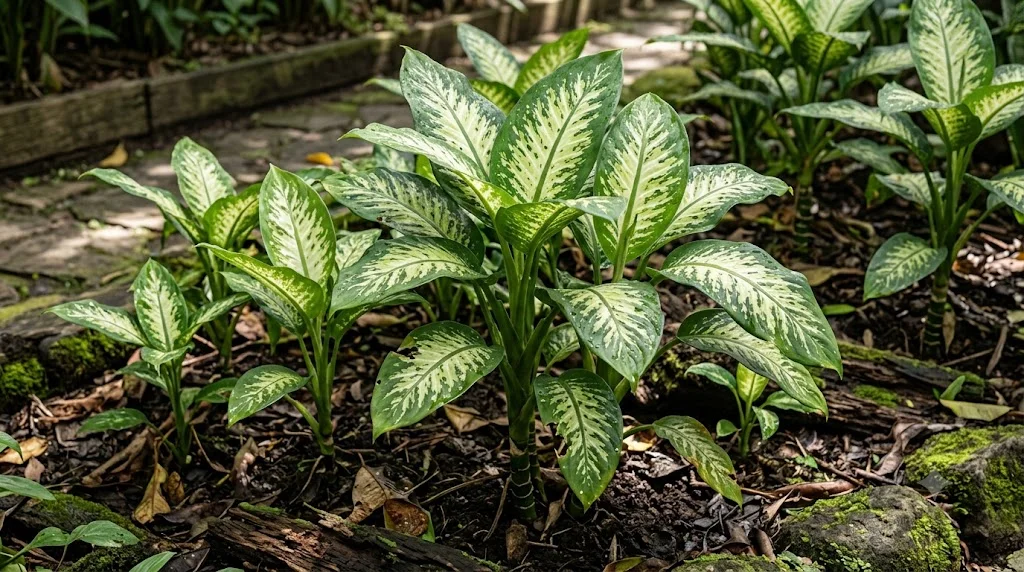

Dumb cane needs enough light to maintain strong stems, broad leaves, and clear variegation, but its foliage can be damaged by intense direct sunshine. Bright indirect light most closely resembles the filtered conditions found beneath a tropical canopy. Light levels should be adjusted as seasons change and as the plant grows farther from the window. Careful observation of leaf colour, spacing, and orientation reveals whether the position is suitable.
Finding the best light level
An east-facing window often provides an excellent balance of brightness and gentle morning sun. A bright north-facing room can also support healthy growth, particularly for greener cultivars. South- and west-facing windows usually require distance or a translucent curtain. The leaves should receive abundant diffuse light without becoming hot.
Distance from a window has a major effect on usable light. A position that appears bright to human eyes may provide little energy for plant growth several metres from the glass. Walls, balconies, trees, and neighbouring buildings can reduce intensity further. Moving the plant closer often improves growth more effectively than increasing fertiliser.
Variegated cultivars need sufficient brightness to retain their contrasting patterns. In low light, new leaves may become smaller, greener, or less clearly marked. Predominantly green forms tolerate shade somewhat better but still grow slowly in dim rooms. Tolerance should not be confused with preference.
Artificial lighting can supplement or replace weak natural light. Use a horticultural lamp that provides adequate intensity over the full leaf area. Keep it on for a consistent daily period and follow safe distance recommendations. Uneven lighting may cause the plant to lean strongly toward one side.
More articles on this topic
Recognising too little or too much light
Insufficient light commonly produces long spaces between leaves and thin, leaning stems. New foliage may emerge smaller than older leaves. Variegation can fade as the plant produces more chlorophyll to compensate. Compost also remains wet longer, increasing the risk of overwatering.
A plant leaning toward the window is responding to directional light. Rotate the pot by a small amount every few weeks rather than turning it dramatically every day. Regular slight rotation encourages a more balanced shape. Severe leaning may require a brighter position rather than rotation alone.
Excessive direct sun creates bleached, yellow, tan, or brown patches. Damage often appears on the side facing the window and does not spread like an infection. Scorched tissue cannot recover, although healthy new leaves can replace it. Move the plant away from the glass or filter the light immediately.
Heat can intensify light injury. Leaves touching hot window glass may burn even when the room temperature seems moderate. Afternoon sunlight through a west-facing window is especially powerful in summer. Air circulation and a sheer curtain help reduce both heat and radiation.
More articles on this topic
Adapting light through the seasons
Spring light becomes stronger quickly, and plants accustomed to winter shade can scorch. Increase exposure gradually while monitoring the upper leaves. A sheer curtain may be needed again as the sun rises higher. Slow acclimatisation allows leaf tissue to adjust.
During summer, bright indirect light is usually plentiful. Protect the plant from midday and afternoon sun, especially behind large south- or west-facing windows. Check that curtains do not create a completely dark environment. Filtered brightness should remain strong for much of the day.
Autumn brings shorter days and a lower sun angle. Move the plant closer to the window if growth becomes weak or one-sided. Clean the glass and foliage to maximise light transmission. Reduce watering as lower light slows moisture use.
Winter may require the brightest available position or supplemental lighting. Keep leaves away from cold panes even when placing the pot near a window. Artificial light can prevent severe stretching and loss of variegation. Maintain a regular day and night cycle rather than leaving lamps on continuously.