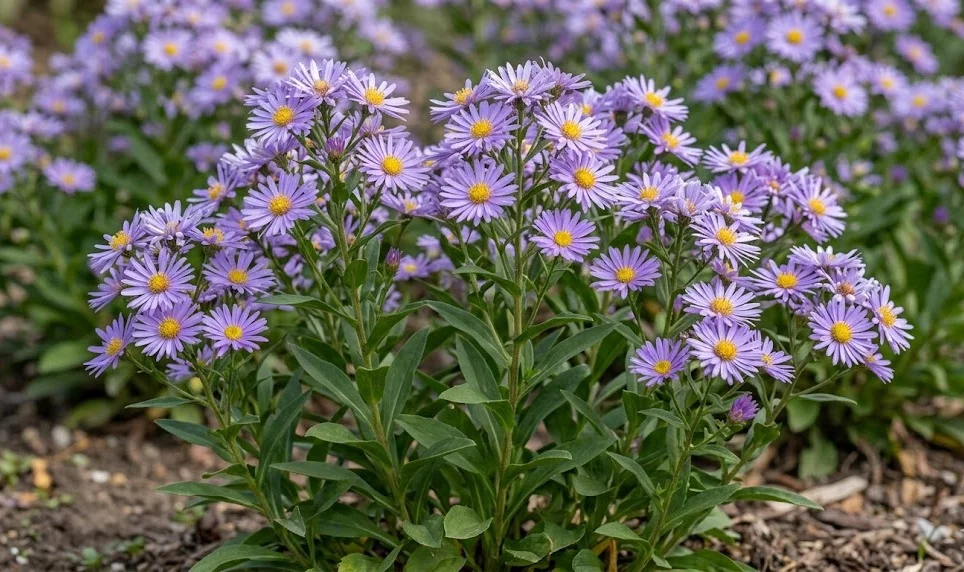

Italian aster flowers best when water and nutrients are supplied with restraint rather than excess. It is a perennial adapted to open, sunny conditions, so it does not need constantly damp soil or aggressive feeding. The most successful approach is to encourage deep roots, firm stems, and balanced seasonal growth. When watering and fertilising are managed well, the plant produces a cleaner, longer-lasting autumn display.
Understanding moisture needs
Italian aster prefers soil that is moderately moist during active growth but never waterlogged. Young plants need more attention because their root systems are still limited. Established plants can draw moisture from deeper soil and are more resilient in dry weather. This difference is important when planning irrigation.
The soil should be checked before watering. A dry surface does not always mean the root zone is dry. Push a finger or small trowel into the soil to assess moisture below the top layer. Water only when the plant actually needs it.
During hot, dry periods, flowering can suffer if the plant becomes severely stressed. Buds may be smaller, flowering may be shorter, and lower leaves may yellow. A deep soak at the right time can prevent this decline. However, repeated shallow watering encourages roots to remain near the surface.
Good watering supports resilience as much as appearance. Plants with deep roots cope better with heat, wind, and temporary drought. They also recover more quickly after flowering. This is why careful watering during establishment is so valuable.
More articles on this topic
Watering methods that protect foliage
Water should be applied at the base of the plant whenever possible. Wetting the foliage frequently can increase the risk of fungal diseases. Italian aster is particularly healthier when leaves dry quickly after rain or irrigation. Soil-level watering keeps the canopy cleaner and drier.
Morning watering is usually the best choice. It gives the plant moisture before the heat of the day becomes intense. It also allows any accidental splashes on the leaves to dry quickly. Evening watering can be acceptable in dry climates, but it is less ideal in humid areas.
Drip irrigation or a slow-flowing hose can work very well. These methods deliver water deeply without washing soil away. They also reduce waste and keep neighbouring weeds from being watered unnecessarily. A watering can with the rose removed can be useful for individual plants.
Containers need special attention because they dry faster than garden soil. A potted Italian aster may need water more often in warm weather. Still, the pot must drain freely and should never stand in a saucer of water for long. Consistent moisture in pots is helpful, but stagnant moisture is harmful.
More articles on this topic
Fertilising in garden soil
In open ground, Italian aster usually needs only modest feeding. A yearly layer of mature compost in spring is often enough. This improves soil structure, supports beneficial organisms, and releases nutrients slowly. It also avoids the sudden surge of growth caused by strong fertilisers.
If the soil is naturally poor, a balanced slow-release fertiliser can be used lightly. Choose a product that supports flowering rather than leafy growth. Too much nitrogen produces soft stems that may bend or collapse. It can also make the plant more attractive to aphids.
Fertiliser should be applied when growth begins in spring. Feeding late in the season is not recommended because it can encourage tender growth before winter. Tender shoots are more vulnerable to cold and disease. A plant that hardens gradually is better prepared for dormancy.
Always water after applying granular fertiliser unless rain is expected soon. This helps move nutrients into the root zone and prevents localised concentration. Avoid scattering fertiliser directly against the crown. Contact with concentrated fertiliser can damage young shoots.
Feeding container-grown plants
Container-grown Italian asters depend more on the gardener for nutrients. Potting mixes contain limited reserves, and regular watering gradually washes nutrients away. A controlled-release fertiliser mixed into the compost can provide steady support. Alternatively, a diluted liquid feed can be used during active growth.
Liquid feeding should be moderate. Half-strength feeding every few weeks is usually safer than frequent strong applications. The plant should look firm and healthy, not overly lush. If stems become long and weak, reduce feeding and check light levels.
The potting mix should be free-draining but not so coarse that it dries instantly. A balanced peat-free perennial compost with added grit can work well. The container must have generous drainage holes. Without drainage, even perfect feeding cannot prevent root stress.
Stop feeding container plants as autumn approaches. The plant needs to prepare for dormancy, not produce soft new growth. Continue watering when needed, especially if autumn is dry. A container can dry out even when temperatures are cool.
Recognising imbalance and correcting it
Yellowing leaves can have several causes, so fertiliser should not be the automatic answer. Overwatering, poor drainage, compacted soil, drought stress, and root competition can all cause yellowing. Look at the entire growing situation before applying nutrients. Correcting soil and water problems often improves the plant more effectively.
Weak flowering may result from too much shade or excessive nitrogen. If the plant is leafy but produces few flowers, review the feeding routine. Moving it to a brighter site may be more useful than changing fertiliser. Italian aster needs light to convert good nutrition into flower production.
Crisp leaf edges often suggest drought or root restriction. This is common in containers and in very sandy soil. A deep watering routine and a light mulch can help stabilise moisture. If the plant is root-bound in a pot, repotting may be necessary.
A well-balanced plant has firm stems, healthy foliage, and plenty of buds. It does not need to look oversized to be successful. The best feeding and watering programme is almost invisible because the plant simply grows naturally. That quiet strength is the sign of good perennial care.