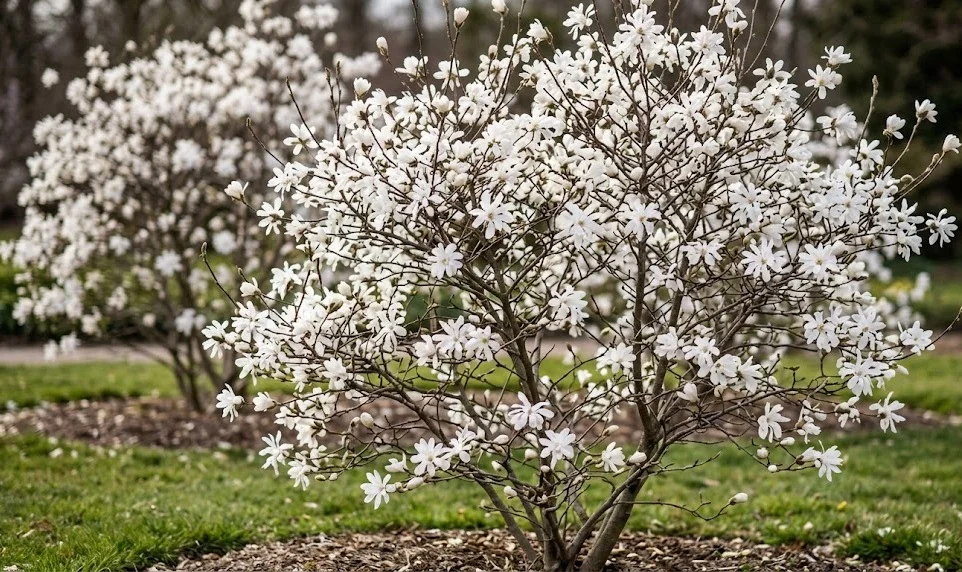

Water and nutrients have a direct influence on the health, flowering, and resilience of star magnolia. This shrub does not thrive under either drought stress or waterlogged conditions, so the gardener’s task is to maintain an even, breathable root environment. Feeding should be moderate and well timed, because excessive nitrogen can reduce plant quality rather than improve it. A successful care program supports steady growth, strong buds, healthy leaves, and reliable spring flowering.
Understanding moisture needs
Star magnolia prefers soil that remains evenly moist but never stagnant. Its root system is relatively shallow, so it reacts quickly to drought in the upper soil layer. Dry conditions during active growth can reduce leaf quality and weaken bud development. A plant that repeatedly wilts may survive but will not perform at its best.
The most critical watering period is the establishment phase after planting. Young shrubs have not yet developed a wide root system, so they depend on moisture close to the original root ball. If that zone dries out, the plant may decline even when the surrounding soil appears damp. Careful checking by hand is often more accurate than judging from the surface alone.
Established star magnolias need less frequent irrigation but still benefit from support during dry spells. Long periods without rain in summer can stress the plant and reduce next year’s flowering. Drought stress may also make the shrub more vulnerable to pests. Deep watering during these periods helps maintain overall vigor.
Moisture management should continue into autumn when conditions are dry. Flower buds develop before winter and depend on the plant’s stored energy and hydration. A dry autumn can leave buds weaker and roots less prepared for cold weather. Watering before winter is particularly useful for young or recently transplanted shrubs.
More articles on this topic
Practical watering methods
Deep, slow watering is better than frequent shallow sprinkling. Water should penetrate the root zone and encourage roots to grow outward and downward. A hose set to a gentle flow, drip irrigation, or a watering bag can all work well. The method should wet the soil without washing it away from the base.
The watering area should extend beyond the trunk. Many absorbing roots are located under and just beyond the canopy edge. Pouring water only at the stem misses much of the active root zone. A broad, even watering pattern supports a stronger root system.
Mulch improves watering efficiency. It reduces evaporation, buffers soil temperature, and prevents crusting. Organic mulch also gradually contributes to soil structure as it decomposes. However, mulch that is too thick or piled against the trunk can cause moisture-related bark issues.
Watering should always respond to weather and soil conditions. After heavy rain, irrigation should be paused until the soil begins to dry slightly. During heatwaves, especially in sandy soils, more frequent checks may be needed. The goal is consistency, not a fixed calendar that ignores real conditions.
More articles on this topic
Fertilizing without overstimulating the plant
Star magnolia is not a heavy feeder. In many garden soils, an annual layer of compost provides enough nutrition. Overfertilization can produce long, soft shoots that are less resistant to cold and wind. It can also shift the plant’s energy toward leafy growth at the expense of flower bud quality.
If growth is weak and soil fertility is low, a balanced slow-release fertilizer may be used in spring. It should be spread evenly over the root area and watered in afterward. Concentrated fertilizer placed close to the trunk can damage roots. The safest strategy is to apply modest amounts and observe the plant’s response.
Avoid feeding late in the growing season. Late nitrogen can encourage tender growth that does not harden properly before winter. This increases the risk of frost damage. Feeding should generally be completed by early to mid-spring in temperate gardens.
Organic feeding methods are often well suited to star magnolia. Compost, leaf mold, and well-rotted plant-based soil conditioners release nutrients gradually. They also improve microbial activity and moisture retention. This slow, balanced support matches the plant’s natural growth habit.
Recognizing nutrient and water stress
Pale leaves may suggest nutrient deficiency, but the cause should be investigated carefully. Iron chlorosis can occur in alkaline soil, especially where roots cannot access iron efficiently. The leaves may turn yellow while the veins remain greener. Improving soil conditions is usually more effective than repeated quick fixes.
Brown leaf edges often indicate water stress, heat stress, salt injury, or root trouble. It does not automatically mean the plant needs fertilizer. Adding nutrients to a stressed root system can make matters worse. The first response should be to check soil moisture, drainage, mulch, and exposure.
Poor flowering may be linked to drought, shade, pruning at the wrong time, or immature plant age. Fertilizer alone rarely solves poor bloom if the underlying cause is environmental. Flower buds form well before spring, so care during the previous growing season matters. Consistent summer and autumn moisture can make a visible difference.
Excessive leafy growth with few flowers may indicate too much nitrogen. It can also occur when the shrub is planted in heavy shade. In this situation, reducing feeding and improving light conditions may help. The aim is a balanced plant with moderate shoots, firm buds, and healthy foliage.
Seasonal watering and feeding schedule
In early spring, inspect the soil as growth begins. If the winter has been dry, water before flowering to support opening buds. Compost or a light slow-release fertilizer can be applied as the soil warms. This is also a good time to renew mulch before weeds become active.
In late spring and early summer, the plant enters an important growth phase. New leaves expand, shoots lengthen, and the plant begins building resources for future flowering. Watering should be consistent during dry weather. Fertilizer should not be repeatedly applied unless there is a clear need.
In high summer, focus on preventing drought stress. Mulch depth should be checked, and irrigation should reach the active root zone. Avoid wetting foliage in the evening if disease pressure is high. Morning watering is generally the most practical and plant-friendly option.
In autumn, reduce feeding but continue watering during prolonged dryness. The plant is preparing for dormancy and setting the foundation for spring bloom. A final deep watering before hard frost may be useful in dry climates. Healthy hydration going into winter supports both roots and flower buds.