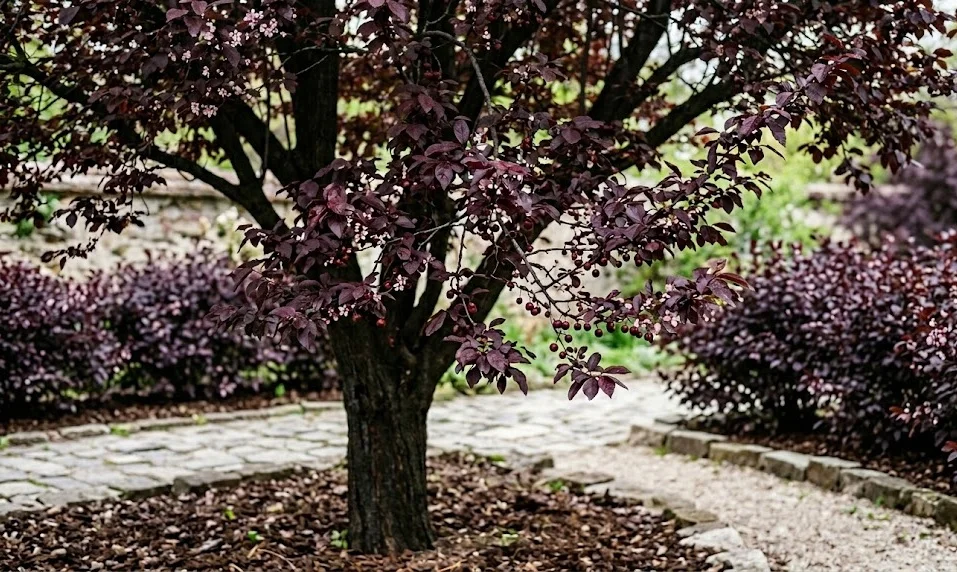

Pruning purple-leaf plum is about refinement, health and structure rather than forcing the tree into an artificial shape. Its natural form is one of its strengths, so the best pruning preserves a graceful crown while removing weak, damaged or poorly placed branches. Timing is important because purple-leaf plum belongs to a group of trees that can be sensitive to poorly timed cuts. With clean tools and a restrained approach, pruning keeps the tree attractive without reducing its vitality.
When and why to prune
The best general time to prune purple-leaf plum is after flowering. This allows you to enjoy the spring blossom before making any shaping cuts. It also reduces the need for winter pruning, which is often less suitable for stone-fruit relatives. Light pruning at the right time is safer than heavy pruning at the wrong time.
The main reasons for pruning are to remove dead wood, improve structure and maintain an open crown. Crossing branches can rub against each other and create wounds. Weak or narrow branch angles can become problems as the tree matures. Removing these issues early helps prevent breakage later.
Pruning can also improve air circulation through the crown. A very dense canopy holds moisture longer after rain, which may encourage leaf diseases. Selective thinning allows light and air to move more freely. The tree still keeps its ornamental character, but the foliage dries more quickly.
Cutting should not be done simply to reduce the tree every year. Repeated hard pruning can produce vigorous upright shoots and spoil the natural outline. It may also reduce flowering and increase stress. A correctly placed tree usually needs only occasional, thoughtful pruning.
More articles on this topic
How to make clean and effective cuts
Sharp, clean tools are essential when pruning purple-leaf plum. A clean cut heals more efficiently than a torn one. Secateurs are suitable for small shoots, while a pruning saw should be used for larger branches. Tools should be cleaned before use, especially if disease has been present in the garden.
Cuts should be made just outside the branch collar rather than flush against the trunk. The branch collar contains tissue that helps the tree close the wound. Leaving a long stub is also unhelpful because it can die back and become an entry point for decay. Good cutting technique protects the tree’s natural healing process.
Large branches should be removed carefully to avoid tearing bark. A three-cut method can be used for heavier limbs, first reducing weight and then making the final cut near the branch collar. This prevents the branch from ripping downward as it falls. Taking time with large cuts is always safer for both the tree and the gardener.
Diseased branches should be cut back into healthy wood. If canker, dieback or suspicious staining is present, the removed material should be taken away from the garden area. Tools may need disinfection between cuts. This reduces the chance of spreading disease from one part of the crown to another.
More articles on this topic
Cutting back, rejuvenation and mistakes to avoid
Purple-leaf plum does not respond well to severe cutting back unless there is a clear reason. Hard reduction can lead to a flush of weak, upright shoots that crowd the crown. These shoots may look vigorous but often create future pruning problems. A gradual approach is usually better than drastic reshaping.
If an old tree has become crowded, rejuvenation should be spread over more than one season. Removing too much live wood at once can stress the tree. Start with dead, damaged and crossing branches, then assess the shape before making further cuts. This method keeps the tree functional and attractive during recovery.
Topping should be avoided. Cutting back the main branches to random stubs destroys the natural form and creates poorly attached regrowth. It also opens large wounds that may not heal well. A topped purple-leaf plum often becomes less beautiful and more difficult to manage.
The best pruning looks almost invisible when finished. The crown should appear lighter, healthier and better balanced, but not stripped. Each cut should have a purpose, and unnecessary cutting should be avoided. With this restrained method, purple-leaf plum remains elegant, colourful and structurally sound.