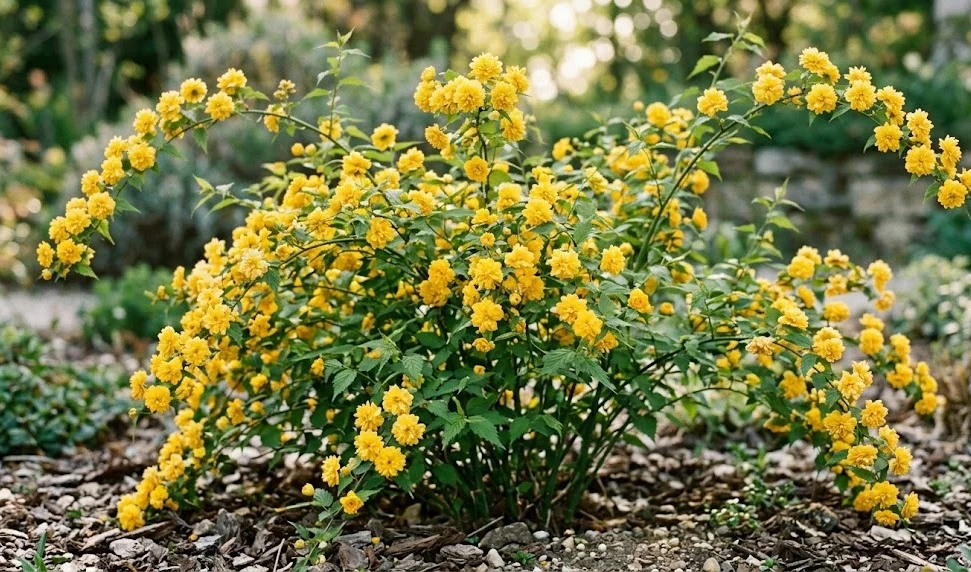

Pruning is the most effective tool you have for managing the vigor, shape, and flowering potential of your Japanese kerria. Because this shrub grows rapidly and has a natural tendency to form thickets, regular intervention is necessary to keep it looking its best. Understanding the specific growth habits of this species allows you to make precise cuts that encourage healthy new wood and abundant spring blossoms. A professional pruning routine not only enhances the plant’s aesthetic appeal but also ensures its long-term health by improving airflow and light penetration.
Timing the cuts for maximum bloom
The single most important rule for pruning the Japanese kerria is to always perform your major maintenance after the flowers have faded. This shrub blooms on “old wood,” which means the flower buds for the following year are formed during the summer months. If you prune in the late winter or early spring before the plant blooms, you will be cutting off the very buds you have been waiting all year to see. By waiting until the petals have fallen, you give the plant the entire growing season to produce new, healthy canes for next spring.
A light, secondary pruning can also be performed in the late summer if the shrub has become overly unruly or is encroaching on other plants. You should focus on removing “water sprouts”—those very fast-growing, vertical shoots that can disrupt the natural arching form of the plant. Removing these early helps maintain the desired shape without taking away from the next season’s floral display. However, you should avoid any heavy cutting late in the year, as this can stimulate new growth that won’t have time to harden off before winter.
Dead, damaged, or diseased wood can and should be removed at any time of the year as soon as you notice it. You should always use sharp, sterilized tools to ensure clean cuts that heal quickly and do not invite further infection. Removing these problematic branches immediately prevents them from becoming a source of pests or disease for the rest of the shrub. This “clean as you go” approach is a hallmark of professional garden maintenance and keeps the plant looking tidy year-round.
If you are trying to encourage a second, lighter flush of flowers in the late summer, you can try “deadheading” the spent spring blooms. This involves cutting back the flowered stems to the first set of healthy leaves or a strong side bud. While this takes some time and patience, it redirects the plant’s energy away from seed production and back into vegetative growth and potential new flowers. Many gardeners find this extra effort rewarding for the extended season of interest it provides.
More articles on this topic
Methods for structural pruning
Thinning is the preferred method for managing the size and density of an established Japanese kerria while maintaining its natural form. You should identify the oldest, most woody canes—which are often grayish and less productive—and cut them off right at the ground level. Aim to remove about one-third of these older stems every year to ensure a constant cycle of renewal within the shrub. This practice opens up the center of the plant, allowing more light and air to reach the base and stimulate new, vibrant green shoots.
Heading back, or shortening the ends of branches, should be done with care to avoid creating a “sheared” or unnatural look. You should always make your cuts just above a healthy leaf node or a side branch that is growing in the direction you want the plant to go. This encourages the shrub to fill out in a more controlled and aesthetically pleasing way. Avoid cutting all the stems to the same height, as this leads to a dense “hedge” effect that hides the plant’s beautiful arching habit.
Managing the suckers that emerge from the base of the plant is another important part of structural pruning. You will find that the Japanese kerria can spread quite aggressively if these underground runners are not kept in check. Use a sharp spade to slice through the roots of any suckers that are growing outside of the plant’s allotted space and pull them out of the ground. This keeps the shrub as a tidy, multi-stemmed specimen rather than allowing it to become an unmanageable thicket.
The goal of professional structural pruning is to create a plant that looks balanced, healthy, and “effortless” in the landscape. You should step back frequently during the process to evaluate the overall shape from different angles and ensure you are not over-pruning one side. A well-pruned Japanese kerria should still look like itself, just a more refined and invigorated version. By following these methods, you ensure that the shrub remains a high-performing asset in your garden design for many years.
More articles on this topic
Rejuvenating old and overgrown shrubs
If you have inherited a Japanese kerria that has been neglected for many years, it may have become a tangled, unproductive mass of old wood. In such cases, a more drastic approach known as “rejuvenation pruning” may be necessary to restore the plant’s vitality. You can choose to cut the entire shrub down to within six inches of the ground in the early spring before growth begins. While this means you will sacrifice the flowers for one season, the plant will respond with a flush of vigorous, healthy new stems.
This “hard prune” is a powerful technique, but it should only be performed on a shrub that is otherwise healthy and has a well-established root system. You should follow up this drastic measure with careful watering and a light application of compost to support the rapid regrowth. Within a single season, the plant will often reach half its original height, and by the second year, it will be fully restored and blooming more heavily than ever. It is a great way to “reset” a plant that has lost its aesthetic appeal.
A more gradual rejuvenation strategy involves the “rule of thirds,” where you remove the oldest third of the stems each year over a three-year period. This method is less shocking to the plant and allows you to continue enjoying some flowers even as you work to renew the shrub. By the end of the third year, you will have a completely new plant composed entirely of young, productive wood. This is often the preferred professional approach for managing large specimens in prominent locations.
After any significant pruning event, you should take the opportunity to refresh the mulch and check the soil moisture levels. The plant will be working hard to heal its wounds and push out new growth, and it needs a stable environment to do so effectively. Consistency is the final secret to success with the Japanese kerria; regular, moderate attention is always better than occasional, drastic interventions. With a little knowledge and the right tools, you can keep your Japanese kerria vibrant and beautiful for a lifetime.