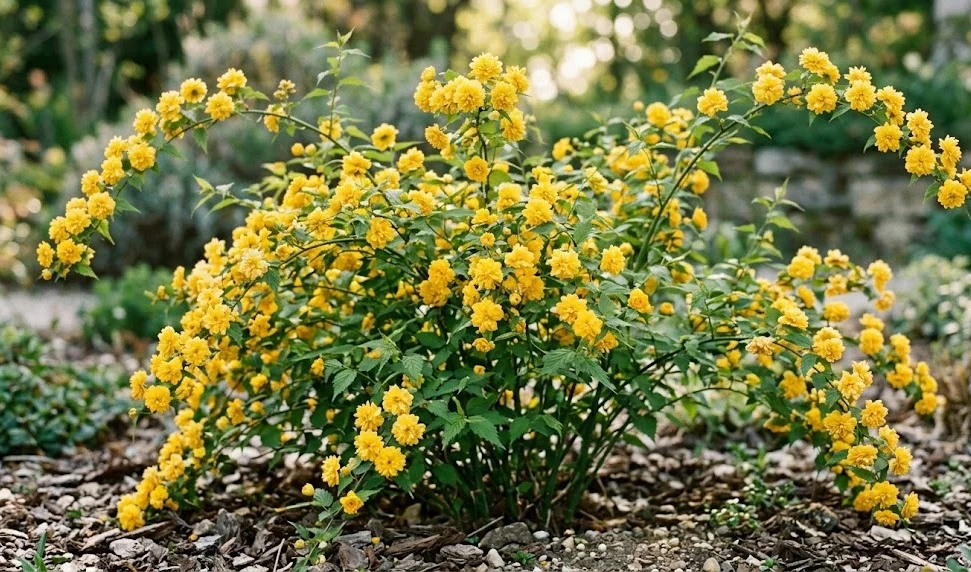

The relationship between the Japanese kerria and the sun is one of the most important factors in determining the quality of its spring floral display and the health of its foliage. This shrub is uniquely versatile, possessing the rare ability to thrive in a range of light conditions that would stress many other ornamental plants. However, finding the “sweet spot” within your specific landscape requires a professional understanding of how light intensity and duration affect the plant’s growth. By matching the shrub’s needs to the right exposure, you can ensure a balanced form and a prolific bloom cycle.
Optimal light conditions for flowering
The most common recommendation for the Japanese kerria is a location that offers partial shade or dappled sunlight throughout the day. You will find that this environment most closely mimics the plant’s natural habitat at the edge of deciduous forests. In these conditions, the shrub receives enough energy to produce a heavy crop of flowers without being subjected to the dehydrating effects of full sun. The light filtering through the canopy of larger trees creates a gentle environment where the delicate petals can last much longer.
If you plant your kerria in deep shade, you will notice a significant change in its growth habit and flowering potential. While the plant will survive and maintain its beautiful green stems, the number of blossoms will be greatly reduced and the foliage may become sparse. The shrub often becomes “leggy” as it reaches toward the light, resulting in a more open and less structural form. For the best visual impact, some direct morning sun or bright indirect light is necessary for robust flower bud development.
On the other end of the spectrum, providing too much direct sunlight can also lead to issues, particularly in warmer climates. You might see the bright yellow flowers begin to bleach or fade to a pale cream color within just a few days of opening. The leaves may also exhibit signs of sunscorch, appearing brown and crispy at the edges during the peak of summer. If your only available space is in full sun, you must be extra vigilant with watering and mulching to compensate for the increased evaporation.
The duration of light is just as important as its intensity when it comes to the plant’s annual cycle. You should aim for a location that provides at least four to six hours of filtered light or partial sun for the best results. Morning sun is generally considered superior to afternoon sun, as it is less intense and allows the plant to photosynthesize before the heat of the day. Observing how the shadows move through your garden during different seasons will help you make the most informed planting decisions.
More articles on this topic
Full sun versus deep shade
In cooler, northern climates, the Japanese kerria can often tolerate and even benefit from more direct sunlight than it can in the south. You might find that a full-sun position leads to a denser, more compact shrub with shorter internodes between the leaves. This results in a very full and lush appearance that can be quite striking in a formal garden setting. However, this increased light exposure must always be balanced with consistent soil moisture to prevent the plant from becoming stressed.
Deep shade presents a different set of challenges that require a more minimalist approach to maintenance. You should expect a more arching and graceful form in low-light areas, as the plant spreads its branches wide to capture every available photon. This natural, loose habit is perfect for woodland gardens where a more “wild” aesthetic is desired. While the flower count will be lower, the individual blooms often have a deeper, richer color because they are not being bleached by the sun.
Transitioning a plant from one light extreme to another should always be done with care to avoid light shock. If you are moving a container-grown specimen from a shady nursery to a sunny garden spot, you should do so gradually over a period of several days. You might see some initial leaf drop or yellowing as the plant adjusts its internal chemistry to the new light levels. This is a normal physiological response, and the plant will eventually produce new leaves that are better adapted to the increased light.
Professional gardeners often use the Japanese kerria to fill “difficult” spots where other flowering shrubs might fail. Its ability to bloom in relatively low light makes it a valuable tool for adding color to north-facing walls or under the shade of large buildings. You can use its bright yellow flowers to illuminate dark corners of the landscape, creating a focal point where you least expect it. Understanding the flexibility of this species allows you to be more creative and effective in your garden design.
More articles on this topic
Indicators of light-related stress
Being able to recognize when your Japanese kerria is unhappy with its light levels is a key skill for any successful gardener. You should look for leaves that are unusually small or pale, as this often indicates that the plant is struggling to produce enough energy in deep shade. If the distance between the leaf nodes becomes very long and the stems seem weak and spindly, the plant is likely “reaching” for more light. In these cases, thinning out overhead branches or moving the shrub to a brighter spot can restore its vigor.
Sunscorch is the most obvious sign that the plant is receiving more light and heat than it can handle. You will see brown, papery patches on the leaves, especially on the parts of the shrub that face south or west. This damage is often permanent for the current growing season, although the plant will produce healthy new leaves if the conditions are corrected. Providing some temporary shade during the hottest part of the afternoon can help a sun-stressed plant recover while you work on a more permanent solution.
The color of the stems can also provide clues about the light environment and the overall health of the plant. In ideal light conditions, the bark should remain a vibrant, healthy green throughout the year, even after the leaves have fallen. If the stems begin to look dull, grayish, or start to die back at the tips, it may be a sign of environmental stress linked to light or moisture. A healthy, well-lit Japanese kerria is a glowing presence in the garden, both in summer and winter.
Finally, pay attention to the timing and duration of the bloom period as a measure of light suitability. If the flowers appear much later than expected or fade almost as soon as they open, the light exposure is likely the cause. You can fine-tune the plant’s environment by using surrounding structures or other plants to provide filtered shade. A professional approach involves constant observation and a willingness to make adjustments to ensure the plant has exactly what it needs to shine.