
Apple powdery mildew, caused by the obligate biotrophic fungus Podosphaera leucotricha, represents one of the most pervasive fungal diseases affecting commercial apple orchards worldwide. This pathogen targets rapidly expanding vegetative tissues, blossoms, and developing fruit, causing severe physiological stress and significant economic yield losses if left unmanaged. Commercial growers must develop a comprehensive understanding of how this organism interacts with host tissue across different phenological stages. By recognizing the precise environmental conditions that trigger spore release, agricultural professionals can optimize their preventative strategies before widespread infections establish.
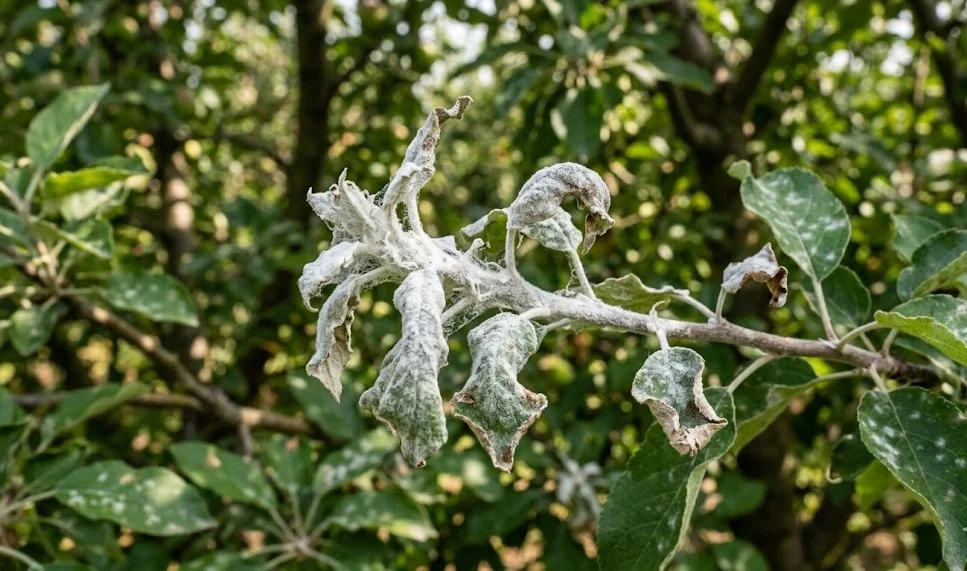
The disease cycle initiates primarily from overwintering mycelium tightly ensconced within dormant vegetative or flower buds that were infected during the previous growing season. As ambient temperatures rise in early spring, these infected buds open later than healthy ones, revealing stunted, silver-white shoots often referred to as primary mildew. These emerging shoots produce a tremendous volume of asexual spores, known as conidia, which serve as the primary source of inoculum for the entire orchard. The wind easily transports these microscopic spores across vast distances, landing them on young, highly susceptible leaf surfaces where secondary infections commence.
Unlike many other common fungal diseases affecting pomology crops, Podosphaera leucotricha does not require free water on the leaf surface to initiate spore germination and infection. In fact, heavy rainfall can physically wash the conidia off the leaves or cause them to burst, effectively suppressing the expansion of the epidemic during wet periods. Instead, the pathogen thrives under conditions of high relative humidity, ideally exceeding seventy percent, combined with warm ambient temperatures ranging between fifteen and twenty-eight degrees Celsius. Dry, warm daytime conditions followed by humid nights create the perfect microclimate for rapid fungal colonization and continuous secondary infection cycles.
As the summer progresses, the fungus may also produce dark, spherical fruiting bodies called chasmothecia on the surfaces of heavily infected shoots and leaves. While these structures contain ascospores resulting from sexual reproduction, their role in the overall epidemiology of the disease is generally considered secondary to the bud-overwintering mycelium. The continuous production of conidia throughout the summer ensures that new vegetative flushes remain under constant disease pressure until shoot growth terminates in late season. Understanding this relentless cycle underscores the absolute necessity of maintaining a continuous and well-timed protection program from green tip through the end of terminal shoot elongation.
Symptom recognition and field monitoring techniques
Early identification of powdery mildew symptoms is critical for implementing timely corrective actions and preventing the escalation of secondary infections within the orchard canopy. The earliest signs appear shortly after bud break on the emerging clusters, which exhibit a distinctly distorted, elongated appearance covered in a powdery white coating. These primary infections typically result in reduced leaf area, chlorosis, and a complete failure of the affected blossoms to set viable fruit. Growers should regularly inspect their blocks during these early vegetative stages, paying close attention to susceptible varieties that serve as indicators for the rest of the farm.
Secondary symptoms develop on younger leaves as they unfold from growing shoot tips, initially presenting as small, indistinct felt-like white patches on the lower leaf surface. As the fungus colonizes the tissue, these patches rapidly expand to encompass both sides of the leaf, causing the margins to curl upward and expose the white mycelial mat. Infected leaves eventually become brittle, dry, and lose their capacity for efficient photosynthesis, leading to premature defoliation and weakened tree vigor over consecutive seasons. Shoots infected later in the season may also display a silvering of the bark, which becomes highly visible during winter pruning operations.
Damage to the fruit occurs primarily when the fungal mycelium colonizes the blossom cluster or the very young, developing fruitlet during or immediately after the petal fall stage. This early infection damages the epidermal cells of the fruit, resulting in a characteristic web-like russeting pattern on the mature skin that significantly reduces market value. Severely affected apples may also remain stunted, become misshapen, or crack open as they expand, making them completely unmarketable for fresh consumption. Regular monitoring must therefore include a detailed examination of developing fruitlets, particularly in the lower, shaded interior zones of the tree canopy.
Establishing a systematic scouting protocol is the cornerstone of any professional disease management system for apple orchards. Field technicians should inspect at least twenty trees per block on a weekly basis, focusing on the highly susceptible top shoots where rapid vegetative growth occurs. Recording the percentage of infected shoots allows managers to calculate disease incidence and track whether the pathogen population is increasing or stabilizing. This quantitative data provides the objective justification needed to adjust fungicide spray intervals or transition to more intensive curative chemistry when thresholds are breached.
Selection of resistant cultivars and rootstocks
Selecting genetically resistant or less susceptible apple cultivars represents the most sustainable, long-term foundation for managing powdery mildew effectively. While market demand heavily influences variety selection, growers must weigh the potential economic returns against the long-term chemical input costs required to protect highly susceptible trees. Some traditional and modern cultivars exhibit exceptional natural resistance to Podosphaera leucotricha, which dramatically simplifies the overall pest management program. Integrating these robust varieties into new orchard designs minimizes reliance on intensive chemical interventions and reduces the overall carbon footprint of production.
Cultivars such as Jonathan, Cortland, Idared, and Gala are notoriously susceptible to powdery mildew, requiring rigorous, unwavering preventative spray programs throughout the spring and summer. In contrast, varieties like Delicious, Enterprise, Liberty, and Freedom demonstrate high levels of field resistance, making them ideal candidates for low-input or organic production models. Even moderately susceptible cultivars can be managed successfully with standard programs if orchardists avoid planting them adjacent to heavy reservoirs of inoculum. Thorough evaluation of regional performance data is highly recommended before finalizing any varietal choices for commercial expansion.
The choice of rootstock also plays an indirect yet significant role in determining the severity of powdery mildew expressions across the orchard block. Vigorous rootstocks stimulate prolonged vegetative shoot growth late into the summer season, providing a continuous supply of highly susceptible young tissue for secondary conidia to infect. Conversely, dwarfing rootstocks like M.9 or virus-free clones promote earlier termination of terminal shoot growth, effectively closing the window for late-season infections. Furthermore, dwarf trees facilitate much better spray coverage and light penetration, both of which are hostile to fungal development.
Modern molecular breeding programs continue to make significant strides in identifying specific resistance genes associated with wild Malus species. Researchers are utilizing marker-assisted selection to stack multiple resistance genes into elite commercial lines, ensuring durable protection that the pathogen cannot easily overcome. These advanced selections undergo rigorous multi-locational trials to verify that fruit quality, storage potential, and yield efficiency meet commercial standards before public release. Investing in these genetically advanced trees represents a forward-looking strategy for professional orchardists aiming for long-term economic resilience.
Cultural practices and canopy architecture optimization
Cultural management practices constitute a vital line of defense by directly altering the microclimate within the tree canopy to disadvantage fungal growth. Pruning during the dormant winter period is the first major cultural intervention, allowing workers to identify and remove silvered shoots that harbor overwintering buds. This meticulous manual removal physically eliminates primary inoculum before the spring cycle can begin, significantly lowering the overall initial disease pressure. Consistent removal of infected terminals during early spring scouting can also help delay the onset of secondary infection cycles.
Proper training and canopy design are equally crucial for facilitating rapid drying and maximizing the penetration of both solar radiation and chemical sprays. Training systems that favor slender, open structures, such as the tall spindle or slender spindle, ensure that every leaf layer receives adequate airflow. Good air circulation prevents the accumulation of stagnant, humid air pockets within the tree interior where Podosphaera leucotricha thrives most aggressively. Furthermore, exposure to direct ultraviolet radiation from sunlight has a natural sanitizing effect, inhibiting spore germination and slowing mycelial expansion.
Nitrogen fertilization management must be carefully calibrated to avoid creating excessive vegetative growth that exacerbates powdery mildew problems. Over-fertilization induces lush, succulent shoot flushes that remain soft and highly susceptible to fungal penetration for an extended period. Growers should utilize regular leaf tissue analysis and soil testing to ensure balanced nutrient delivery that supports fruit development without triggering uncontrollable vegetative surges. Splitting nitrogen applications or utilizing slow-release formulations helps maintain stable, manageable growth dynamics throughout the critical spring months.
Floor management practices, including cover cropping and mowing schedules, also exert a subtle influence on the relative humidity within the orchard block. Maintaining a short, clean orchard floor reduces the moisture transpiration from understory vegetation, helping to keep localized humidity levels below the optimal threshold for conidial germination. Adequate row spacing and the elimination of tall weed barriers along the perimeter further enhance wind penetration through the orchard columns. These collective cultural adjustments create an environment that is fundamentally hostile to the biological requirements of the pathogen.
Chemical management and strategic fungicide application
Chemical control remains an indispensable component of commercial apple production, particularly when dealing with susceptible varieties or high disease pressure. The timing of the first preventative fungicide application is absolutely critical, typically starting at the tight cluster or pink bud stage when overwintering infections begin to emerge. Waiting until visible symptoms appear on secondary leaves usually means the epidemic has already established a foothold, making control significantly harder to achieve. Maintaining continuous protection through petal fall and first cover is essential for safeguarding both the vegetative shoots and the delicate young fruitlets.
Modern chemical programs rely heavily on several distinct classes of synthetic fungicides, including demethylation inhibitors, succinate dehydrogenase inhibitors, and quinone outside inhibitors. Demethylation inhibitors, commonly known as triazoles, offer excellent systemic activity and provide both protective and limited curative action against the mycelium. Succinate dehydrogenase inhibitors represent a newer chemistry class that delivers highly effective, long-lasting protection by disrupting cellular respiration in the fungal mitochondria. Rotating these different modes of action is mandatory to prevent the development of resistant pathogen strains over time.
Spray application technology and calibration play a decisive role in determining the actual field efficacy of any chemical management program. High-volume air-blast sprayers must be calibrated precisely to deliver uniform droplet distribution throughout the entire height and depth of the tree canopy. Inadequate coverage in the upper thirds of the tree or inside dense canopies creates untreated sanctuaries where the fungus can continue to multiply unchecked. Regular adjustments to nozzle configurations, travel speeds, and air deflector positions are required to compensate for changing canopy density as the season progresses.
Weather-based disease forecasting models provide growers with invaluable decision-support data to optimize spray timing and avoid unnecessary chemical applications. These digital systems utilize real-time temperature, relative humidity, and canopy wetness data to calculate daily risk indices for powdery mildew expansion. When the model indicates a prolonged period of high risk, growers can proactively shorten their spray intervals or opt for stronger systemic chemistry. Conversely, during extended hot, dry periods when humidity is extremely low, spray intervals can be safely extended, reducing input costs and environmental exposure.
Organic solutions and biological control agents
Organic apple producers and conventional growers seeking to reduce synthetic chemical usage can utilize a diverse array of alternative management tools. Elemental sulfur remains the traditional cornerstone of organic powdery mildew control, offering reliable multi-site protective action at a relatively low material cost. Sulfur works by disrupting vital metabolic pathways within the fungal cell, making it highly unlikely that the pathogen will ever develop resistance. However, applications must be timed carefully because sulfur can cause phytotoxic leaf burn if applied when ambient temperatures exceed twenty-eight degrees Celsius.
Potassium bicarbonate formulations represent another highly effective, contact-oriented organic tool that alters the osmotic pressure and pH on the leaf surface. This sudden environmental shift causes the delicate fungal mycelium and conidia to collapse and dehydrate almost immediately upon contact. Horticultural oils, including both petroleum-based and plant-derived options, can also be integrated to suffocate fungal structures and form a physical barrier against spore penetration. These contact materials require immaculate spray coverage since they possess no systemic or curative movement within the plant tissue.
Biological control agents, including specific strains of beneficial bacteria and antagonistic fungi, are gaining significant traction within integrated management programs. Formulations based on Bacillus subtilis or Bacillus amyloliquefaciens work by colonizing the leaf surface and producing lipopeptides that directly inhibit fungal cell wall synthesis. These live biological products also trigger the natural systemic acquired resistance mechanisms within the host apple tree, enhancing its defense responses. Utilizing bio-fungicides helps minimize chemical residues on the final harvest, which is a key requirement for modern export markets.
Plant extracts and botanical distillates, such as cold-pressed neem oil or laminarin derived from brown algae, offer additional layers of natural protection. Laminarin acts primarily as an elicitor, stimulating the plant to produce defense-related enzymes before any actual pathogen attack occurs. Neem oil provides a dual benefit by acting as a mild fungicide against powdery mildew and suppressing certain soft-bodied insect pests simultaneously. Integrating these diverse organic options requires meticulous planning, as their residual efficacy is typically shorter than that of conventional synthetic compounds.
Integrated pest management and resistance mitigation
Implementing a rigorous integrated pest management strategy is essential for preserving the long-term efficacy of available control measures and protecting orchard profitability. This holistic approach combines cultural, genetic, biological, and chemical tools to maintain pathogen populations below economically damaging thresholds without relying excessively on a single method. Over-reliance on mono-site synthetic fungicides has historically led to rapid resistance development, rendering highly effective products completely useless within a few seasons. Professional orchardists must therefore view every management decision through the lens of long-term sustainability and resistance mitigation.
Fungicide Resistance Action Committee guidelines provide the operational framework necessary for designing intelligent chemical rotation programs. Growers should never apply products from the same chemical class consecutively, ensuring that surviving individuals with minor mutations are eliminated by an alternative mode of action. Tank-mixing single-site systemic fungicides with multi-site protectants like sulfur or mancozeb is a highly recommended practice that significantly dilutes selection pressure. Additionally, limiting the total number of applications per class per season ensures that specific chemistries remain viable for future emergency situations.
Post-harvest orchard sanitation is an often overlooked aspect of comprehensive integrated management that pays significant dividends in the subsequent spring. Applying foliar urea sprays late in the autumn just before leaf drop accelerates the decomposition of fallen leaves and organic debris on the orchard floor. While Podosphaera leucotricha primarily overwinters in buds, reducing overall orchard debris improves soil health and helps suppress other co-existing pathogens like apple scab. Ensuring trees enter dormancy in optimal health reduces their susceptibility to early-season physiological stress when growth resumes.
Continuing professional education and active collaboration with local agricultural extension services ensure growers stay informed about emerging resistance patterns and technological advancements. Field trials, regional spore trapping data, and updated efficacy ratings should guide the annual revision of the orchard spray calendar. By adopting a proactive, data-driven management posture, commercial apple producers can successfully navigate the challenges posed by powdery mildew. Protecting crop yields while minimizing environmental impact remains the ultimate benchmark of success for modern horticultural operations.